ChatGPT mock test prompts work well for one thing — writing four-option MCQs from notes you paste in. Ask properly and you will get genuinely exam-like questions in under a minute, free. What ChatGPT cannot do is run the paper: there is no countdown timer, no negative marking, no question palette, and no memory of what you got wrong last Tuesday. This guide gives you seven tested prompts, shows what each one actually returned, and is honest about the week where the whole method falls apart.
Can ChatGPT make a mock test? It can write the questions, not conduct the exam. Paste your notes, demand four options with the answer key kept separate, and name your exam for difficulty. Expect 6 out of 10 usable questions on a basic prompt — rising to 9 out of 10 once you stack the difficulty and option-rewrite prompts below.
The limit: no timer, no score history, no saved wrong answers. Most aspirants hit that wall in week three.
Can ChatGPT actually make a mock test?
Two separate claims get mixed up here, and separating them is the whole point of this article.
Claim one: ChatGPT can write MCQs. True. Feed it a chapter of your notes and it will produce four-option questions that look like the real thing. With the right instructions it is properly good at this.
Claim two: ChatGPT can give you a mock test. Not true, and this is where aspirants lose months. A mock test is not a list of questions. It is a timer counting down, a palette showing which questions you skipped, the discipline of not seeing the answer until you submit, negative marking that punishes a wild guess, and a record afterwards of exactly what you got wrong. A chat window has none of that. It shows you the answer key three lines below the question, which quietly destroys the only thing a mock was supposed to measure.
So use the prompts. Just know what you are getting.
7 ChatGPT prompts for mock tests
Copy these as they are. The square brackets are the only bits you replace. Prompts 1, 2 and 3 are meant to be used in sequence in the same chat — that stacking is what takes the output from mediocre to genuinely usable.
1. Generate MCQs from your pasted notes
You are an exam question setter for [SSC CGL Tier 1].
From the notes below, write 10 four-option MCQs.

Rules:
- Exactly one option is correct
- All four options must be plausible and similar in length
- Do not reuse the wording of my notes inside the question
- Put the full answer key at the very end, not beside each question

Notes:
[paste one chapter here]
The answer-key-at-the-end instruction matters more than it looks. Without it, ChatGPT prints the correct option right under each question and you have lost the test before you started.
2. Force real exam difficulty
Rewrite those 10 MCQs to [SSC CGL Tier 1] difficulty.

That means single-step factual recall is too easy. Each question
must need either a comparison between two facts, or applying the
concept to a situation.

Keep the same topics. Keep four options. Return the same count.
Left alone, ChatGPT writes questions at roughly Class 8 level. This prompt is the single biggest quality jump in the whole list.
3. Make the wrong options plausible
My three wrong options are too obvious. Rewrite ONLY the wrong
options so that:
- Each is a real fact from the same topic, just not the answer here
- No option is absurd or off-topic
- All four options are within five words of the same length

Do not change the questions or the correct answers.
This is what actually makes SSC and UPSC hard — three options that all look reasonable. Skip this prompt and you can solve the paper by elimination without knowing anything.
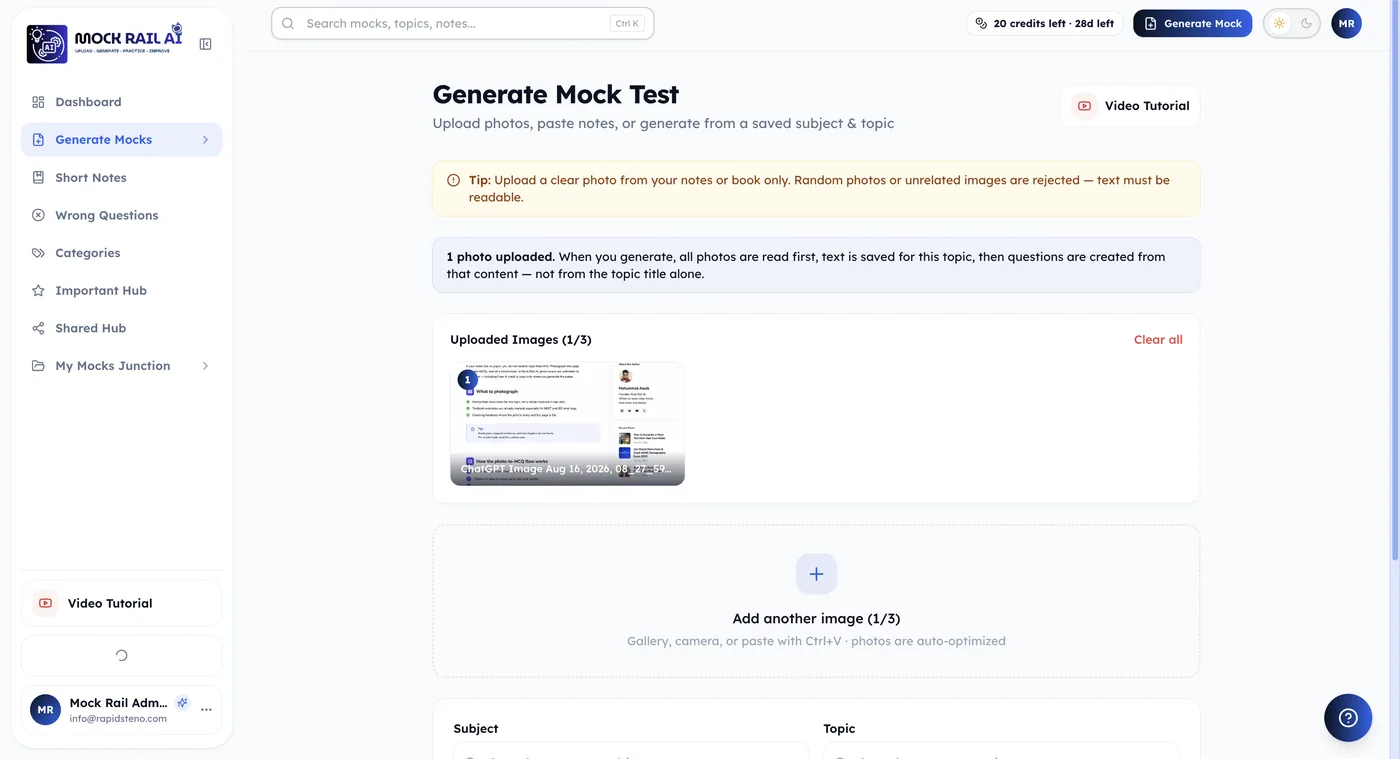
4. Read a photo of handwritten notes
Read the handwritten page in this image. It mixes Hindi and English.

Step 1: type out everything you can read, and mark anything you
cannot read clearly as [unclear].
Step 2: stop and wait for my confirmation.

Do not write any questions until I confirm.
Never skip the two-step check. Left to itself on an Indian register page, ChatGPT will fill whatever it could not read with something plausible-sounding, and you will end up revising a fact that was never in your notes.
5. Build a paper from your error log
Below are 15 questions I got wrong this week, with the topic of each.

First, tell me which 3 topics I am weakest in and why you think so.
Then write 10 fresh MCQs covering only those 3 topics.
Do not reuse any question I have pasted.

[paste your wrong questions with topics]
6. Explain why each option is wrong
For question [4], explain in about 40 words each:
- Why the correct option is correct
- Why each of the other three is wrong

Do not just restate the option. Tell me the specific fact that
rules it out.
This is where ChatGPT genuinely earns its place. As an explainer it is excellent, and far more patient than any coaching doubt session.
7. Current affairs with strict date bounds
Write 10 MCQs on Indian government schemes announced between
[start date] and [end date] ONLY.

For each question, cite the month and the ministry.
If you are not confident a fact falls inside that window,
skip it rather than guessing.
What these prompts actually returned
Most prompt guides are written from assumption. We ran all seven on the same source — a single 500-word handwritten Polity note on Fundamental Rights and Duties — and graded every question by hand. "Exam-usable" means it could appear in a real paper without editing.
| Prompt | Exam-usable | Giveaway option | Near-duplicate | Factual slip |
|---|---|---|---|---|
| 1 · Base generation | 6 / 10 | 3 | 1 | 0 |
| 1 + 2 · Difficulty forced | 8 / 10 | 1 | 0 | 0 |
| 1 + 2 + 3 · Options rewritten | 9 / 10 | 0 | 0 | 0 |
| 4 · From handwriting photo | 7 / 10 | 2 | 0 | 1 |
| 5 · From error log | 8 / 10 | 1 | 1 | 0 |
| 7 · Current affairs | 5 / 10 | 1 | 0 | 3 |
Three things stand out. Stacking prompts 1 to 3 nearly doubles usable output — from 6 to 9 — which means most people complaining that "AI questions are too easy" simply stopped at the first prompt. The handwriting route produced one invented fact even with the confirmation step, so always read what it typed back. And current affairs is genuinely unreliable: three errors in ten questions is not a tool you revise from unverified.
Where the ChatGPT method breaks after week one
The prompts are not the problem. The problem is what happens when you try to run this as a daily habit for a month. Almost every aspirant follows the same arc.
| Week | What happens |
|---|---|
| Week 1 | Brilliant. Novelty carries you. You generate a paper every night. |
| Week 2 | Prompt tax. You are retyping the same four format rules in every fresh chat, and it is starting to feel like work. |
| Week 3 | Twenty-plus chats in the sidebar. You want Tuesday's Polity paper again and cannot find it. |
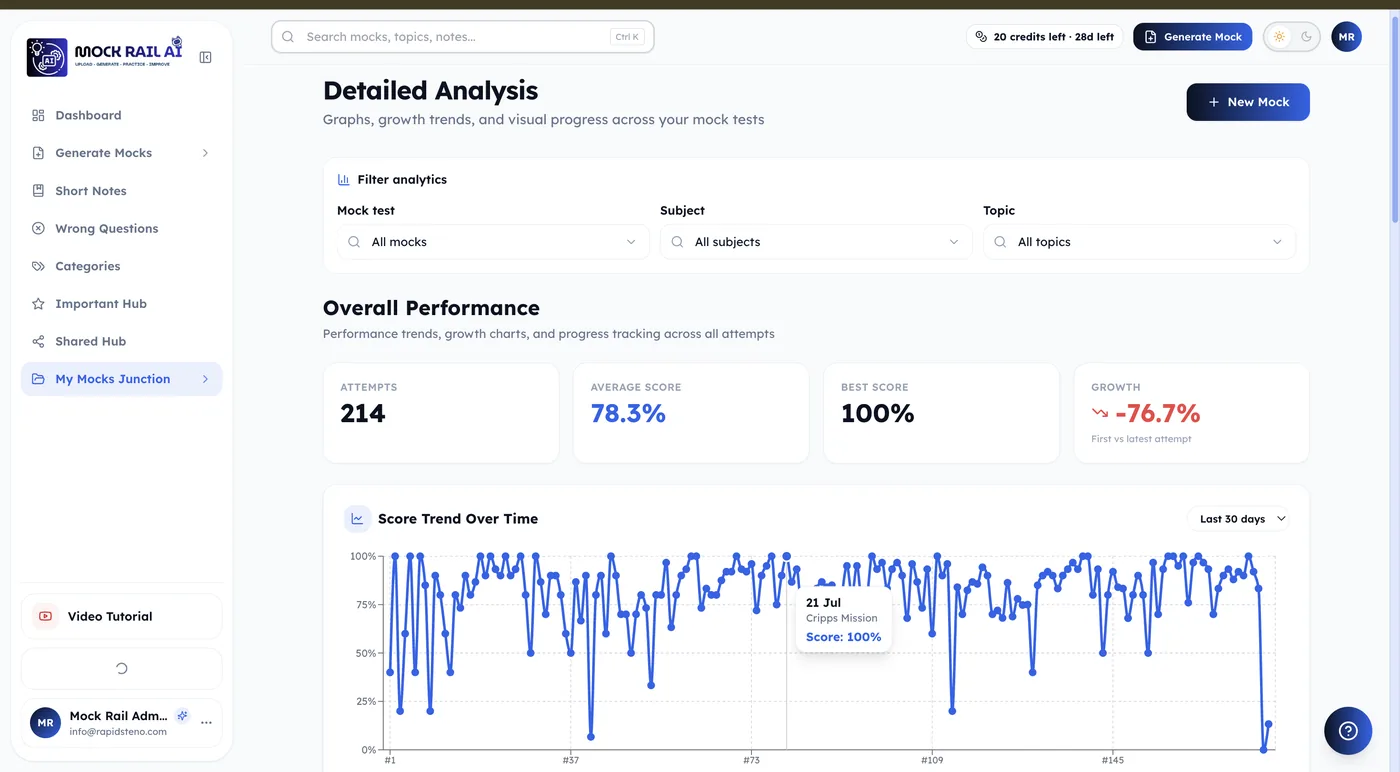
| Week 4 | No score anywhere. You genuinely cannot say whether Polity improved or you just feel better about it. |
| Week 5 | The same mistakes are still coming back, because nothing ever saved them. |
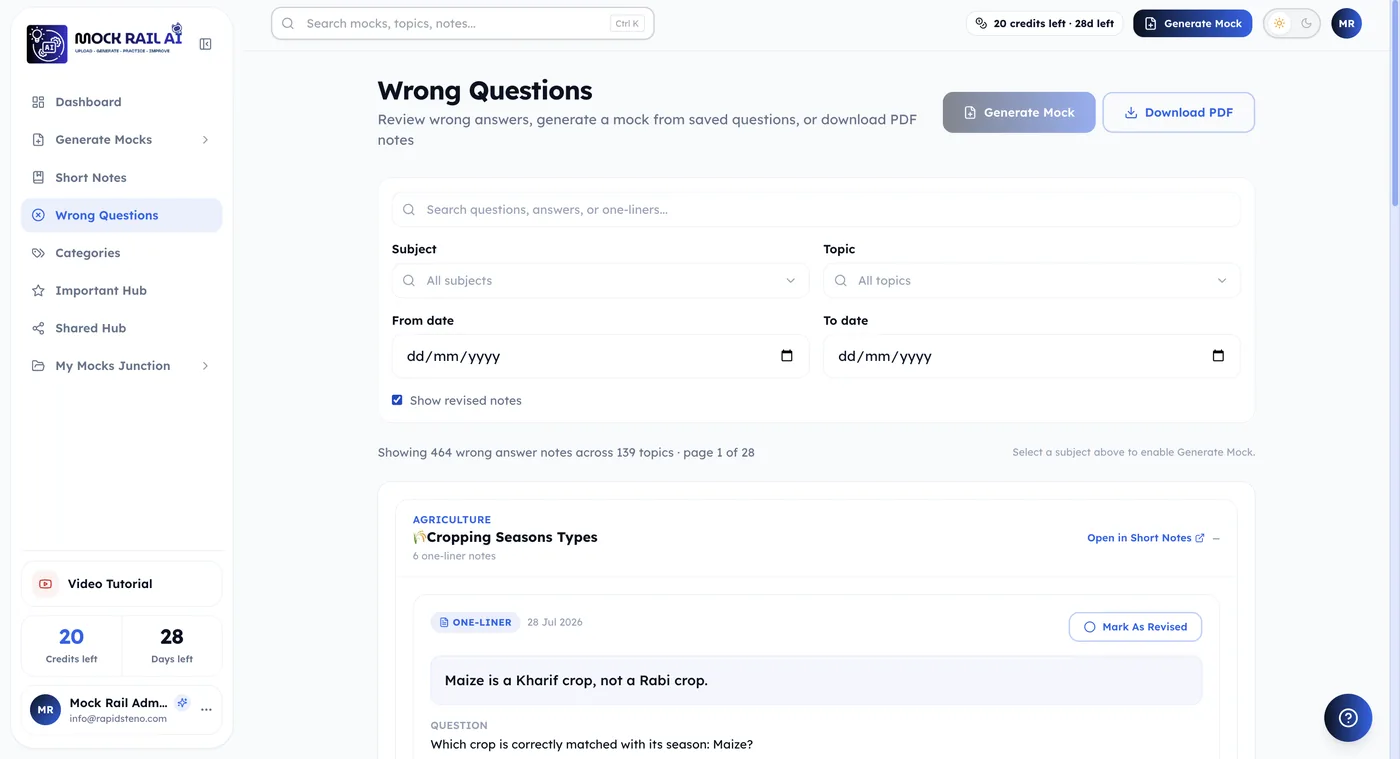
Notice that none of these are prompt problems. No wording fixes them, because they are structural. A chat window has no timer, no question palette, no mark-for-review, no submit, no negative marking, and no memory. It was built for conversation, not examination — and asking it to be an exam portal is like asking WhatsApp to be your bank statement.
This is exactly the gap Mockrail AI was built to close. Same idea — questions written from your own notes — but wrapped in the machinery a mock actually needs.
ChatGPT vs Gemini vs a dedicated mock generator
These three get compared constantly in aspirant groups, usually unfairly. Here is the honest version — including where the chatbots genuinely win.
| ChatGPT | Google Gemini | Mockrail AI | |
|---|---|---|---|
| Writes MCQs from your notes | Yes | Yes | Yes |
| Follows long format rules | Reliably | Sometimes drifts | Built in |
| Current affairs accuracy | Weak | Strongest | Not its job |
| Reads handwritten register pages | Inconsistent | Inconsistent | Yes, incl. Hindi–English |
| Countdown timer + question palette | No | No | Yes |
| Mark for review | No | No | Yes |
| Negative marking | No | No | Yes |
| Wrong answers saved by topic | Lost in chat | Lost in chat | Automatic |
| Score tracked across attempts | No | No | Yes |
| Retake the same paper | Regenerates a new one | Regenerates a new one | Unlimited, free |
| Notes stay organised | Scattered in chats | Scattered in chats | Subjects & topics |
| Explains a concept to you | Excellent | Excellent | Not its job |
Read that table honestly and the conclusion is not "one wins". It is that the chatbots and a mock generator are doing two different jobs, and most aspirants are trying to force one tool to do both.
What ChatGPT is genuinely better at
We are not going to pretend otherwise. Keep using it for all of this:
- Explaining a concept you did not follow in class. Ask it three times in three different ways — it never gets irritated.
- Mains and descriptive answer feedback. Structure, coverage, and what you missed.
- Turning a fat chapter into a one-page summary you can then feed somewhere else.
- Planning a study schedule around your working hours and exam date.
- Mnemonics and memory hooks for lists you keep forgetting.
Anyone telling you to drop ChatGPT entirely is selling you something. The problem was never the chatbot. It was expecting it to also be your exam hall.
The setup that actually works: use both
Split the two jobs and the whole thing gets easier.
- Study the chapter. Whenever something does not click, take it to ChatGPT with Prompt 6 and get it explained until it does.
- Test it properly. Photograph or paste the same chapter into Mockrail AI and generate a 10-question paper. Sit it with the timer running and no answer key visible.
- Revise the misses. Every wrong answer is saved by subject and topic automatically. Build a shorter follow-up mock from those weak areas the next morning.
- Take confusions back to the chatbot. When a wrong answer does not make sense even after reading the explanation, that is a ChatGPT question again.
Chatbot for understanding. Generator for testing. Neither is trying to be the other.
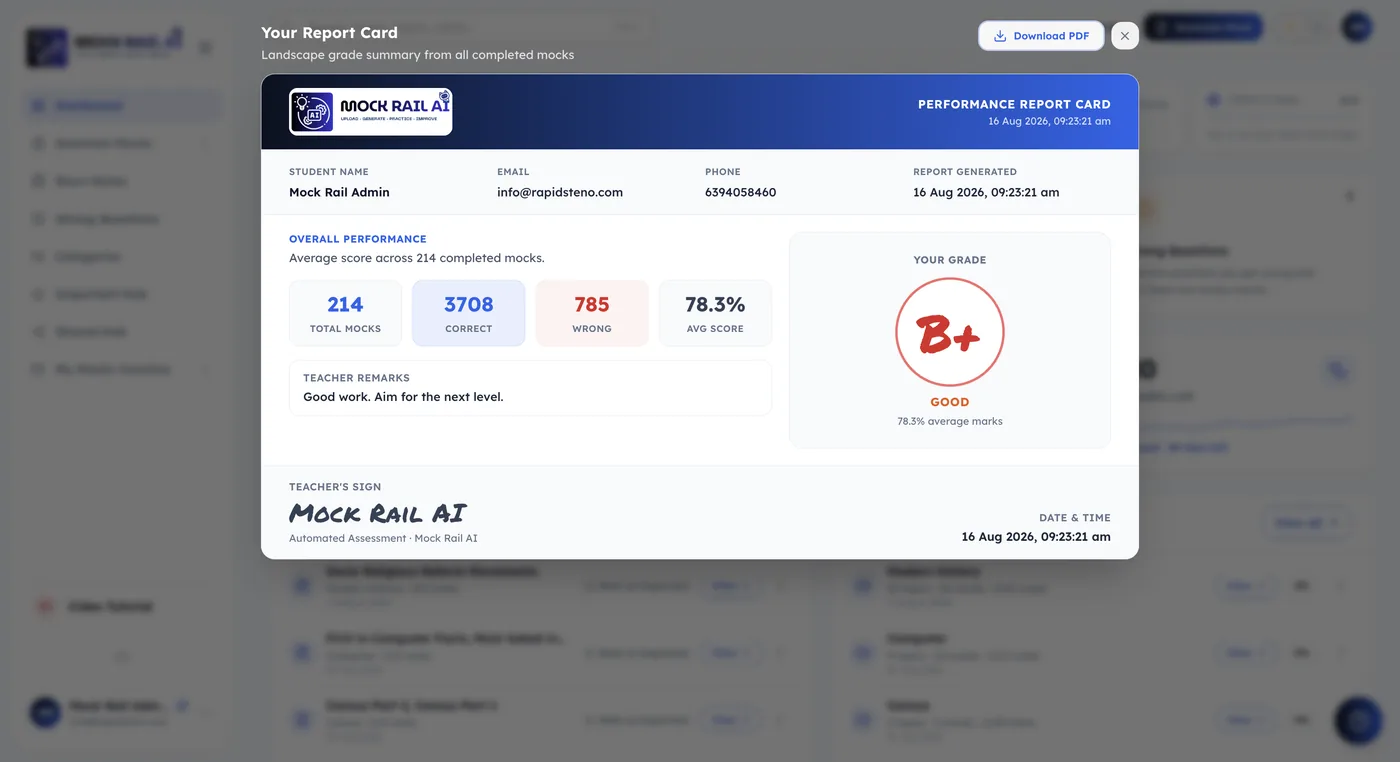
Concretely, what the generator adds on top of the prompts above: Mockrail AI previews sample questions free before a credit is spent, so you can check quality the same way you would re-run a prompt. Every paper you generate is saved and gets unlimited retakes on any plan, including Free — the chat equivalent would be regenerating and getting a different paper each time. Mock Analysis compares your score across those retakes, and the Important Hub lets you flag shaky chapters for the final revision weeks. The Free plan covers 5 AI mock generations a month with unlimited note scans, and a 5–15 question chapter mock uses 1 credit.
If you would rather see the testing half than read about it:
The exam-pattern reality check
Here is what your actual paper enforces, and what a chat window enforces. The second column is empty for a reason.
| Exam | Questions | Time | Negative marking | Enforced in a chat? |
|---|---|---|---|---|
| SSC CGL Tier 1 | 100 | 60 min | −0.50 | No |
| SSC CHSL Tier 1 | 100 | 60 min | −0.50 | No |
| RRB NTPC CBT 1 | 100 | 90 min | −1/3 | No |
| UPSC Prelims GS Paper 1 | 100 | 120 min | −1/3 | No |
| IBPS / SBI PO Prelims | 100 | 60 min | −0.25 | No |
Always confirm the current pattern against the official notification for your exam year — commissions do revise question counts, timing and marking between cycles. But the last column will not change: no prompt makes a chat window count down or deduct a third of a mark.
Where your material actually lives
The quiet cost of the chat method is organisation. After a month your syllabus is spread across forty conversations with names like "New chat" and "Polity questions 2". Nothing is filed, nothing is searchable, and nothing tells you which chapters you have covered.
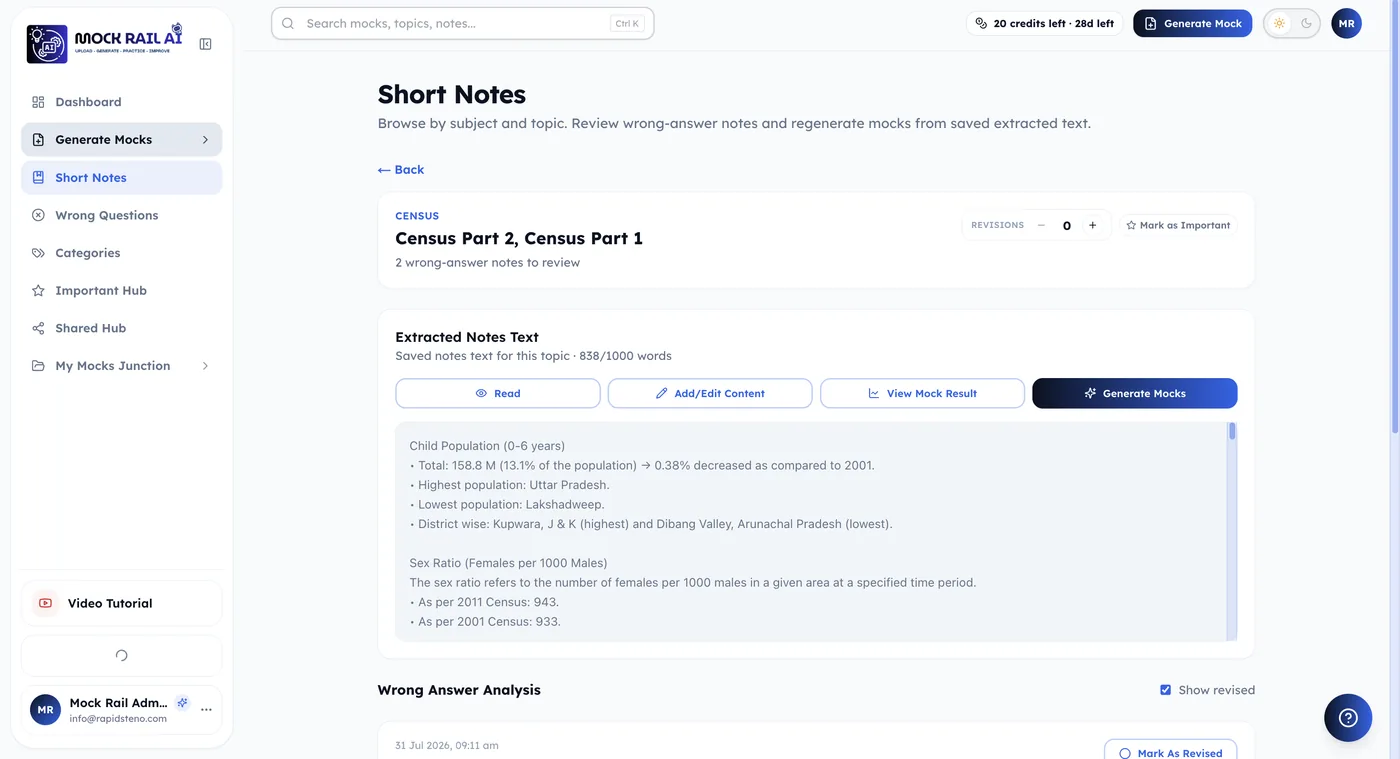
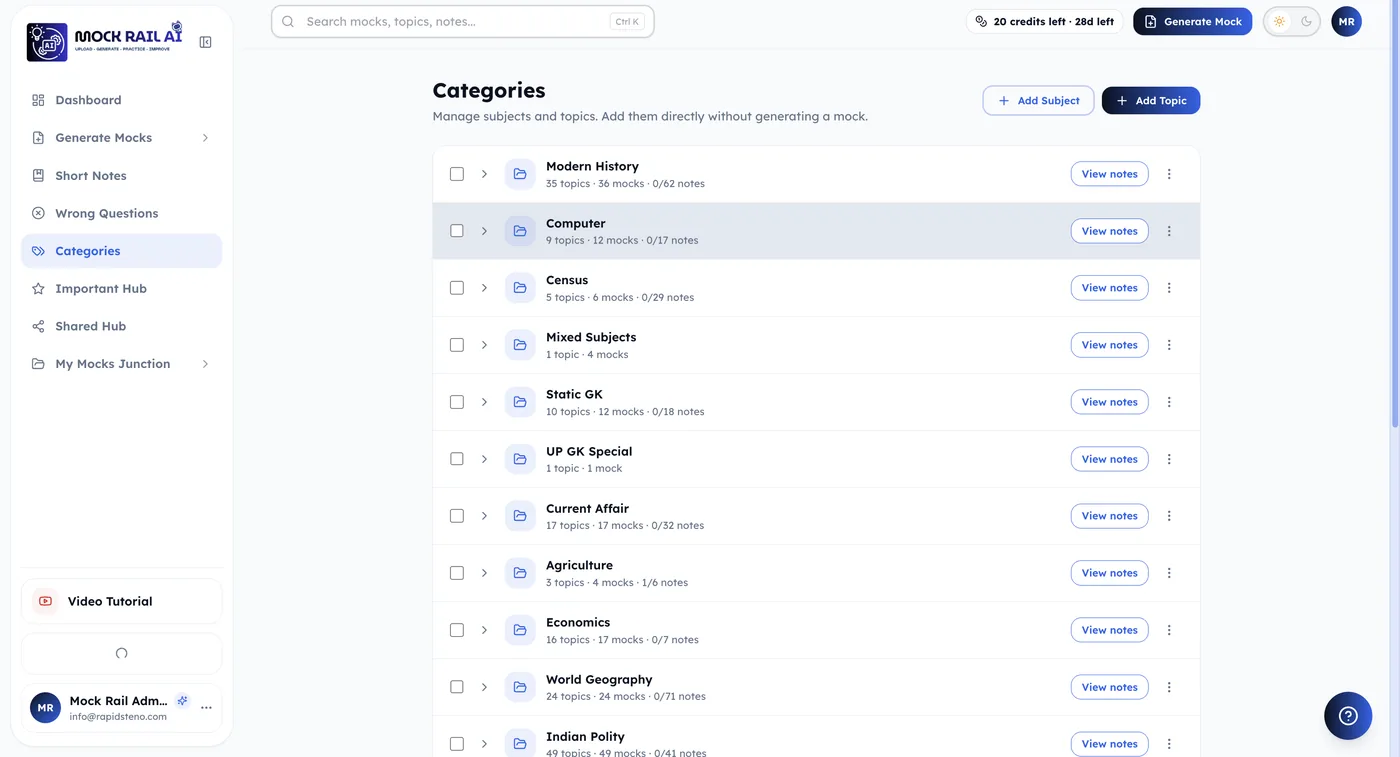
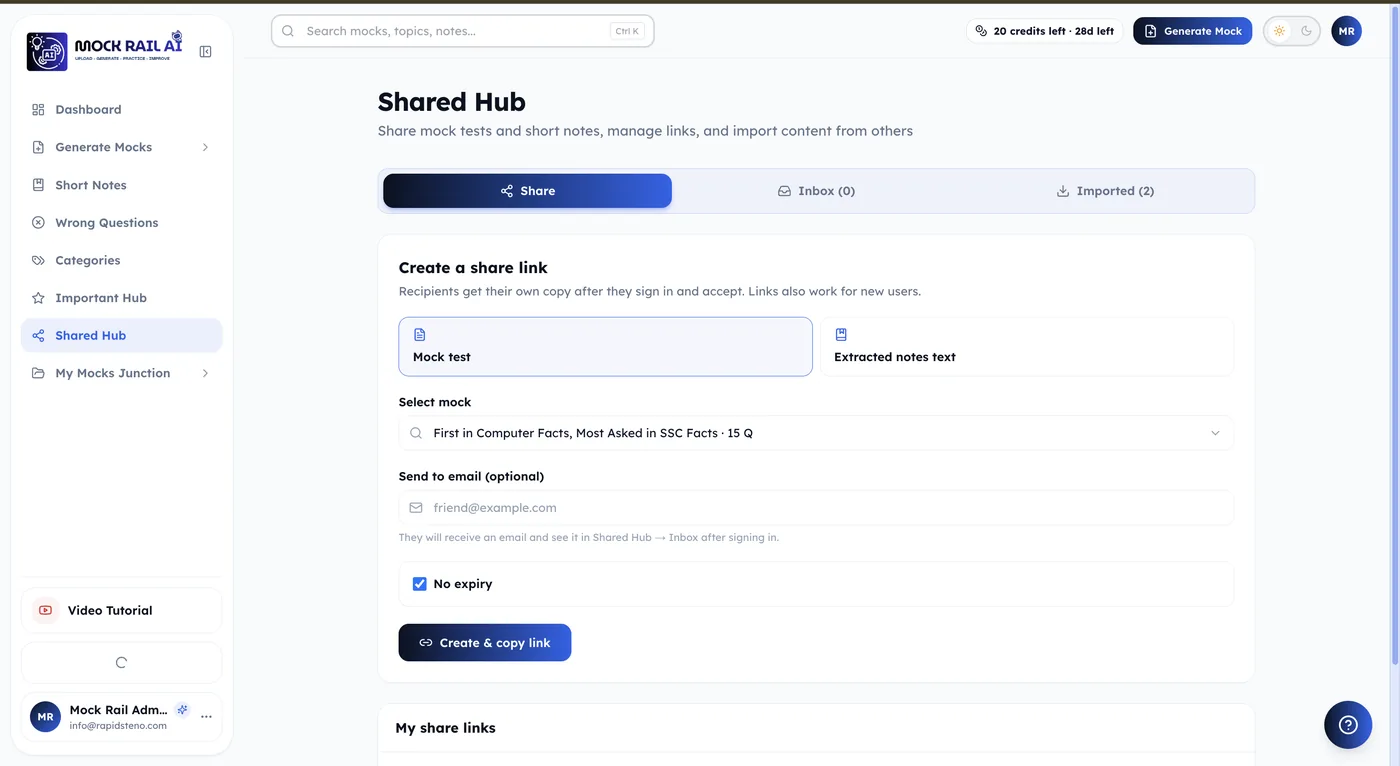
There is also a Shared Hub, which solves the thing WhatsApp groups do badly: four batchmates split four chapters, generate one mock each, and everybody ends up with four papers instead of one. Try forwarding a ChatGPT conversation and see how that goes.
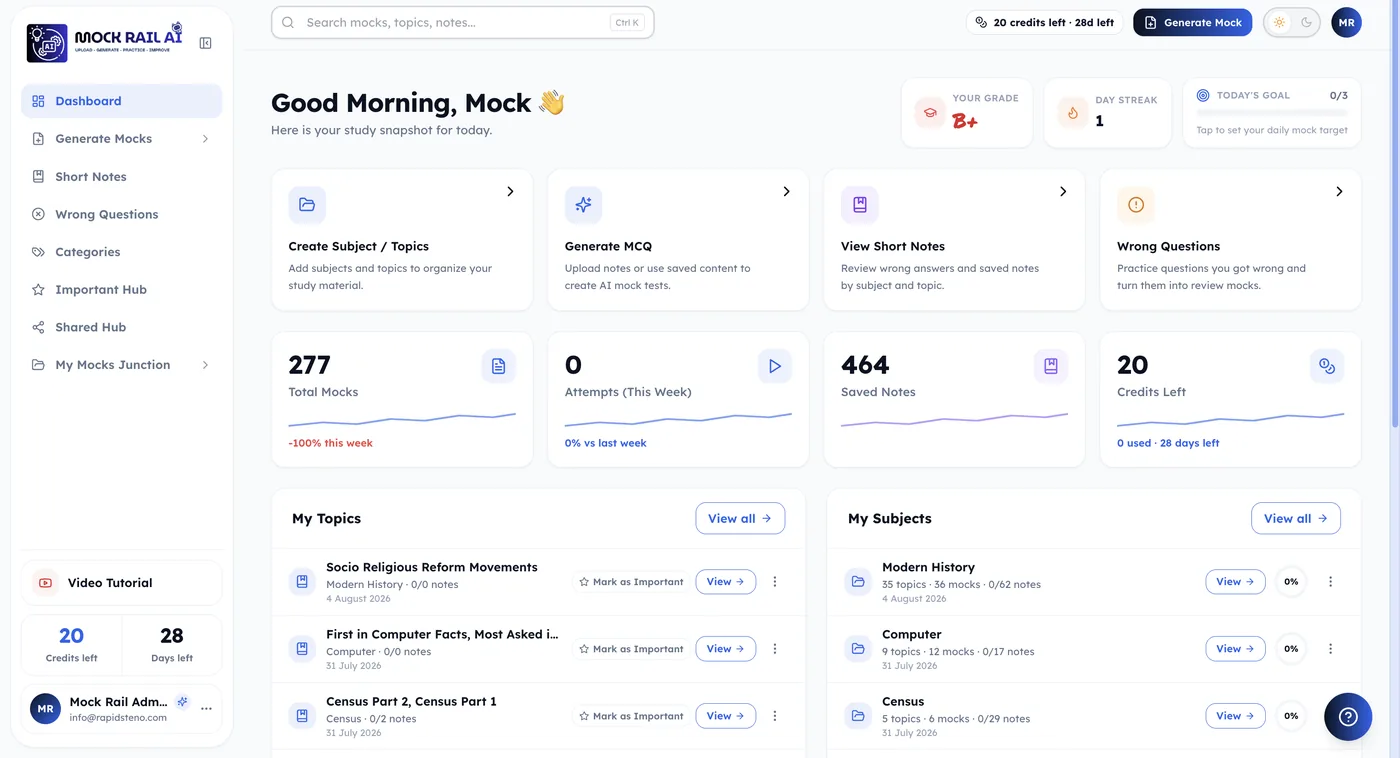
Everything you generate stays on one dashboard rather than scrolling away into chat history.
What aspirants say
"I used ChatGPT for two months. Great questions, but by the end I had no idea what my score even was. That was the moment I switched the testing part."
Harshit Chaudhary SSC CGL aspirant, Agra"Prompt 3 changed everything for me. Before that I was solving my own papers by elimination without reading the question properly."
Meenakshi Iyer Banking aspirant, Coimbatore"Still use ChatGPT daily for doubts. I just stopped pretending a chat window was a mock test."
Sahil Qureshi RRB NTPC aspirant, Bhopal"The timer is the whole thing. Without it I was taking three minutes on questions I get forty seconds for in the real exam."
Pooja Mahto State PSC aspirant, Ranchi"My ChatGPT sidebar had 60 chats and I could not find last week's paper. Now everything sits under the subject it belongs to."
Naveen Rathore UPSC aspirant, Udaipur"Wrong answers being saved automatically is the part ChatGPT could never do. I stopped keeping a separate error notebook in week two."
Farhan Ansari SSC CHSL aspirant, LucknowChatGPT mock test FAQs
Can ChatGPT make a mock test from my notes?
Yes. Paste your notes and ask for four-option MCQs with the answer key kept separate at the end. ChatGPT writes usable questions, especially if you also name the exam and difficulty level. What it cannot do is run the paper — there is no countdown timer, no question palette, no negative marking and no record of what you got wrong.
Is ChatGPT free for making practice questions?
The free tier can generate MCQs, with message limits and slower models during busy hours. For most aspirants the real cost is not money but time — retyping your format rules in every new chat, and losing older papers in a long chat history.
Can ChatGPT read my handwritten notes?
It can attempt it, but results on Indian register pages with mixed Hindi and English are inconsistent. Always make it type out what it read first and confirm before it writes any questions — otherwise it will quietly invent facts to fill the gaps it could not read.
Does ChatGPT give wrong answers in MCQs?
Sometimes, and most often on dates, numbers, article numbers and recent current affairs. In our testing on a Polity note it made no factual slips, but on the current-affairs prompt three of ten questions contained an error. Cross-check anything numerical against your source.
ChatGPT or Gemini for exam preparation?
Gemini is generally stronger on current affairs and recent factual data because of its live search grounding. ChatGPT tends to follow long formatting instructions more reliably, which matters when you want ten MCQs in a fixed structure. Neither runs a timed paper or remembers your mistakes.
Can ChatGPT track which questions I got wrong?
No. A chat has no score history and no error log. You can paste your wrong answers back in manually each time, but nothing is stored, nothing is grouped by topic, and there is no way to see whether a weak subject is actually improving across weeks.
How do I make ChatGPT follow the SSC exam pattern?
Name the exam, demand four options with exactly one correct, ask for the answer key at the end rather than beside each question, and tell it that single-step factual recall is too easy. It still will not enforce a timer or apply negative marking — you have to time yourself.
How many questions should I ask ChatGPT to generate at once?
Ten from one chapter is the practical limit. Past that, quality drops noticeably — options get repetitive and questions start restating your notes word for word. Two batches of ten from the same notes works better than asking for twenty in one go.
What should I use instead of ChatGPT for mock tests?
Keep ChatGPT for explanations and doubt-solving, where it is genuinely strong, and use a dedicated generator for the practice loop. Mockrail AI builds papers from the same notes, runs them with a timer and question palette, and saves every wrong answer by subject and topic. The Free plan gives 5 mock generations a month with unlimited note scans.
Is it cheating to make practice questions with AI?
No. You are generating practice material from your own study notes, not accessing exam content. It is the same as a friend quizzing you from your notebook. What matters is that you attempt the questions honestly, under time, without peeking at the answer key first.
Start with the prompts, then decide
Genuinely — go and use them. Copy Prompt 1, then 2, then 3 on tonight's chapter and see the difference stacking makes. That alone will improve whatever you are doing now.
Then notice what week three feels like. When you want the timer, the saved mistakes and a score you can actually track, the same notes will work here too. Start with how to generate a mock test from your notes, or read the wider comparison in our mock test maker guide. Sitting a specific paper? See our Allahabad High Court RO/ARO and SSC Stenographer guides.