You can generate a free SSC Stenographer mock test in about a minute from the notes you already have — paste a chapter or photograph your register page, set the question count and timer to match the real paper, and sit it properly. That matters for this exam in particular, because an SSC Stenographer mock test only covers half of what decides your selection. The Computer Based Test is one stage; the qualifying shorthand Skill Test is the other, and no MCQ platform on the market prepares you for it at all.
To generate a free SSC Stenographer mock test from your notes: paste or photograph one topic → set the question count and timer → attempt it under the clock → revise every wrong answer. Free plan: 5 AI mock generations a month, unlimited note scans, unlimited retakes.
CBT: 200 questions, 200 marks, 2 hours — Reasoning 50, General Awareness 50, English 100, negative marking 0.25, and 30 / 30 / 60 minute section locks.
Skill Test: 10-minute dictation at 100 wpm for Grade C or 80 wpm for Grade D, then transcription. Qualifying — a strong CBT score cannot save a failed transcription.
What changed for SSC Stenographer mock test practice in 2026
Until this cycle, the SSC Stenographer CBT ran on a single two-hour clock across all 200 questions. How you spent that time was your business. Most aspirants used the obvious tactic — rush General Awareness, which is pure recall and takes twelve to fifteen minutes if you know it, then spend the banked time on English comprehension where the marks actually are.
Sectional timing ends that. Each section now has its own clock, and when the section closes you move on whether you are finished or not. There is no carrying forward, no coming back, no rescuing a weak section with time saved elsewhere.
This is not a small administrative change. It invalidates the timing habit that most serious candidates spent months building, and almost nobody preparing right now has adjusted their practice for it.
SSC Stenographer exam pattern: CBT and Skill Test
Stage one, the Computer Based Test:
| Section | Questions | Marks | Section time | Per question |
|---|---|---|---|---|
| General Intelligence & Reasoning | 50 | 50 | 30 min | 36 sec |
| General Awareness | 50 | 50 | 30 min | 36 sec |
| English Language & Comprehension | 100 | 100 | 60 min | 36 sec |
| Total | 200 | 200 | 120 min | −0.25 per wrong answer |
Stage two, the Skill Test in stenography:
| Grade | Dictation speed | Dictation length | Transcription time (English) | Nature |
|---|---|---|---|---|
| Grade C | 100 w.p.m. | 10 minutes | 40 minutes | Qualifying |
| Grade D | 80 w.p.m. | 10 minutes | 50 minutes | Qualifying |
Verify before you plan. Sectional timing is new this cycle, which makes it exactly the figure that secondary sites get wrong. Download the official notification from ssc.gov.in and confirm the section split, the marking scheme and the transcription windows for your grade.
Do not build a ten-week plan on any coaching website's summary — including this one. We have told you which numbers are newest so you know what to check first.
Sectional timing, briefly
Divide each section by its question count and all three land on the same number: Reasoning 30 min ÷ 50 questions, General Awareness 30 ÷ 50, English 60 ÷ 100 — 36 seconds per question throughout. You cannot bank time from one section into another any more.
The consequence for your practice is simple: your practice unit is now the section, not the full paper. A 50-question set against a real 30-minute countdown tells you something a 200-question mock hides completely.
We worked through the full arithmetic of this — what the change breaks, and the outdated pacing advice still circulating — in our SSC CGL mock test and sectional timing guide. The logic applies here unchanged.
English is half the paper
One hundred of the two hundred marks. Fifty per cent of your CBT score sits in one section, and it is the section most aspirants under-prepare — because they arrive carrying SSC CGL habits, where English is a quarter of the paper and Quantitative Aptitude eats the study hours.
There is no Maths section here at all. That surprises people every year. If you are switching from CGL preparation, the hours you were giving to Quant should go almost entirely to English, not spread evenly across Reasoning and GA.
What actually carries weight in this section: reading comprehension passages, error spotting, sentence improvement, fill in the blanks, synonyms and antonyms, idioms and phrases, active and passive voice, direct and indirect speech, cloze tests, and para jumbles. Vocabulary is worth grinding daily because it compounds — every new word helps in synonyms, antonyms, cloze and comprehension simultaneously.
Negative marking at 0.25
Worth being precise about, because it is the opposite of some other government papers. Allahabad High Court RO/ARO reports no negative marking at all, where leaving a blank is simply irrational — we covered that in our Allahabad High Court RO ARO preparation guide. Here, a wrong answer costs you a quarter mark, so wild guessing bleeds score.
| Your situation | Expected value | Decision |
|---|---|---|
| You know it | +1 | Attempt |
| Eliminated two options | +0.375 | Attempt |
| Eliminated one option | +0.167 | Attempt |
| Total blind guess | +0.0625 | Marginal — only if time remains |
| Blind guess while rushing | Negative in practice | Skip |
Even a blind guess is very slightly positive on pure arithmetic. The catch is that guessing costs seconds you do not have at 36 seconds a question, and hurried guesses are worse than random. Eliminate at least one option or move on.
The Skill Test is where selections are decided
Clear the CBT and you are not through — you are at the stage that actually eliminates people. A passage is dictated for ten minutes at your grade's speed, and then you transcribe your shorthand notes on a computer inside a fixed window. It is qualifying, so no amount of CBT score rescues a failed transcript.
Speed is not usually the problem
Most candidates who fail did take the dictation. What kills them is the transcript — mistake counts stacking up from words they could not read back, outlines that looked fine at 80 wpm and became ambiguous ten minutes later, and spelling that collapses under time pressure. Building raw speed without building readback accuracy is the classic preparation mistake.
Accuracy is counted, not estimated
Evaluators count specific error types — missing words, extra words, wrong spellings, capitalisation, punctuation. Practising with a friend reading a newspaper aloud tells you nothing about those numbers. You need practice that grades your transcript the way an evaluator does, mistake category by mistake category.
Ten minutes of stamina
Taking dictation for two minutes is a different physical task from taking it for ten. Hand fatigue, outline quality drift and concentration loss all appear in the last three minutes, which is exactly where most transcripts fall apart. Extended dictations need to be part of your routine, not just short drills.
Legal and administrative vocabulary
Government dictations lean on formal, legal and administrative language. Outlines for words you never practise are the ones you cannot read back. Court and departmental matter should be in your practice mix well before the exam window.
Which tool for which half
This exam has two genuinely different halves and they need different tools. We build both, so we will be plain about which does what — and where neither helps.
| What you need | Use |
|---|---|
| Shorthand dictation at 80 / 100 wpm | Rapid Steno — SSC special dictations, progressive speed building, 1000-word extended dictations |
| Transcription graded like an evaluator | Rapid Steno — separates spelling, capitalisation, punctuation, missing and extra words, with a downloadable report |
| Legal and court matter practice | Rapid Steno — court dictations and previous-year SSC matters |
| Full 200-mark CBT mock papers | Rapid Steno's SSC Stenographer mock test series, or the free papers from the big test-series platforms |
| Practising a single weak topic you just studied | Mockrail AI — generate a mock from that chapter of your own notes |
| Rehearsing sectional timing | Mockrail AI — generate a 50-question set and run it against a 30-minute timer with the question palette open |
| Current-affairs GA from your own notes | Mockrail AI — paste or photograph your notes, unlimited scans on every plan |
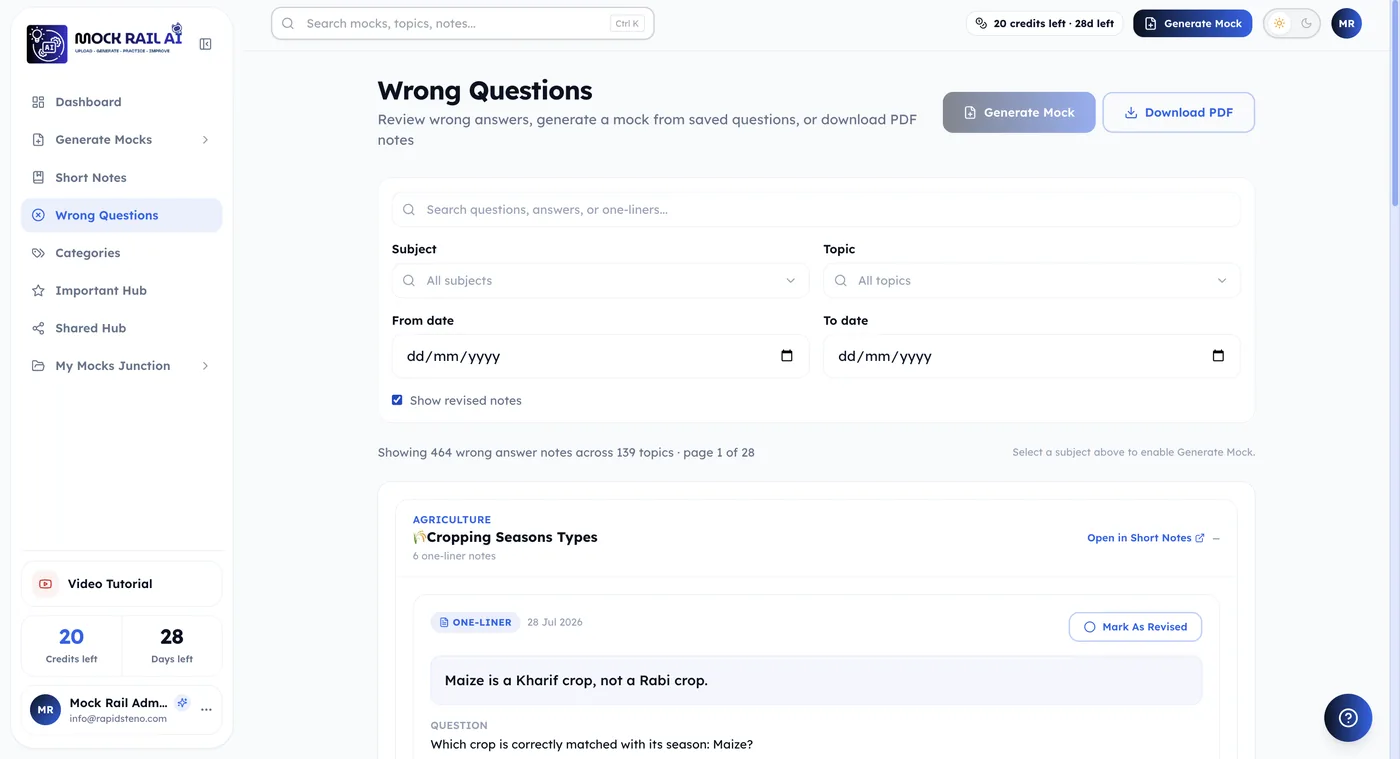
| Wrong answers collected and re-drilled | Mockrail AI — Wrong Questions saves every miss by subject and topic |
| Typing speed for the computer stage | Rapid Steno — exam typing tests with mistake-wise analytics |
| Shorthand theory from scratch | Neither replaces a teacher or a Pitman course. Rapid Steno has Pitman exercises and book revision, but you still need to learn the system. |
That last row is honest and worth saying: software drills a skill you already have. If you have not learnt shorthand theory yet, start there.
Why generate your own SSC Stenographer mock test
Fair question, and the answer is specific to this exam rather than a general sales pitch. Ready-made test series are built for the average candidate. Three things about SSC Stenographer make that averaging work against you.
| The problem | Why a ready-made series cannot fix it | What Mockrail AI does |
|---|---|---|
| Sectional timing is new | Most series still ship full 200-question papers on one clock | Generate a 50-question set, set the timer to 30 minutes, rehearse the real section pace tonight |
| Your score mixes two problems | A full mock tests the whole syllabus, including chapters you have not reached | Questions come only from the chapter you studied today, so a wrong answer means you studied it and still missed it |
| Current affairs goes stale | GA banks are written months before your exam window | Paste this week's notes and test yourself on them the same evening |
| You run out of fresh papers | Free mocks are exhausted by week six; paid series start repeating | New paper from any chapter, plus unlimited retakes on anything you have already generated |
| The same mistakes keep returning | Wrong answers live inside one report you never open again | Wrong Questions collects every miss by subject and topic, and builds a fresh mock from weak areas only |
The point is not that you should stop attempting full-length papers. You should not — stamina for a two-hour paper is its own skill. The point is that a full mock every Sunday tells you where you stand, while a ten-question mock on tonight's chapter tells you whether tonight's study actually worked. Those are different jobs and most aspirants only do the first one.
Mockrail AI runs the paper properly too, which matters more than it sounds. You get a countdown timer, a question palette showing what you have skipped, mark-for-review on anything you are unsure about, and a real submit — no answer key visible until you finish. Recognising a fact in your notes and answering it in 36 seconds with four plausible options are completely different skills, and only the second one is being tested in April.
On cost, since aspirants ask: the Free plan gives 5 AI mock generations a month with the full app, unlimited note scans and unlimited retakes. A 5–15 question chapter mock uses 1 credit and a 16–30 question set uses 2, and you can preview sample questions free before committing a credit. For the daily-chapter routine below, the ₹199 Starter plan at 50 mocks a month comfortably covers a ten-week preparation. Details on the pricing page, and every feature is on the features page.
How to generate a free SSC Stenographer mock test
Here is the practical routine for the CBT half. After you finish a chapter — a Reasoning topic, a GA area, an English grammar rule — paste it into Mockrail AI or photograph the register page, and generate a mock from exactly that material. Set the count and the timer to match the real section pace.
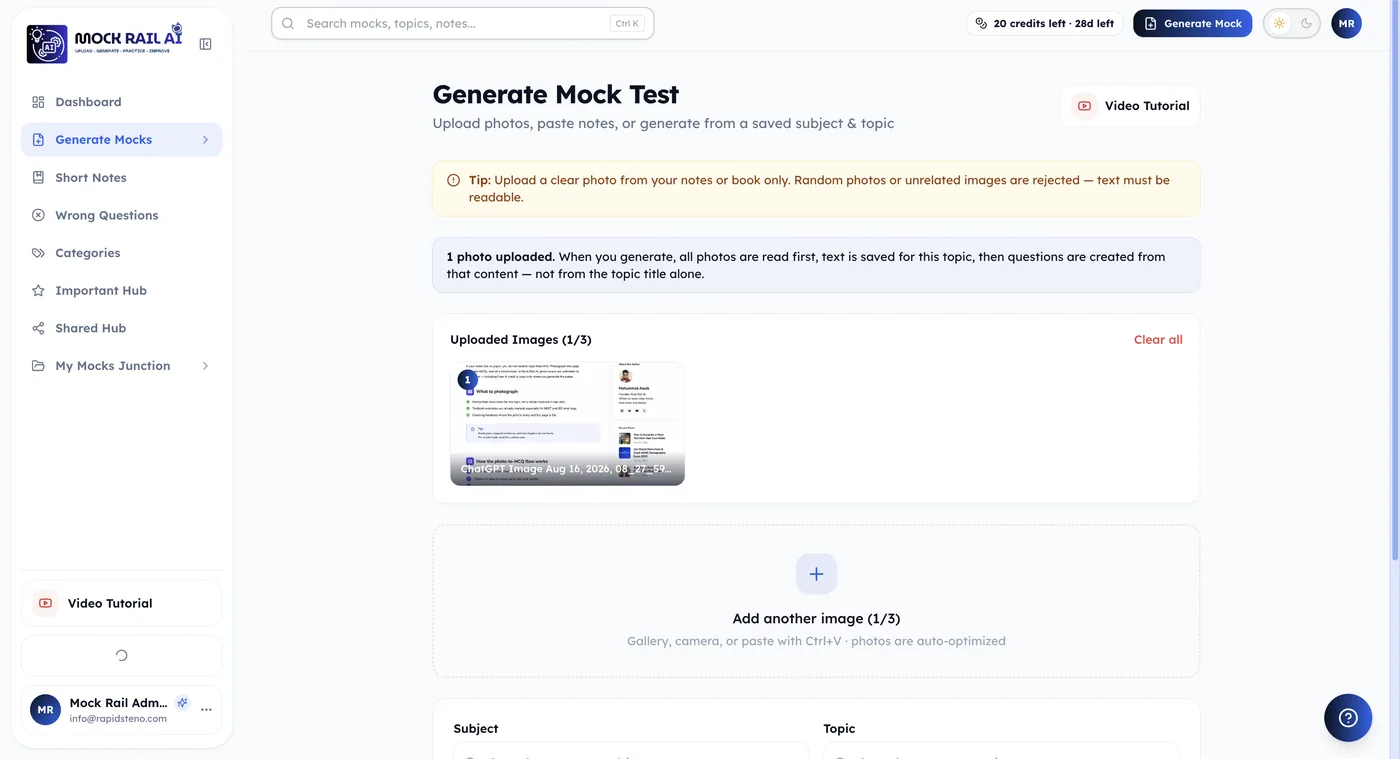
For sectional rehearsal specifically: build a 50-question set and give it 30 minutes. That single habit is worth more than any number of untimed papers, because it turns the 36-second pace from a number you read into a rhythm your hand knows.
Handwritten notes work directly — the photo upload reads register pages including the mixed Hindi and English most aspirants actually write, so nothing needs retyping. Scanning is unlimited and free on every plan, and a credit is only used at the moment you generate a paper.
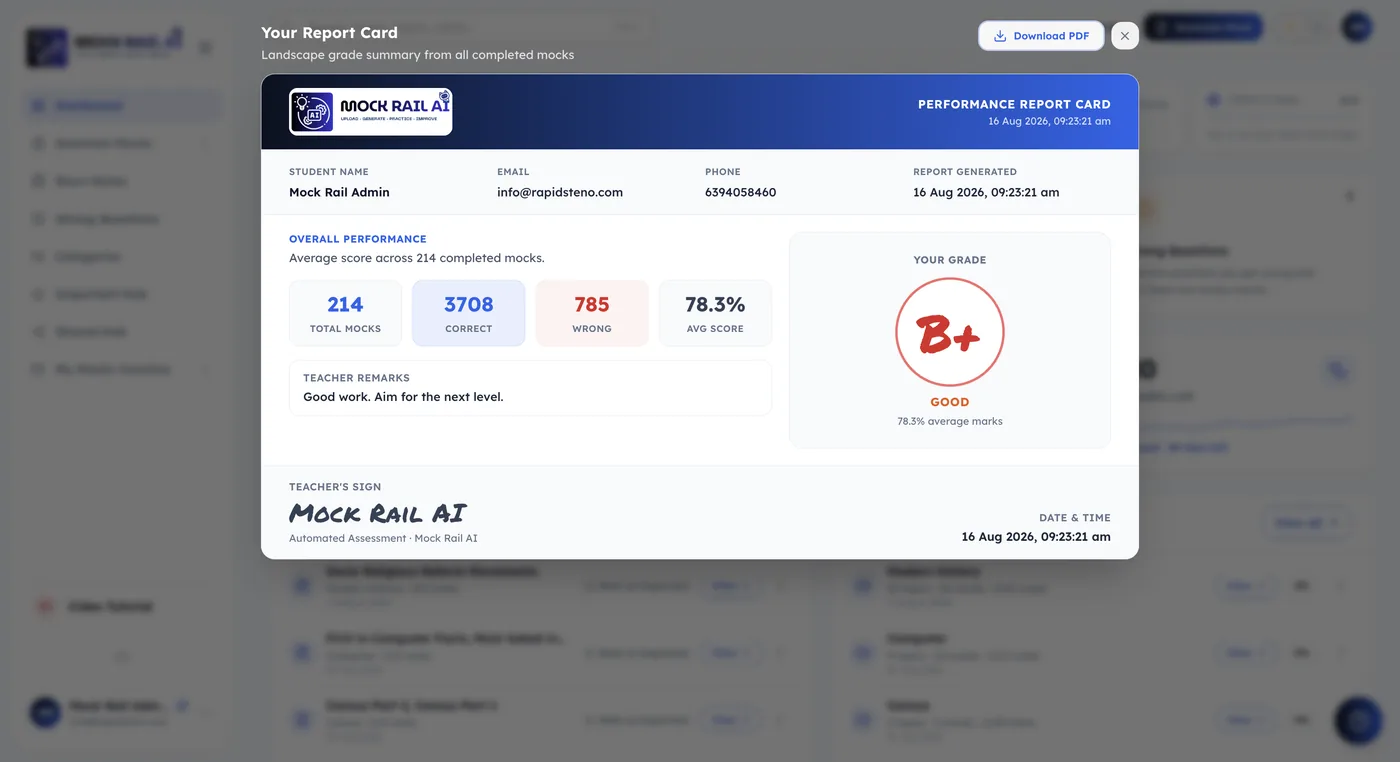
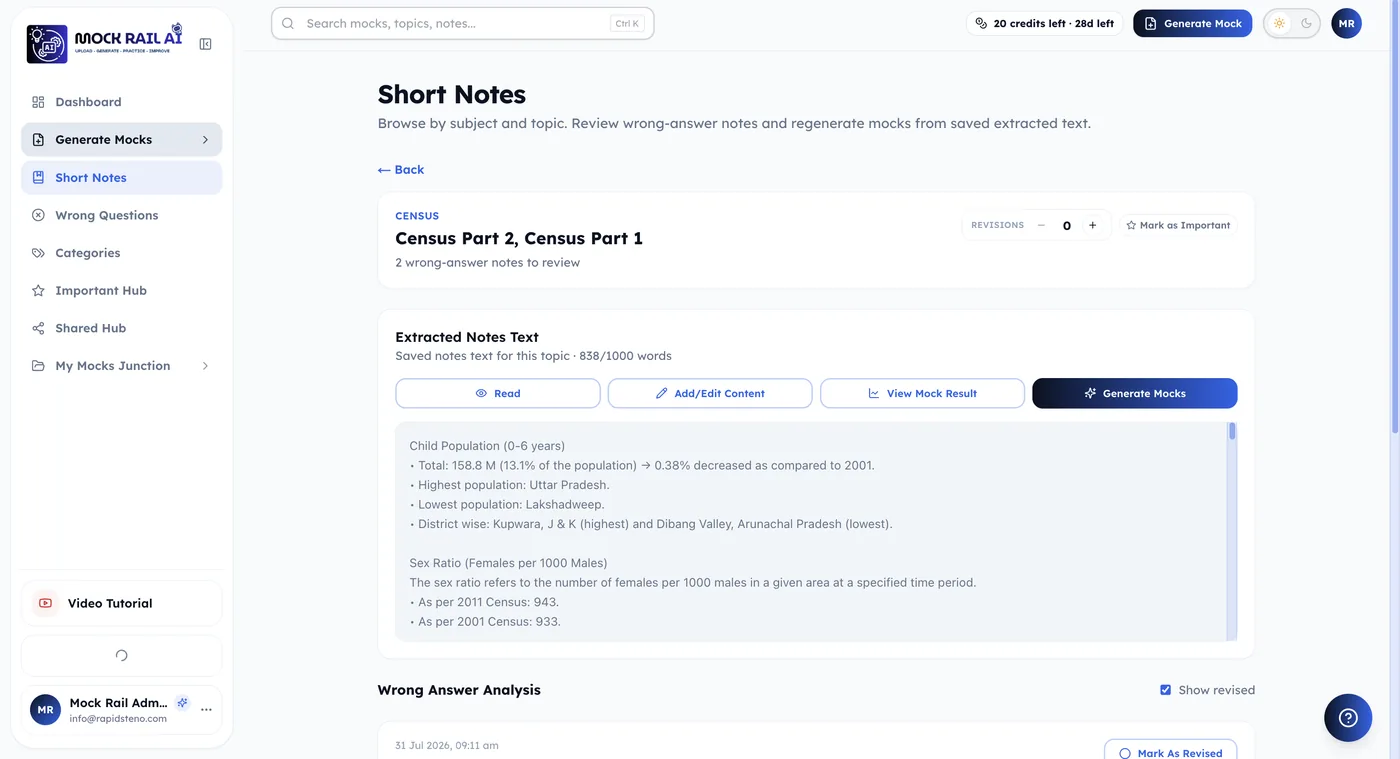
After you submit, the report card gives you score, accuracy and a question-wise breakdown — and every wrong answer files itself under its subject and topic instead of into an error notebook you abandon by week three.
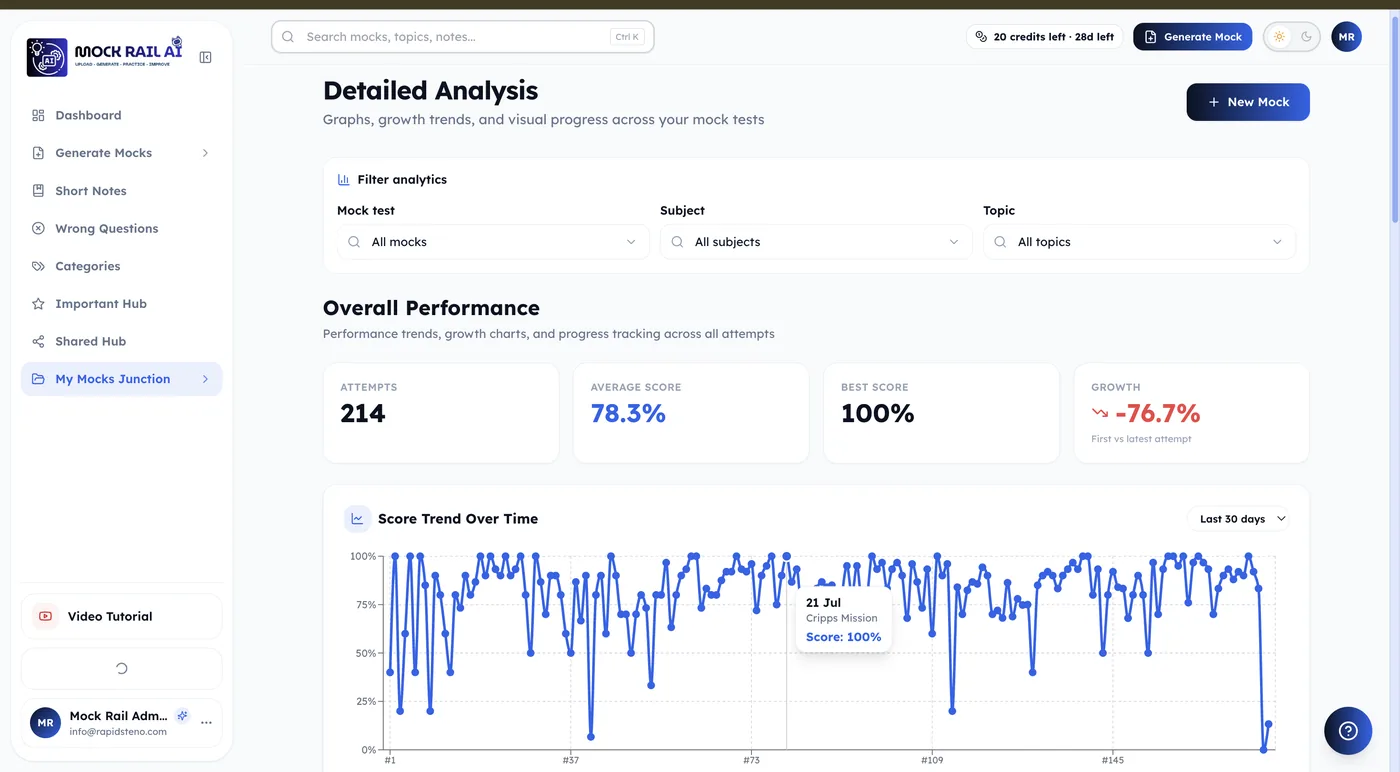
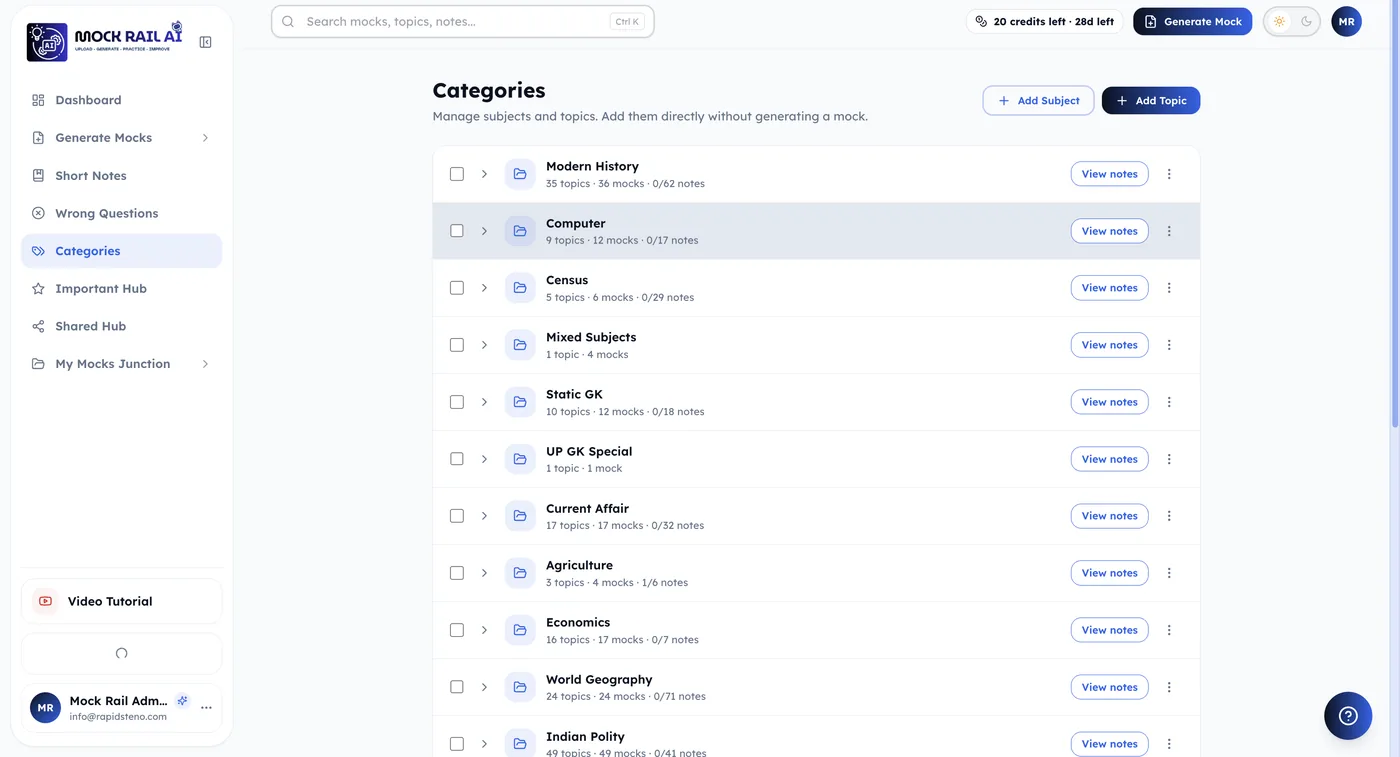
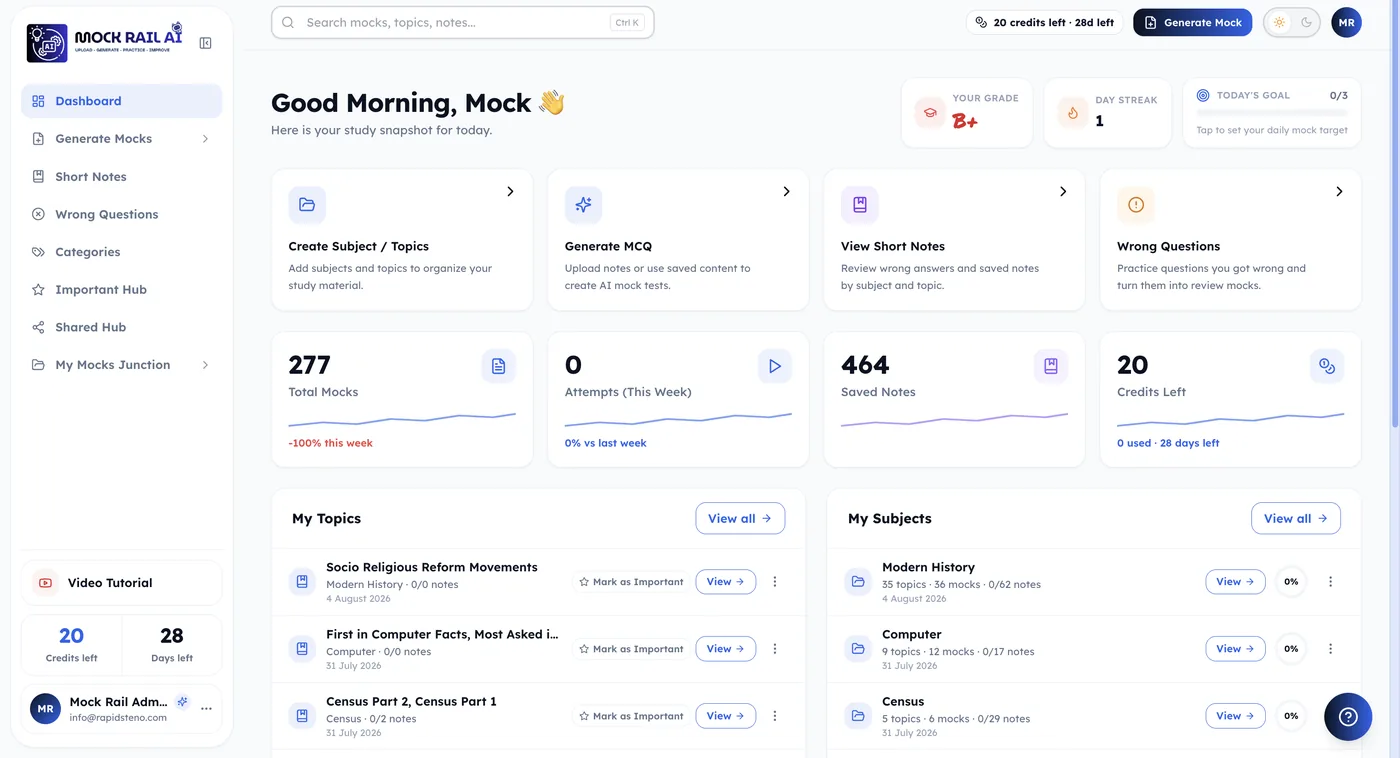
Keep the syllabus structured as it grows — separate subjects for Reasoning, General Awareness and English, with topics nested underneath, and a revision counter per topic that quietly tells you which chapters you keep skipping. Star the shaky ones into the Important Hub so they are waiting for you in the final fortnight instead of being rediscovered the night before.
A 10-week plan
Assuming you already know shorthand theory and can give four to five hours a day. The non-negotiable is that dictation practice runs every single week — it is a physical skill and it decays fast.
| Weeks | CBT focus | Skill Test focus |
|---|---|---|
| 1–3 | English foundations — grammar rules, daily vocabulary, one comprehension passage a day. Reasoning basics. | Dictation at 10 wpm below target speed. Build readback accuracy first. |
| 4–6 | General Awareness build-up plus English practice. One 50-question section against a 30-minute clock, three times a week. | Reach target speed. Start 10-minute extended dictations. |
| 7–8 | Weak areas only — mocks built from your Wrong Questions. Two section-timed papers a week. | Court and legal matter. Track mistake categories, not just accuracy percentage. |
| 9–10 | Full 200-question mocks under sectional timing. Final GA revision sweep. | Full simulations — 10-minute dictation plus transcription inside the real window. |
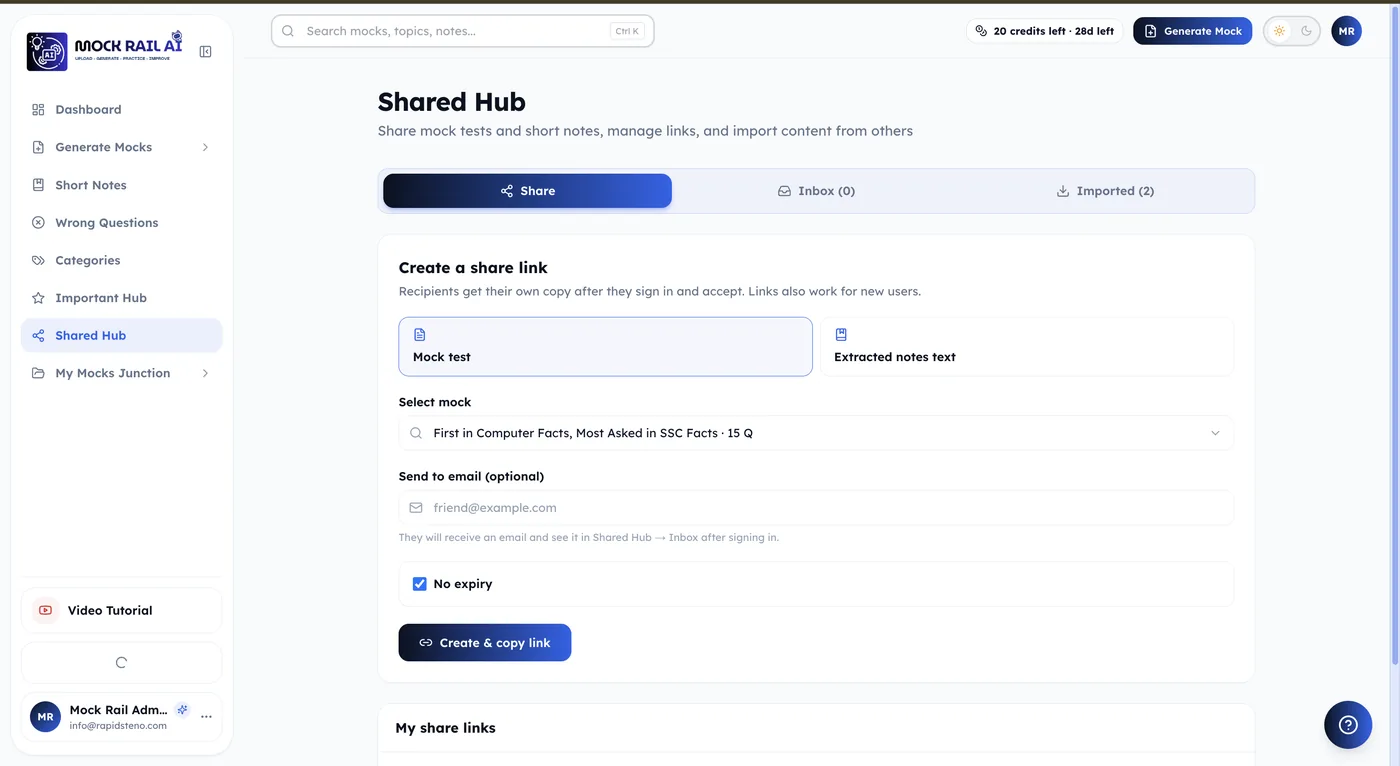
Protect the Saturday habit: one mock built entirely from the week's wrong answers. Every question in it is something you have already got wrong once, which makes it the highest-value paper you will sit all week. If you study with a batch, Shared Hub lets four of you split four topics and swap the mocks, so everyone gets four papers for the effort of one.
What aspirants say
"I had never sat a 50-question set against a 30-minute clock. First time I tried it I left eleven blank. That was a wake-up call worth having in August, not in the exam hall."
Amit Kushwaha SSC Steno Grade D aspirant, Delhi"Coming from CGL I kept giving English a quarter of my time. Once I realised it is a hundred marks here, everything changed."
Priyanka Rawat SSC Steno aspirant, Dehradun"My dictation speed was fine at 80. My transcript was the problem — I could not read back my own outlines after ten minutes."
Sameer Khan SSC Steno Grade D aspirant, Bhopal"Seeing capitalisation and punctuation counted separately was uncomfortable. It was also the first time I knew exactly what to fix."
Neha Chauhan SSC Steno aspirant, Meerut"I photograph my GA notes at night and take a 50-question timed set the next morning. Two sections, two tools, one routine."
Gaurav Bisht SSC Steno aspirant, Haldwani"Nobody in my coaching batch had adjusted for sectional timing. We were all still practising full papers in one go."
Tanvi Joshi SSC Steno Grade C aspirant, NagpurSSC Stenographer FAQs
What is the SSC Stenographer exam pattern in 2026?
Reported pattern is a Computer Based Test of 200 questions worth 200 marks in 2 hours, split as Reasoning 50, General Awareness 50 and English 100, with 0.25 negative marking. New for this cycle is sectional timing of 30 minutes for Reasoning, 30 for General Awareness and 60 for English. Qualified candidates then sit a shorthand Skill Test. Confirm every figure against the official notification at ssc.gov.in.
What does sectional timing change for SSC Stenographer?
It removes time banking. Previously you could finish General Awareness in fifteen minutes and pour the saved time into English. With separate section clocks you cannot carry a single minute forward, so each section must be practised to its own time limit. All three sections work out to exactly 36 seconds per question.
What shorthand speed is needed for Grade C and Grade D?
Grade C requires 100 words per minute and Grade D requires 80 words per minute. A passage is dictated for 10 minutes, after which you transcribe it on a computer. Reported transcription windows are 40 minutes for Grade C and 50 minutes for Grade D in English.
Is the SSC Stenographer skill test qualifying?
Yes. The Skill Test is qualifying in nature, which means a strong CBT score cannot rescue a failed transcription. Candidates are eliminated at this stage every cycle for mistake counts rather than for speed, because accuracy under a running clock is a different skill from raw dictation speed.
Why is English worth 100 marks in SSC Stenographer?
English Language and Comprehension carries 100 of the 200 marks, which is half the paper, because the role itself is language work. Aspirants coming from SSC CGL habits often under-prepare it, since English is only a quarter of the paper there. On this exam, English deserves half your CBT study hours.
Is there negative marking in SSC Stenographer?
Reported negative marking is 0.25 marks per wrong answer. That makes blind guessing a losing bet in practice, but an educated guess after eliminating two options is still worth attempting. Verify the marking scheme in the official notification, since it differs from exams like Allahabad High Court RO ARO which report no negative marking.
How do I practise shorthand dictation at home?
You need dictation at a controlled speed, then a transcription window, then a mistake-wise evaluation. Rapid Steno is built for exactly this loop, with SSC special dictations, progressive speed building and a transcription engine that separates spelling, capitalisation, punctuation, missing words and extra words the way an evaluator marks them.
Can Mockrail AI help with SSC Stenographer preparation?
It helps with the CBT half only. Mockrail AI turns your own notes, pasted or photographed, into a timed MCQ mock with a question palette and a score, and saves every wrong answer by subject and topic. Set the timer to 30 minutes for a 50-question Reasoning or GA set to rehearse sectional timing. It does nothing for shorthand or transcription — that is what Rapid Steno covers.
Should I use a ready-made test series or generate my own MCQ practice?
Both, for different jobs. A ready-made series is built for the average candidate, so a full-length paper tells you where you stand against the syllabus — keep doing one most weekends for stamina. What it cannot do is test the chapter you studied tonight, because the paper also covers topics you have not reached. Mockrail AI generates a mock from your own notes, so every wrong answer points at a line you have already read. Use the series to measure, and your own mocks to fix.
How many mock tests should I take before the exam?
Quality matters more than count. A realistic pattern is one short topic mock most evenings, one section-timed paper each weekend, and a full 200-question mock every fortnight in the last six weeks. What decides improvement is whether you revisit the wrong answers, not how many papers you attempt.
Which is easier, Grade C or Grade D?
The written paper is the same. The difference is the Skill Test, where Grade C demands 100 words per minute against 80 for Grade D, with a shorter transcription window of 40 minutes versus 50. Grade D is the more achievable target for most first-time candidates, and many apply for both.
Start this week
Three things, today. Download the official notification from ssc.gov.in and confirm the sectional split for your cycle — it is new, so check it rather than trusting any summary, ours included. Take one 50-question Reasoning set against a real 30-minute clock and find out what your actual pace is. And put a ten-minute dictation in your routine tonight, not next month.
For the CBT half, start with how to generate a mock test from your notes, or the wider mock test maker guide. Also sitting SSC CGL? Its Tier 1 now runs on the same kind of section lock — see generate a free SSC CGL mock test. If you are already using a chatbot for practice questions, our tested ChatGPT mock test prompts show what it does and does not do well. For dictation and transcription, Rapid Steno is the half of this exam that MCQ platforms cannot touch.