A mock test maker is a tool that turns study material into an exam-style MCQ paper with options, a timer and a score at the end. Most of them give you a ready-made question bank. Mockrail AI works the other way round — you give it your own notes, a photo of your handwritten pages, or text you paste in, and it writes the paper from that.
Why a question bank is not the same thing
Open any online mock test maker and you will usually get thousands of pre-loaded questions for SSC, banking or UPSC. That sounds generous until you sit one. The paper has no connection to the chapter you read last night, so a low score tells you nothing — you cannot separate "I have not studied this yet" from "I studied it and still got it wrong".
When the questions come from your own material, that confusion disappears. Every wrong answer points at a line you have already read. That is the whole reason to use a mock test creator that works from your notes instead of a bank.
Three ways to give it your material
You do not have to type anything out. Pick whichever matches how your notes already exist.
| Method | Best for | What you do |
|---|---|---|
| Paste content | Digital notes, NCERT summaries, coaching PDFs | Copy one chapter, paste it, set a reference source and generate. |
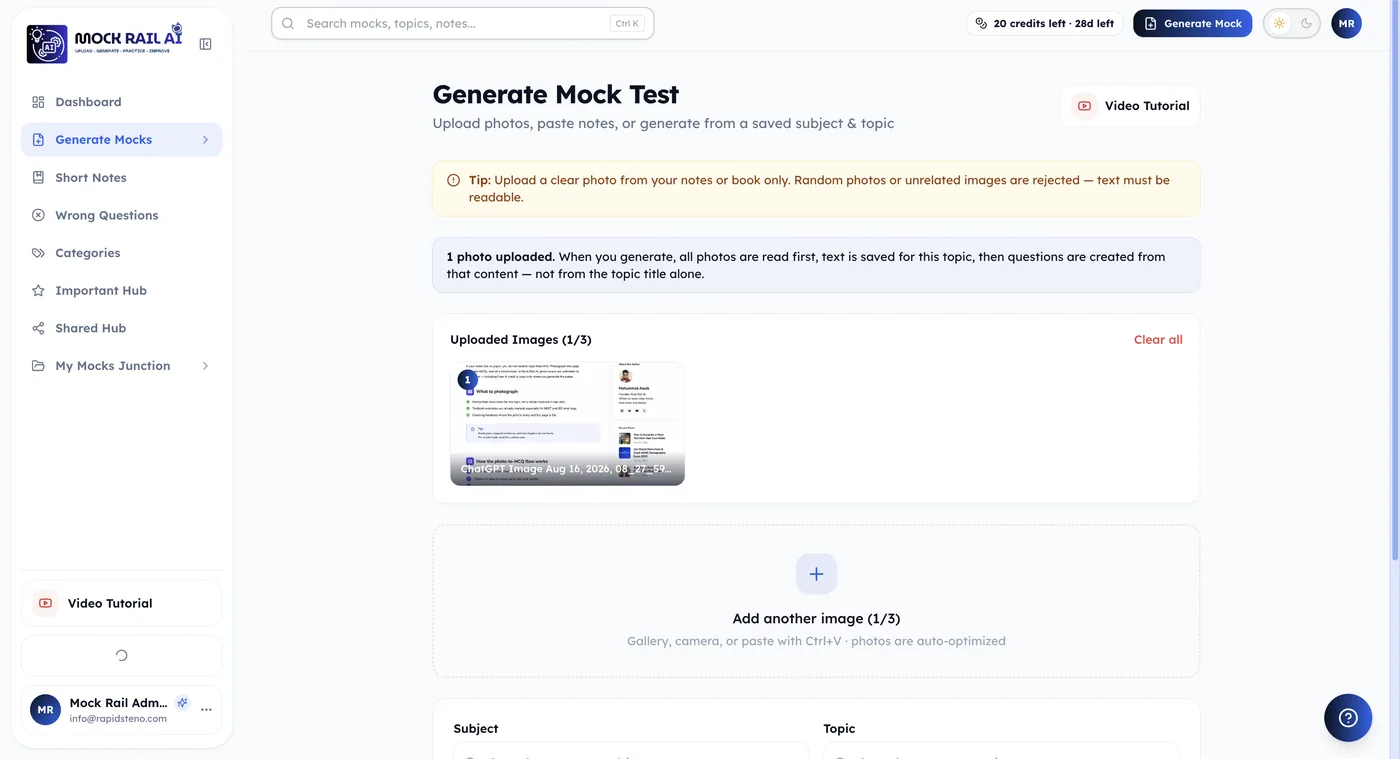
| Image upload | Handwritten registers, textbook pages | Photograph the page. The AI reads it and builds MCQs from it. |
| Saved notes | Material you have already organised | Pick subjects and topics from Short Notes and rebuild mocks anytime. |
Scanning notes into Short Notes is unlimited and free on every plan, including Free. Nothing is charged until you actually generate a paper.
Question bank vs ChatGPT vs your own notes
Three options exist when you want practice questions tonight. They are not equal.
| Question bank app | ChatGPT / Gemini | Mockrail AI | |
|---|---|---|---|
| Built from your notes | No | Only if you paste every time | Yes |
| Reads handwritten photos | No | Not reliably | Yes |
| Timer and question palette | Yes | No | Yes |
| Mark for review | Sometimes | No | Yes |
| Wrong answers saved | Per test only | Lost in chat | By subject and topic |
| Revision counter per topic | No | No | Yes |
| Score tracked across mocks | Yes | No | Yes |
| Notes stay organised | No | Scattered in chats | Subjects and topics |
ChatGPT will happily write ten MCQs. What it will not do is remember what you got wrong last Tuesday. If you are already using the chatbot, we tested seven ChatGPT mock test prompts and graded what each one actually returned.
From notes to score in 4 steps
- Upload. Photograph a page, paste one chapter, or pick a saved topic. Keep it to what you studied today.
- Generate. Set the number of questions, time and difficulty. Preview a few sample questions free before committing a credit.
- Attempt. Sit it in the exam layout — live timer, question palette, mark-for-review — and submit properly.
- Improve. Check your score, open Wrong Questions, and build a shorter mock from your misses the next morning.
The full loop takes about ten minutes, and most of that is you attempting the paper. Step 2 is the only step that uses a credit. For a step-by-step walkthrough of each stage, read how to generate a mock test from your notes.
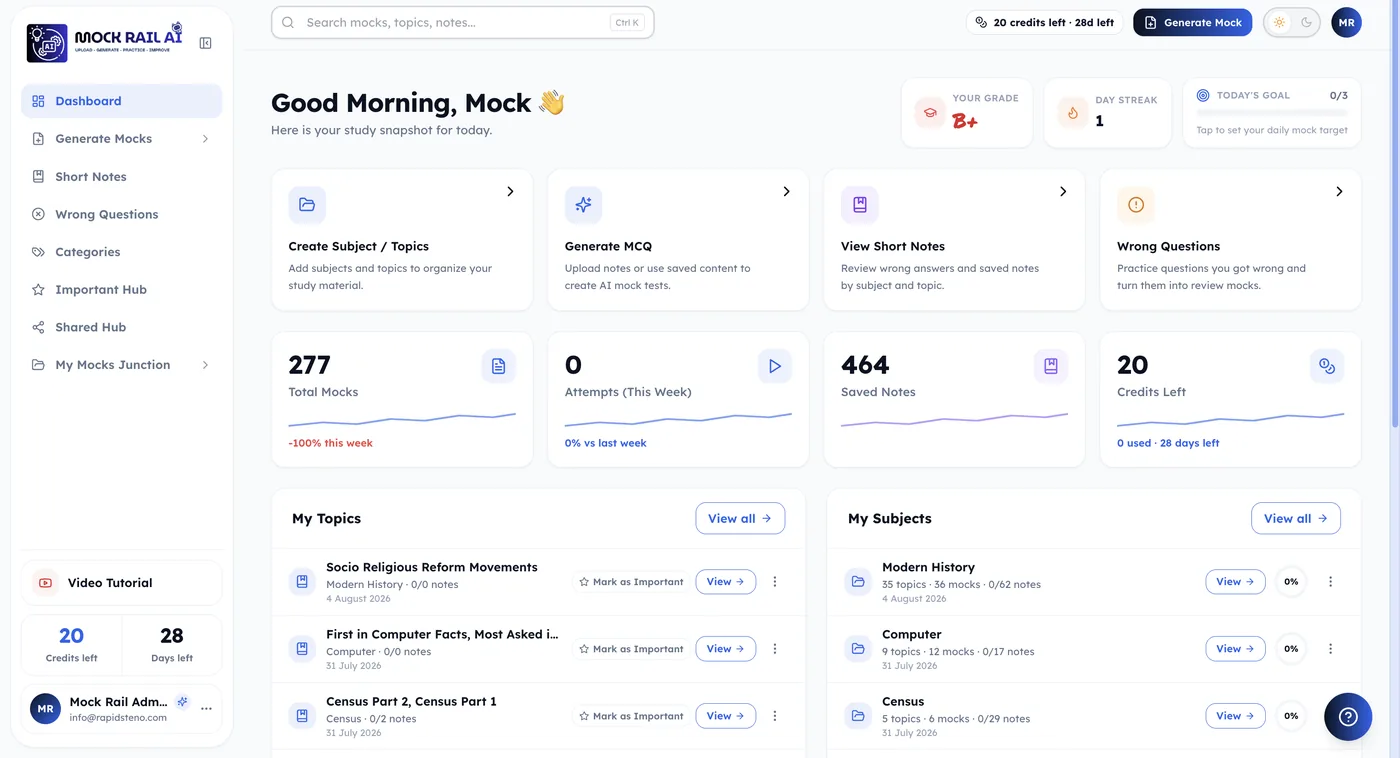
"If I gave the notes, won't I already know the answers?"
This is the first doubt everyone has. It is fair, and the answer is no.
You supplied the material, not the questions. There is a wide gap between reading a paragraph about the Preamble and answering which amendment inserted the words "socialist" and "secular". You chose the source. You did not decide what gets asked from it.
The wrong options do the real work. Anyone can recognise a correct answer sitting on its own. What makes SSC and UPSC hard is three options that all look reasonable. You did not write those, so you cannot predict them.
Recognising is not recalling. Your notes feel familiar when you read them. Under a timer, with four options and forty seconds, that same information behaves completely differently — and that gap is exactly what a mock is meant to expose.
How to spot a weak question — and what it is telling you
Any tool that writes questions automatically will produce a poor one now and then. That is worth knowing rather than hiding, because a weak question is usually a signal about your notes, not about the software. Use the free preview step to check a few samples before you spend a credit.
| What you see | What it usually means | What to do |
|---|---|---|
| Two options both look correct | Your notes were vague on that line | Skip it and go reread that page properly. The question found a real gap. |
| It asks for a year or a name only | The AI pulled from a heading, not the explanation | Remove headings and page numbers before uploading. |
| Three options are obviously wrong | Difficulty is set too low for that chapter | Raise the difficulty and generate a fresh set. |
| The question is from a solved sum | Theory and practice sums were uploaded together | Split them. Upload concept pages on their own. |
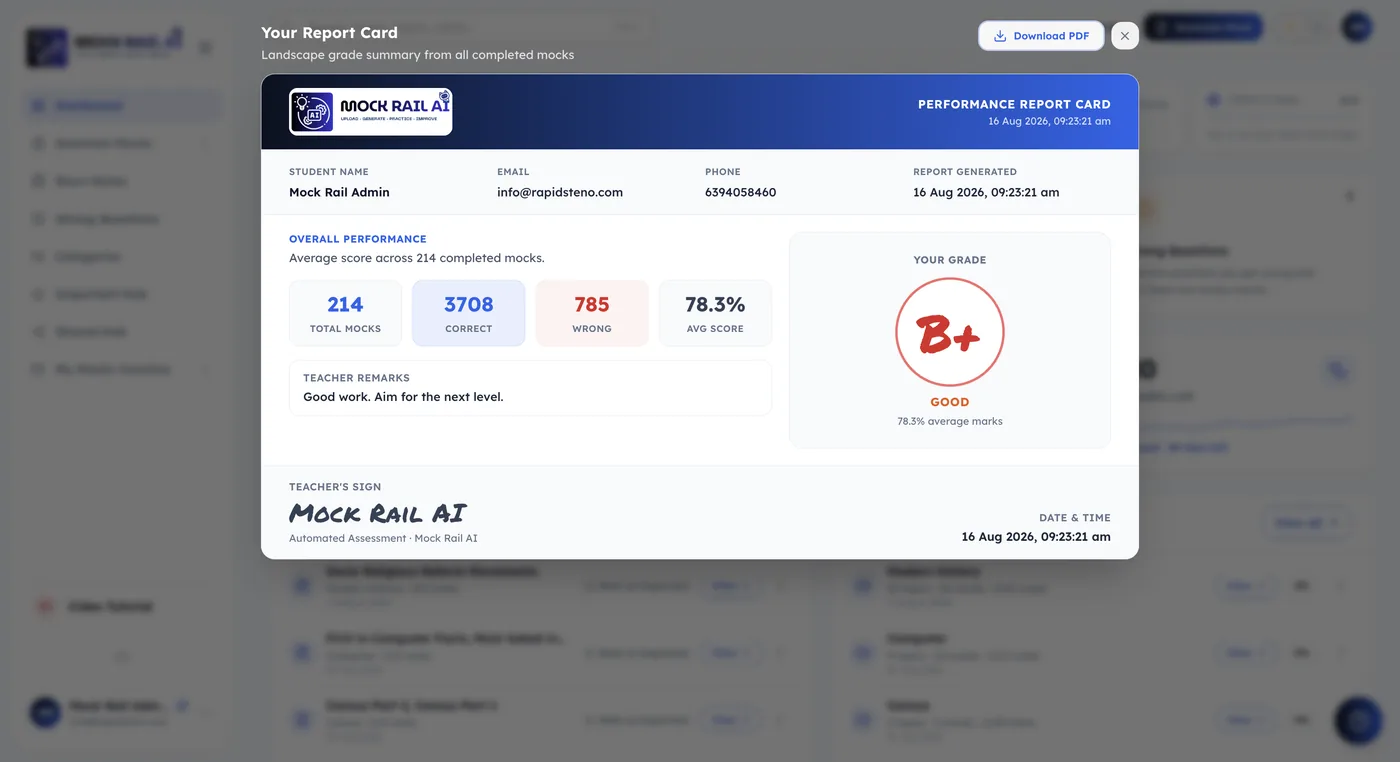
Treat the first mock on any new chapter as a check on your notes as much as a check on yourself. If the questions come out thin, the source pages were thin — and that is far better to discover now than in the exam hall.
How many questions should one mock have?
Between 5 and 15 questions from a single chapter is the sweet spot, and it is also the cheaper option. Here is how it works:
| Mock size | Questions | Credits used | When to use it |
|---|---|---|---|
| Standard | 5–15 | 1 mock | Daily chapter revision. Use this most of the time. |
| Large | 16–30, or 2–3 photos | 2 mocks | Full unit revision before a real exam. |
| Preview | Sample only | Free | Checking question quality before you generate. |
A ten-question mock from one chapter teaches you more than a thirty-question mock spread across a whole subject, because you can actually trace every mistake back to a specific page. Start small and generate more often.
What to feed it for your exam
- SSC (CGL, CHSL): static GK summaries and current-affairs notes you already condensed. Keep mocks short and repeat the same chapter until you finish well inside the time.
- Banking (IBPS, SBI PO and Clerk): make separate mocks per section rather than one mixed paper, so sectional timing gets practised properly.
- UPSC and state PSC: your own short notes on one chapter of Polity, Economy or Modern History. Not a forty-page printout.
- NEET and JEE: upload theory pages separately from solved sums, otherwise the questions come from worked examples instead of concepts.
- College internals: lecture notes for one unit, then sit the mock the same evening while it is fresh.
What happens after you submit
The mock itself is the easy half. What decides your score is what you do in the twenty minutes afterwards, and this is where a proper online mock test creator earns its place over a chat window.
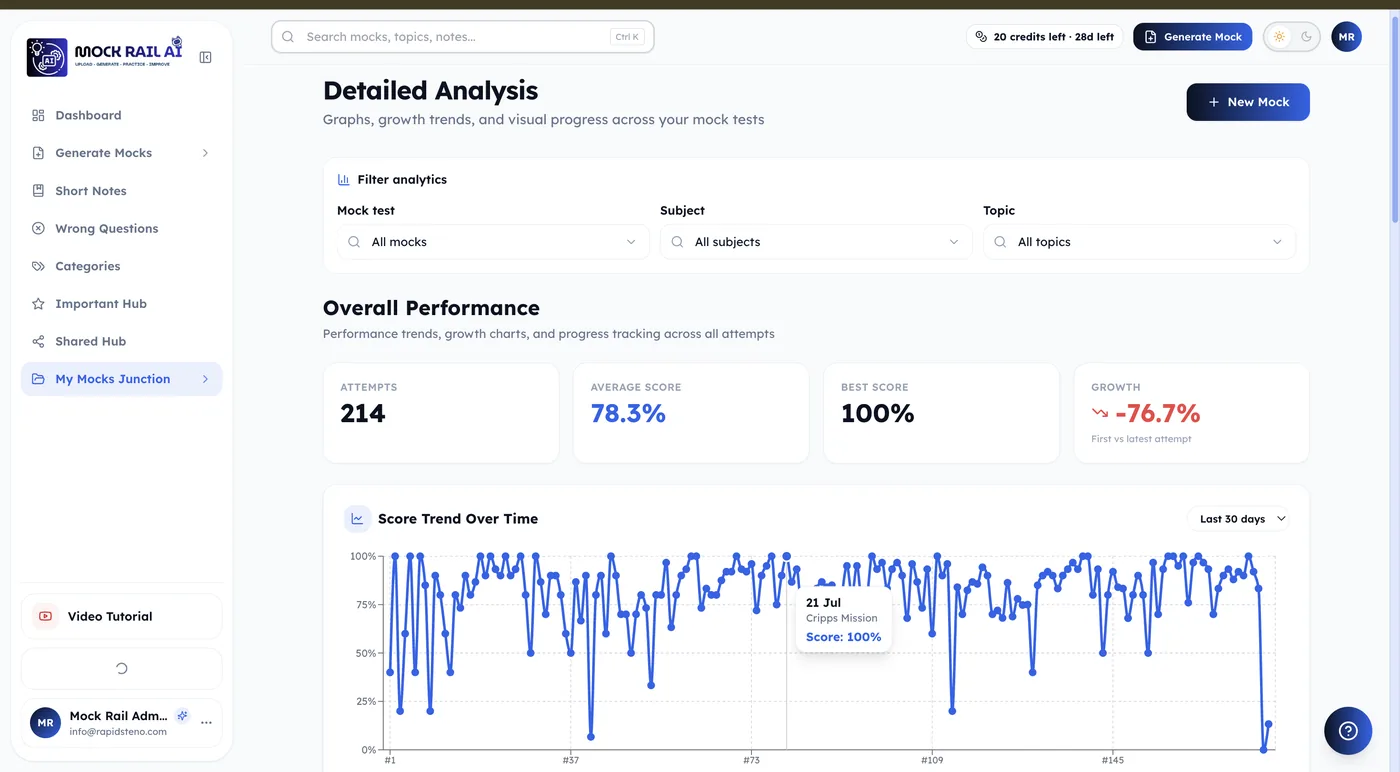
Every question you got wrong is saved automatically, sorted by subject and topic — no copying into a separate notebook. You can practise those same questions again until your accuracy improves, or turn your wrong-answer bank into a fresh mock for focused revision. Mock Analysis tracks your score across attempts so you can see whether a weak topic is actually improving or just feels like it is.
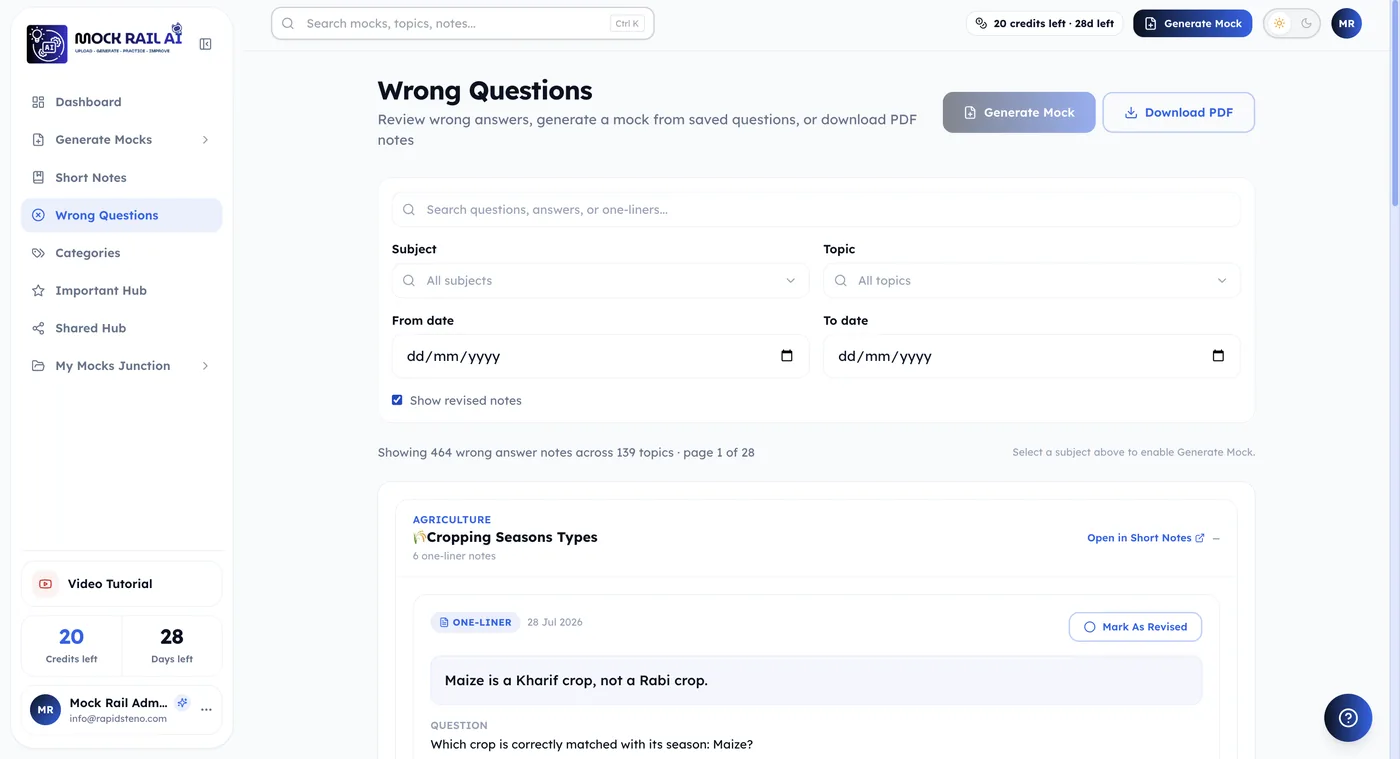
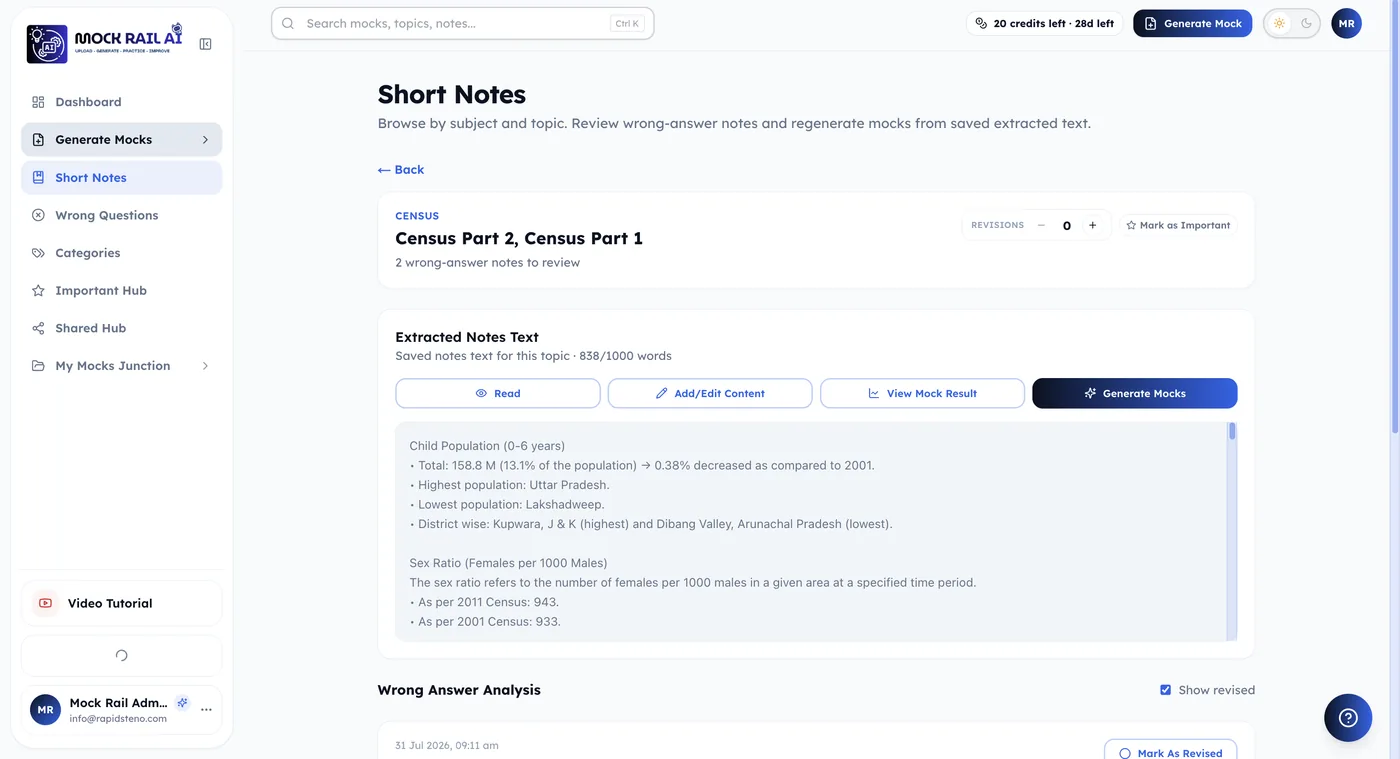
There is also a revision counter on every topic card. It counts how many times you have genuinely read, edited or reviewed that topic — which is an uncomfortable but useful number when you are convinced you have "done" Polity twice.
A weekly loop that actually sticks
Tools do not fix preparation on their own. A routine does. This one fits around whatever your main study plan already is, and costs about four credits a week on the Free plan.
- Monday to Friday: after each study session, photograph or paste that day's chapter and generate a ten-question mock. Attempt it the same evening.
- Saturday: open Wrong Questions and build one mock purely from the week's misses. This is the highest-value paper you will sit all week.
- Sunday: check Mock Analysis. Look at which subjects are climbing and which are flat, then decide where next week's hours go.
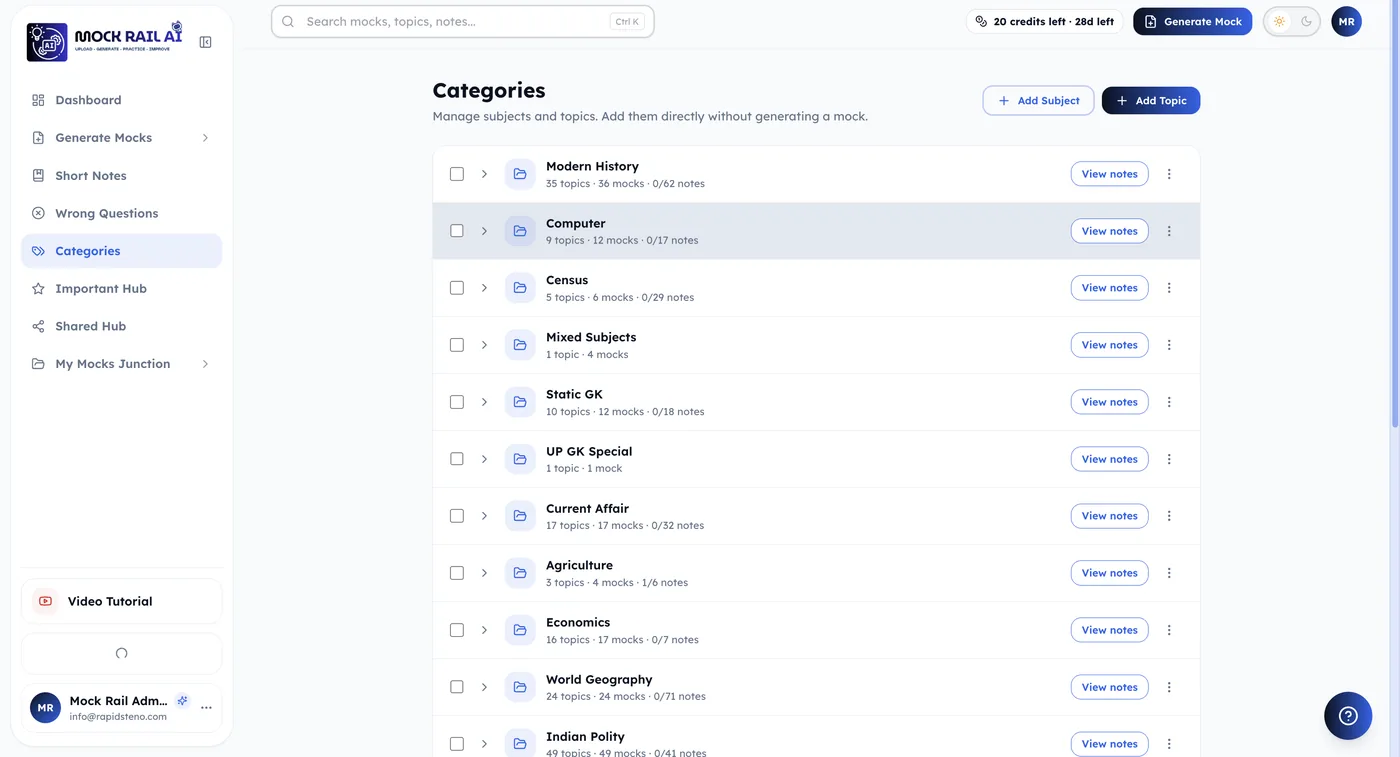
Mark anything still shaky into the Important Hub so it is waiting for you in the final revision weeks instead of being rediscovered the night before. Want to try it first? The free mock test generator needs no signup. Preparing for a specific paper? We have exam-wise guides for Allahabad High Court RO/ARO and SSC Stenographer.
Plans, in plain terms
Every plan includes the full app. You are only paying for how many AI mocks you generate each month — note scans and unlimited retakes on saved mocks stay free throughout. Re-sitting last week's polity paper costs nothing, which is what makes spaced repetition affordable rather than theoretical.
| Plan | Price | AI mocks / month | Suited for |
|---|---|---|---|
| Free · Platform Rail | ₹0 | 5 | Trying it on one chapter |
| Lite · Passenger Rail | ₹99 | 20 | Light weekly revision |
| Starter · Local Rail | ₹199 | 50 | Regular daily practice |
| Pro · Express Rail | ₹399 | 120 | Full-time preparation |
| Max · Rajdhani Rail | ₹699 | 250 | Final months before the exam |
If you run out mid-month, credit add-ons start at ₹49 for 10 mocks and go down to ₹3.29 per mock on the 100-pack. Your monthly allowance is always used first. Full details are on the pricing page.
What aspirants say
"I upload my notes at night and take a mock the next morning. My revision got so much faster."
Priya Sharma UPSC Aspirant"Wrong questions saved me — I practice the same mistakes until I stop getting them wrong."
Arjun Mehta Mockrail AI user"Finally notes and mocks in one place. No more switching between ChatGPT and scattered PDFs."
Ananya Reddy Mockrail AI user"The revision counter keeps me honest about which topics I've actually studied twice."
Rohit Singh Mockrail AI userMock test maker FAQs
Can I make a mock test from handwritten notes?
Yes. Photograph your notebook page and upload it. Mockrail AI reads the page and generates MCQs from it. Keep the photo straight and well-lit, and stick to one topic per upload for cleaner questions.
Is there a free mock test maker?
Yes. The Free plan gives you 5 AI mocks a month plus the full app, and note scans stay unlimited. No credit card is needed to sign up and generate your first paper.
Does scanning notes use up my mocks?
No. Scanning photos into Short Notes is unlimited and free on every plan. A credit is only used at the moment you generate a mock, and previewing sample questions before that is free.
How many questions should one mock have?
Five to fifteen questions from a single chapter works best and uses just 1 credit. Larger mocks of 16 to 30 questions use 2 credits and are better saved for full unit revision.
How is this different from asking ChatGPT?
ChatGPT writes questions in a chat window. There is no timer, no question palette, no saved wrong answers and no record of what you attempted last week. Mockrail AI runs the whole exam and revision loop instead.
Can I reuse a mock I already generated?
Yes. Retakes on saved mocks are unlimited on every plan, including Free. Re-attempting the same paper after a week is one of the cheapest ways to check whether a topic has actually stuck.
Can I share mocks with my study group?
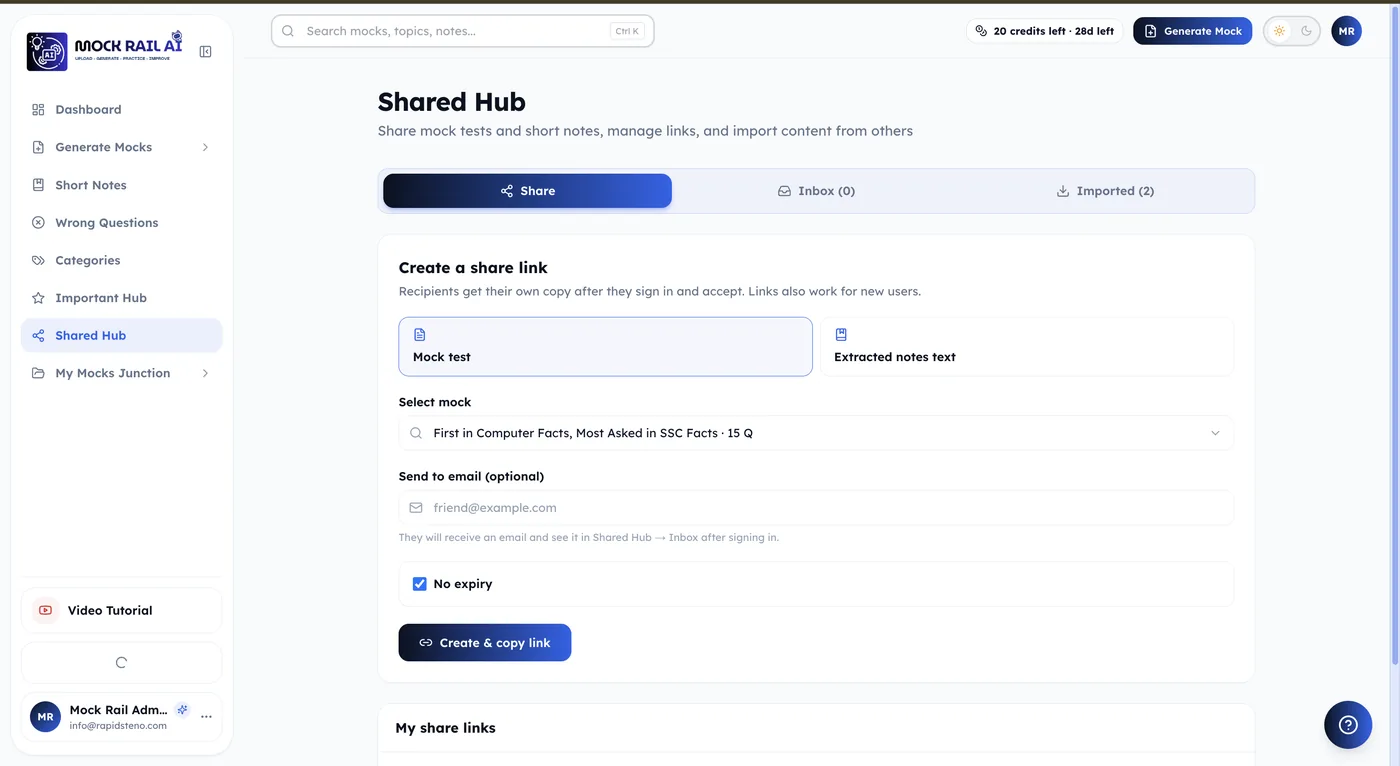
Yes. Notes and mocks can both be shared, and anything shared with you appears in a dedicated Shared Hub. Everyone still tracks their own score separately.
Start with one chapter tonight
Pick the chapter you studied today. Photograph the pages or paste the text, generate ten questions, and attempt it with the timer running. Within ten minutes you will know which parts you actually remember and which parts only felt familiar.
For feature walkthroughs, see generate from notes and generate from photos on the features page, then run the loop.