To generate a mock test from notes, paste one chapter of your notes into Mockrail AI, upload text from a coaching PDF, or simply photograph your handwritten register page. Choose how many MCQs you want and generate. You get a timed, exam-style paper with four options per question, a score at the end, and every wrong answer saved by subject and topic for revision. Start to finish, it takes about ten minutes.
Generating a mock test from notes means the questions are written from your study material instead of a publisher's question bank. Four steps: add your notes → set question count and time → attempt under a timer → revise every wrong answer.
Free plan: 5 AI mock generations a month, unlimited note scans, unlimited retakes. Works for SSC, RRB, UPSC, banking, state PSC and CTET preparation.
What "generate a mock test from notes" actually means
Most aspirants have used a test series. You open the app, a hundred questions load, you attempt them, you get a score. The questions came from somebody in an office who has never seen your notebook.
Generating a mock from notes flips that. You hand over the source material — the chapter you read tonight, the coaching handout you photographed, the register page you filled during class — and the AI writes the MCQs from that specific content. Same exam-style format, same timer, same four options and negative-marking discipline. Different origin.
Two things it is not. It is not a scraped previous-year-question dump wearing a new name. And it is not a flashcard deck — you sit a proper paper with a countdown and a submit button, because recognising a term on a card and answering under time pressure are two different skills.
Why your own notes beat a ready-made test series
Here is the problem with generic mocks that nobody warns you about. You are four months into SSC CGL preparation. You have finished Polity and half of Modern History. You sit a full-length mock and score 62 out of 100.
What does that 62 tell you? Almost nothing useful. Of the 38 you got wrong, maybe 20 were on Economy and Geography — chapters you have not opened yet. The score has mixed together two completely different problems: "I have not studied this" and "I studied this and still could not answer it." Only the second one is actionable tonight.
When the paper is built from your own notes, that confusion disappears entirely. Every single wrong answer points at a line you have already read. There is no excuse available. That is the whole argument for a mock test from notes over a bank — it converts a vague score into a specific list of things to fix.
What your notes need before you generate
This is the part every other guide skips, and it is the single biggest factor in whether your generated paper is sharp or useless. Here is the rule in one line: notes written to jog your memory produce weak questions; notes written to explain produce strong ones.
Look at the difference in practice. Your register says "Art 21 → life & liberty". That fragment can only produce one question, and it is a bad one. Now compare a full line: "Article 21 guarantees that no person shall be deprived of his life or personal liberty except according to procedure established by law." That single sentence can generate a question on the article number, on the exact wording, on the phrase "procedure established by law" versus "due process", and on which case expanded its interpretation.
Before you upload, run through this checklist:
- Full sentences, not arrows. If a line has more symbols than words, expand it before uploading.
- Numbers, dates and names are present. These become your answer options. Notes with no specifics generate vague questions.
- One topic per upload. A single chapter beats forty pages of a coaching module every time.
- Headings left intact. They tell the AI where one concept ends and the next begins.
- Text over diagrams. A flowchart of the Budget process generates less than three sentences describing the same process.
A rough working figure from our own testing: around 500 words of properly written, full-sentence notes reliably yields 12 to 15 usable MCQs. The same content reduced to bullet fragments yields roughly half that, and the questions are noticeably flatter. If you take nothing else from this article, take that — fixing your notes fixes your mocks.
How to generate a mock test from notes in 4 steps
The full loop takes about ten minutes, and most of that is you actually attempting the paper. Only step 2 uses a credit.
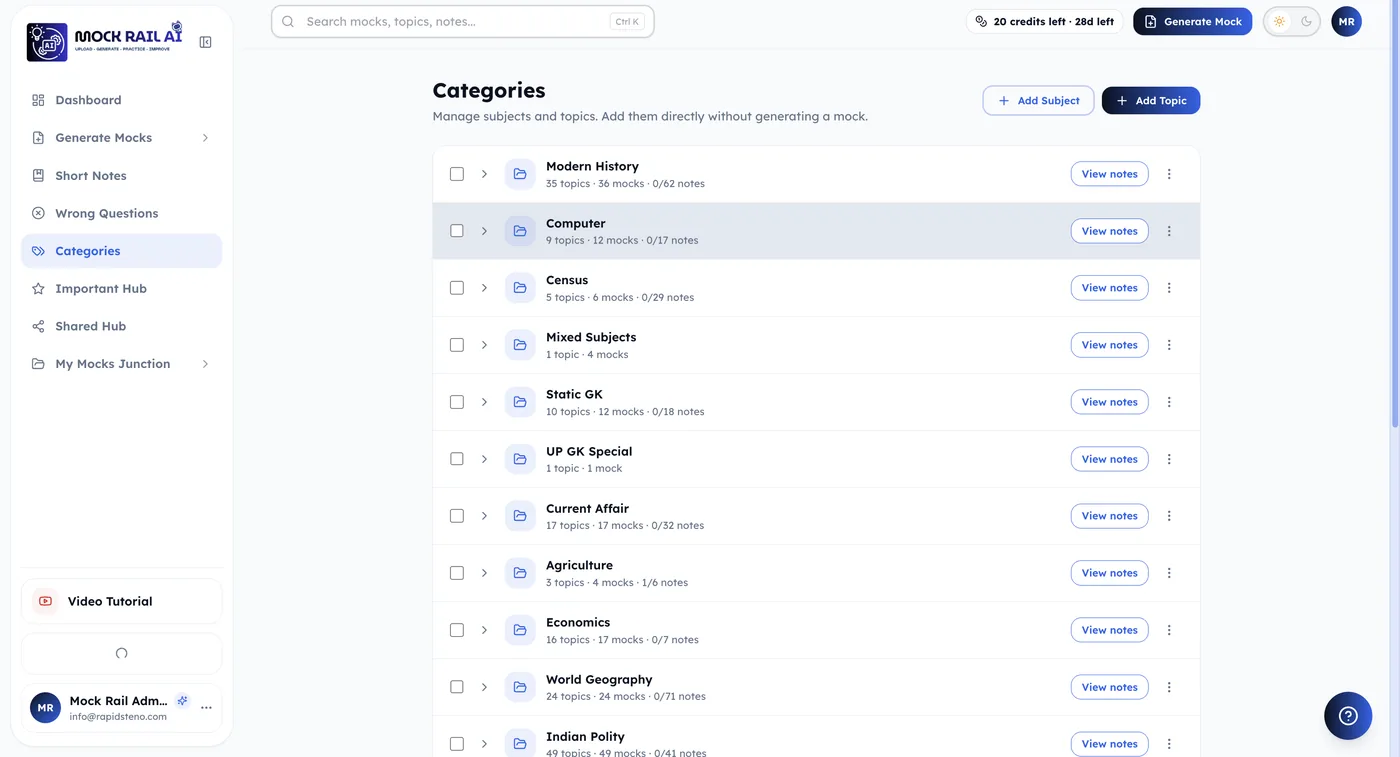
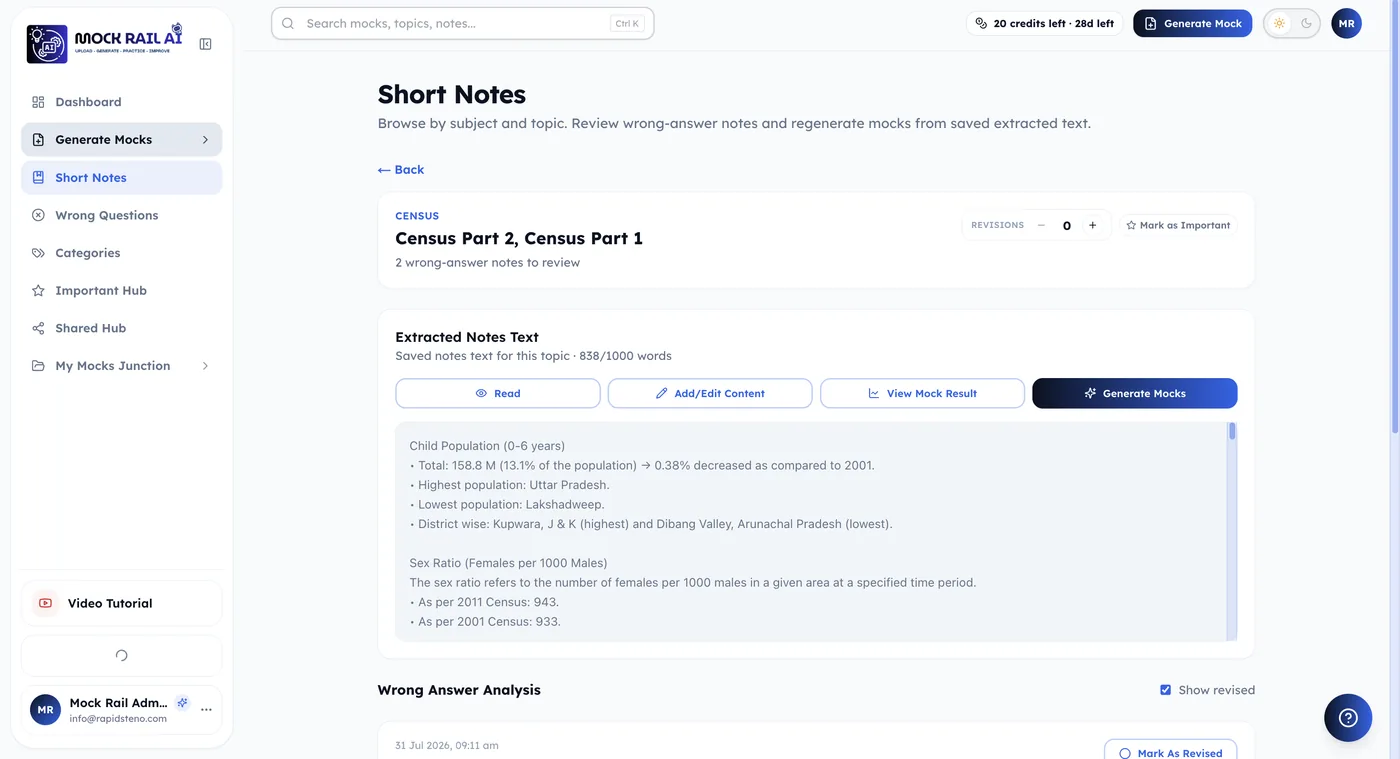
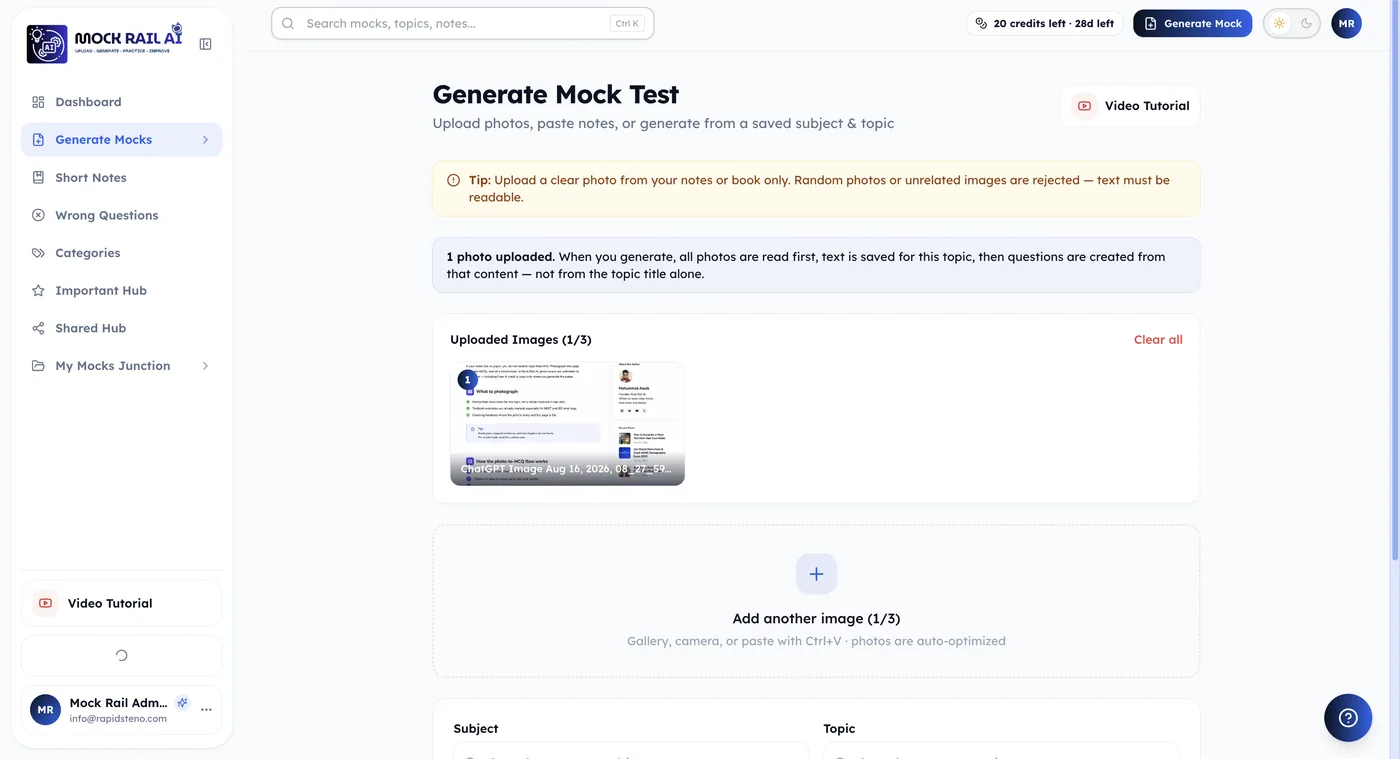
- Add your material. Three routes into the same place. Paste a chapter of typed notes or text copied from a coaching PDF. Upload a photo of your handwritten register page — combine two or three photos if the topic runs across pages. Or pick a topic you have already saved in Short Notes and rebuild from it without uploading again.
- Set question count, time and difficulty. For one chapter, 10 questions is the sweet spot. Preview a few sample questions free before you commit a credit — if the preview looks thin, go back and improve the source rather than spending the credit.
- Attempt it properly. Countdown timer running, question palette open, mark-for-review on anything you are unsure of, and a real submit at the end. Do not check answers as you go. The pressure is the point.
- Revise every miss. Open Wrong Questions. Each mistake is already sorted by subject and topic. Build a shorter follow-up mock from those weak areas the next morning while the mistake is still fresh.
If you would rather watch it than read it, here is the whole process end to end:
Typed text, PDF, or a photo of handwritten pages
All three inputs work. They do not behave identically, and knowing the difference saves you credits.
| Input | Best for | What to watch |
|---|---|---|
| Pasted text | Typed notes, NCERT summaries, anything digital | Cleanest results. Strip page numbers and headers before pasting. |
| Coaching PDF text | Printed modules and handouts | Split by chapter. Pasting forty pages gives scattered, off-topic questions. |
| Photo of handwriting | Register pages, class notes, textbook spreads | One page per shot, flat, no shadow across the fold. Mixed Hindi–English is fine. |
| Saved short notes | Weekly revision across two or three chapters | No re-upload needed. Ideal before a coaching test. |
On the handwriting question specifically, because this is what most aspirants actually have: the OCR handles ordinary messy handwriting and the Hindi–English mix that fills most Indian notebooks. What genuinely hurts it is a shadow falling across the page gutter, a photo taken at an angle so the lines curve, and cramming two facing pages into one frame. Shoot straight down, one page at a time, under a tubelight rather than against a window.
How to read a weak question — and what it is telling you
Sometimes a generated question will be flat. Most people conclude the tool is not good. That is usually the wrong conclusion. A weak question is a diagnostic on your notes, not a defect in the paper. Read it that way and it becomes the most useful feedback you get all week.
| What you see | What it means | The fix |
|---|---|---|
| Three options are obviously wrong | The source line was too thin to build plausible distractors from | Expand that note into a full explanatory sentence and regenerate |
| The question quotes your note word for word | Your note was a fragment, so there was nothing to rephrase | Add the surrounding context and the "why", not just the fact |
| The answer is visible inside the question | Term and definition sat on the same line | Split them across separate lines in your notes |
| Questions drift off your syllabus | The upload covered too many topics at once | Scope to one chapter per generation |
| Every question is factual recall | Your notes are a list of facts with no reasoning | Add cause-and-effect lines: why it happened, what followed |
Aspirants who use the preview honestly for a week end up writing better notes by the second week. That side effect is arguably worth more than the mocks.
Match the mock to your exam pattern
A ten-question chapter mock is for daily revision. When you want the paper to feel like the real thing, set the count and timer to mirror your exam. Common patterns for reference:
| Exam | Questions | Time | Negative marking | Daily mock size |
|---|---|---|---|---|
| SSC CGL Tier 1 | 100 | 60 min | −0.50 | 10–15 per chapter |
| SSC CHSL Tier 1 | 100 | 60 min | −0.50 | 10–15 per chapter |
| RRB NTPC CBT 1 | 100 | 90 min | −1/3 | 10–20 per chapter |
| UPSC Prelims GS Paper 1 | 100 | 120 min | −1/3 | 10–15 per topic |
| IBPS / SBI PO Prelims | 100 | 60 min | −0.25 | 10–15 per section |
Always confirm the current pattern against the official notification for your exam year — commissions do revise question counts, timing and marking between cycles.
One counter-intuitive point worth making. Full-length papers feel productive, but for revision they are inefficient. A 25-question sprint on a single chapter, sat the same evening you studied it, moves your score more than a 100-question mock sat once a week. The reason is timing, not volume: you are testing while the material is still fresh enough to correct.
What happens after you submit
Generating the mock is the easy half. What actually moves your rank is the twenty minutes after you press submit, and this is where a proper AI mock test generator earns its place over a chat window.
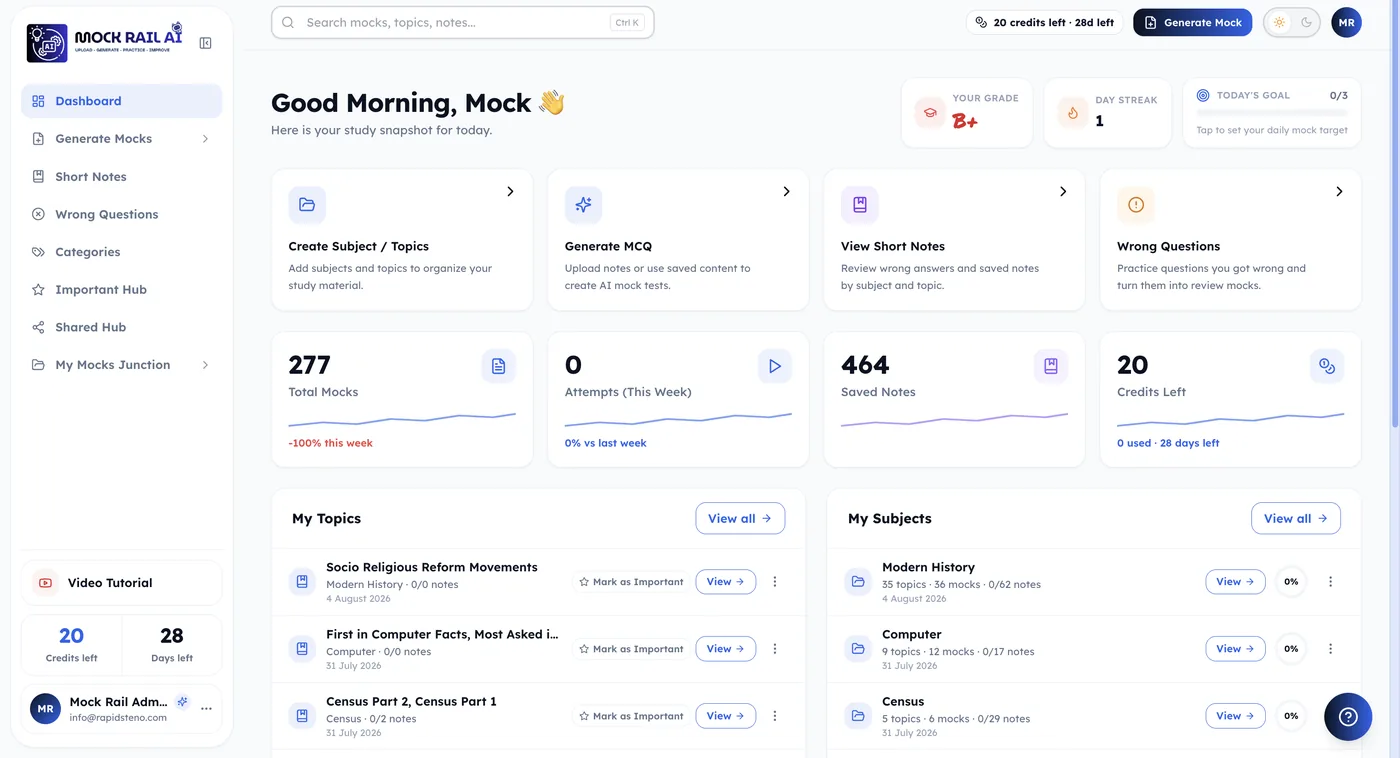
You get a report card first: score, accuracy, time taken, and a question-wise breakdown showing exactly where you went wrong. Then every incorrect answer is filed automatically into Wrong Questions, grouped by subject and topic — no copying into a separate error notebook, which is the step everyone promises to do and nobody sustains past week three.
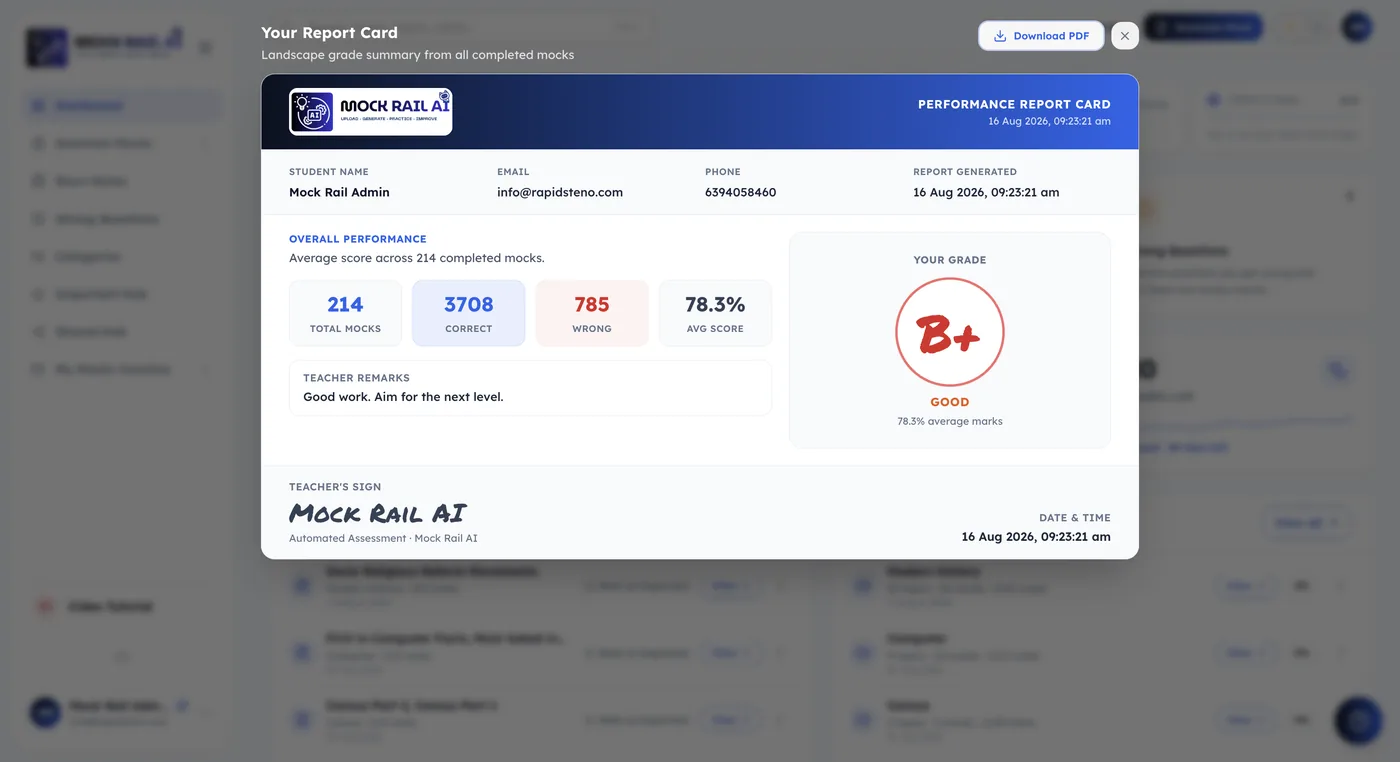
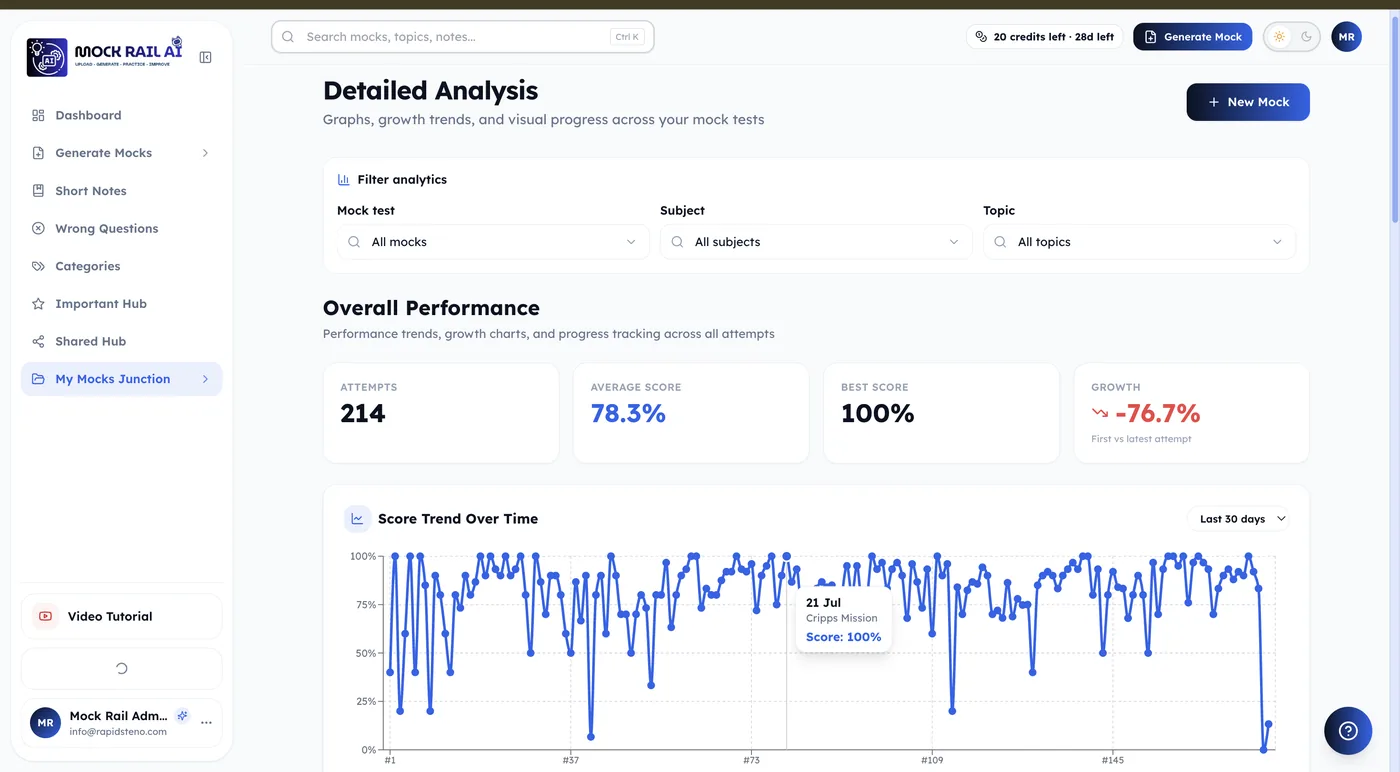
From there you can practise the same wrong questions until your accuracy improves, or turn the wrong-answer bank itself into a fresh mock. Mock Analysis tracks your score across every attempt on the same paper, so you can tell the difference between a topic that is genuinely improving and one that merely feels familiar now.
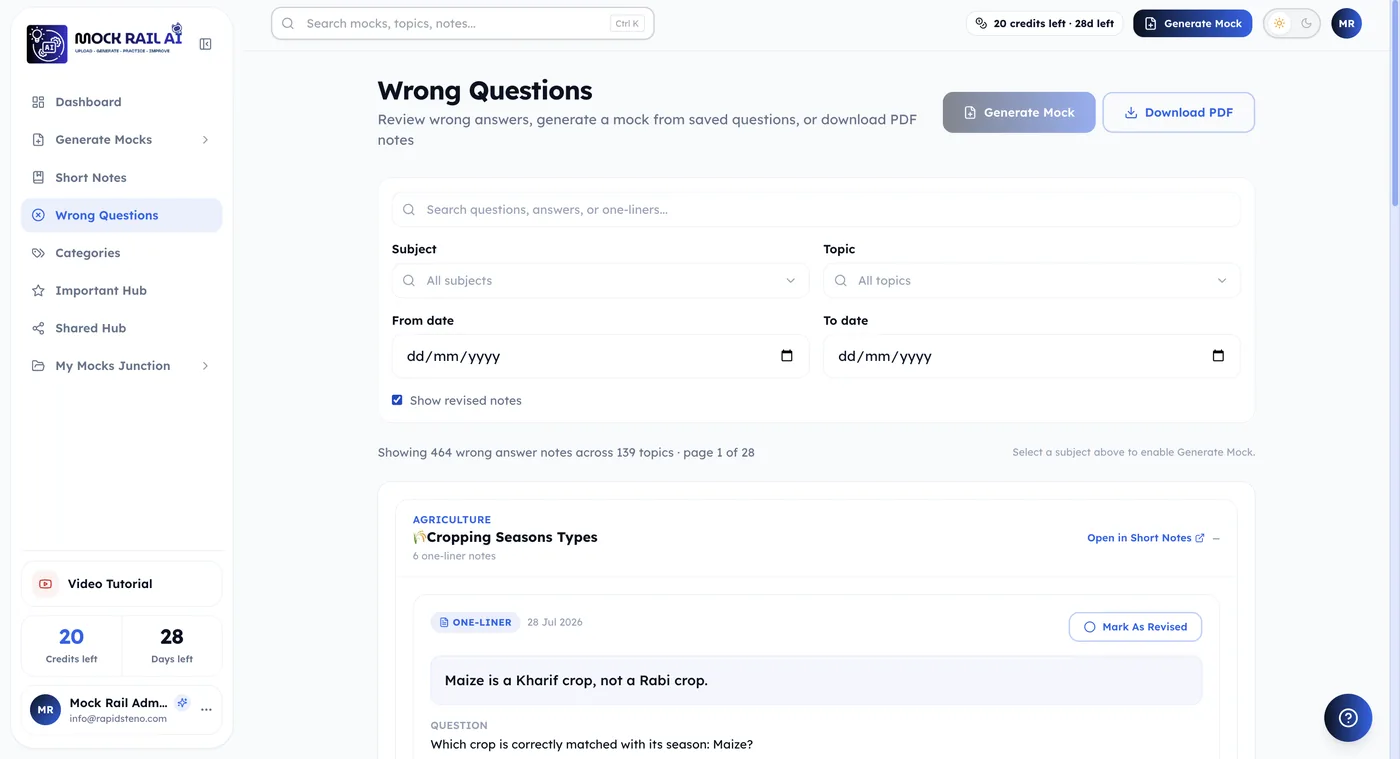
There is also a revision counter on every topic card, counting how many times you have genuinely revised that topic rather than just opened it. It is an uncomfortable number the first time you look at it, especially if you were convinced you had "done" Polity twice. Flag anything still shaky into the Important Hub so it is waiting for you in the final revision weeks instead of being rediscovered the night before Tier 1.
A 7-day notes-to-mock loop that actually sticks
Tools do not fix preparation. Routines do. This one fits around whatever study plan you already follow and costs about four credits a week — well inside the Free plan.
- Monday to Friday, after each session. Photograph or paste that day's chapter and generate a 10-question mock. Attempt it the same evening, before you sleep. Ten minutes total.
- Saturday. Open Wrong Questions and build one mock purely from the week's misses. This is the single highest-value paper you will sit all week — every question is something you have already got wrong once.
- Sunday. Check Mock Analysis. Look at which subjects are climbing and which are flat across attempts, then decide where next week's hours go. Star the flat ones into Important Hub.
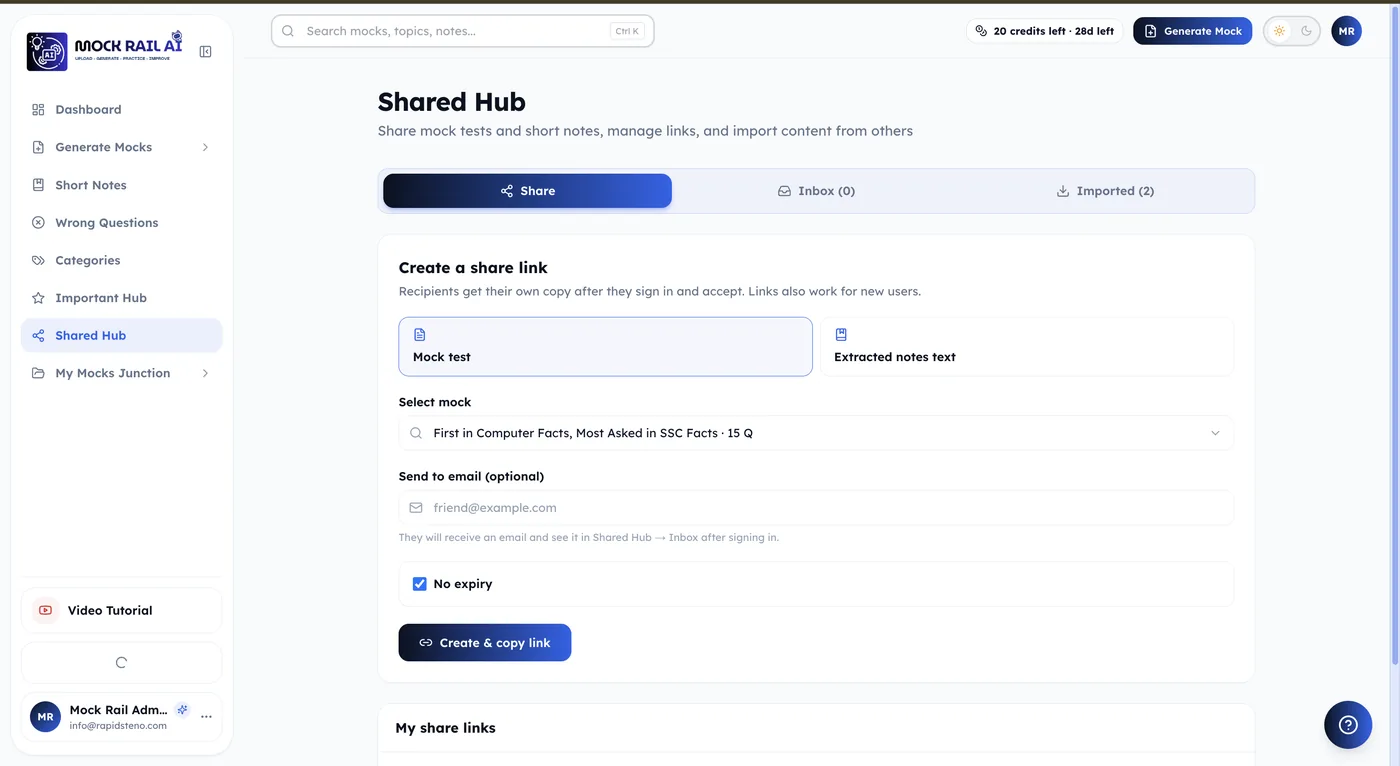
If you study in a group or a coaching batch, Shared Hub lets you swap saved notes and generated mocks directly, so four people covering four chapters end up with four papers each instead of one — without anyone forwarding PDFs on WhatsApp.
What it costs
Every plan includes the full app. You are only paying for how many AI mocks you generate each month — note scans, saved notes and retakes stay unlimited throughout.
| Plan | Price | AI mocks / month | Suited for |
|---|---|---|---|
| Free · Platform Rail | ₹0 | 5 | Trying it on one chapter |
| Lite · Passenger Rail | ₹99 | 20 | Light weekly revision |
| Starter · Local Rail | ₹199 | 50 | Regular daily practice |
| Pro · Express Rail | ₹399 | 120 | Full-time preparation |
| Max · Rajdhani Rail | ₹699 | 250 | Final months before the exam |
A 5–15 question mock uses 1 credit; 16–30 questions uses 2. If you run out mid-month, add-ons start at ₹49 for 10 mocks and fall to ₹3.29 per mock on the 100-pack, with your monthly allowance always used first. Full breakdown on the pricing page, and every feature is listed on the features page.
What aspirants say
"I photograph my register page after every class and generate a 10-question mock the same night. Two months in, my Polity accuracy went from 55% to 80%."
Vikas Yadav SSC CGL aspirant, Kanpur"My notes are half Hindi, half English. I assumed no app would read them. It reads them fine."
Sneha Patil RRB NTPC aspirant, Nashik"The Saturday mock built only from my wrong answers is the best hour of my week. Nothing else forces me to face the same mistake twice."
Md. Faizan Banking aspirant, Patna"Test series told me I scored 64. It never told me which of those were chapters I had not even opened. This does."
Kavya Nair UPSC aspirant, Kochi"Honestly it improved my note-making more than my scores at first. Weak questions showed me my notes were just arrows and short forms."
Deepak Kumawat State PSC aspirant, Jaipur"Four of us in the batch split chapters and share the mocks. Everyone gets four papers for the effort of one."
Ritika Bansal CTET aspirant, LudhianaFAQs: generating mock tests from notes
How do I generate a mock test from my notes?
Paste a chapter of notes, upload text from a coaching PDF, or photograph your handwritten register page in Mockrail AI. Choose how many MCQs you want, then generate. You get a timed exam-style paper, a score at the end, and every wrong answer saved by subject and topic. The whole loop takes about ten minutes.
Can I generate a mock test from handwritten notes in Hindi?
Yes. Photograph the page and upload it. Mockrail AI reads handwritten register pages, including the mixed Hindi and English most aspirants actually write. Keep the page flat, well lit and shadow-free, and shoot one page per photo for the cleanest questions.
If I wrote the notes myself, won't I already know the answers?
No. You supplied the material, not the questions. The three wrong options are written for you and you cannot predict them. And recognising a line in your notebook is very different from recalling it under a timer with four plausible choices — that gap is exactly what a mock is meant to expose.
How many questions should one mock test have?
For daily revision from one chapter, 5 to 15 questions works best and uses 1 credit. Larger mocks of 16 to 30 questions use 2 credits and suit full-unit revision. Save 100-question full-length papers for weekend practice, not for testing a single night's study.
Does uploading or scanning notes use my monthly mock credits?
No. Scanning and saving notes into Short Notes is unlimited and free on every plan, including Free. A credit is only used at the moment you generate a mock. Previewing sample questions before that is free, and retaking a mock you already generated never costs a credit.
Can I generate a mock test from a coaching PDF?
Yes. Copy the text from the PDF and paste it in, or photograph the pages if it is a scanned handout. Split long modules by chapter rather than pasting forty pages at once — a narrower source produces sharper, more exam-like questions.
Is there a free way to generate mock tests from notes?
Yes. The Free plan gives you 5 AI mock generations a month plus the full app, with unlimited note scans and unlimited retakes. No credit card is needed to sign up and generate your first paper. Paid plans start at ₹99 a month for 20 mocks.
How is this different from asking ChatGPT to make MCQs?
ChatGPT writes questions in a chat window. There is no countdown timer, no question palette, no mark-for-review, no score history, and no record of what you got wrong last Tuesday. Mockrail AI runs the full exam and revision loop, and keeps your notes organised by subject and topic instead of scattered across chats. We tested seven ChatGPT mock test prompts and published what each one scored out of 10.
Can I retake a mock test I already generated?
Yes, as many times as you want, on every plan including Free. Retakes never use a credit, which makes spaced repetition affordable. Mock Analysis compares your score across attempts on the same paper so you can see whether a weak topic is genuinely improving.
Which exams does this work for?
Any exam built on four-option MCQs. Aspirants use it for SSC CGL, CHSL and MTS, RRB NTPC and Group D, UPSC Prelims, IBPS and SBI banking exams, state PSC prelims, CTET and police recruitment. Because the paper is built from your notes, it follows your syllabus rather than a fixed publisher bank.
Start with one chapter tonight
Do not plan a system. Take the chapter you studied today, photograph it or paste it, and generate ten questions. Attempt them before you sleep. Whatever you get wrong is already saved and waiting for you tomorrow morning.
That is the entire method. If you would rather just try it, the free mock test generator runs without an account. If you want the wider picture of how notes-based practice compares with question banks and chat tools, read our guide to the mock test maker approach next — or, if you are sitting a specific paper, our Allahabad High Court RO ARO preparation guide.