This free mock test generator turns your own study material into an exam-style MCQ paper you can sit immediately. Paste a chapter of notes or upload a photo of a handwritten register page, choose how many questions you want, and you get four-option questions with a countdown timer and a score at the end. There is no question bank behind it — every paper is written from the material you supply, which is why a wrong answer here points at a line you have already read.
To generate a free mock test: paste your notes or upload a photo → choose 5, 10 or 15 questions → generate → attempt it under the timer → see your score and question-wise breakdown.
Cost: your first test is free to generate and free to take, with no account. A free account adds 5 generations a month, unlimited note scans, saved papers and wrong-answer tracking.
How the free mock test generator works
- Add your material. Paste typed notes or text from a coaching PDF, or photograph your register page. Around 300–500 words of source material produces the best results.
- Set the shape of the paper. Choose 5, 10 or 15 questions and a time limit. If you are rehearsing exam pace, match your section — most SSC papers now run 25 questions in 15 minutes.
- Generate and sit it. You get four-option MCQs written from your material, with a countdown running. No answer key visible until you submit.
- Read the breakdown. Score, accuracy and a question-wise view of what you got wrong — which is the part that actually changes your next study session.
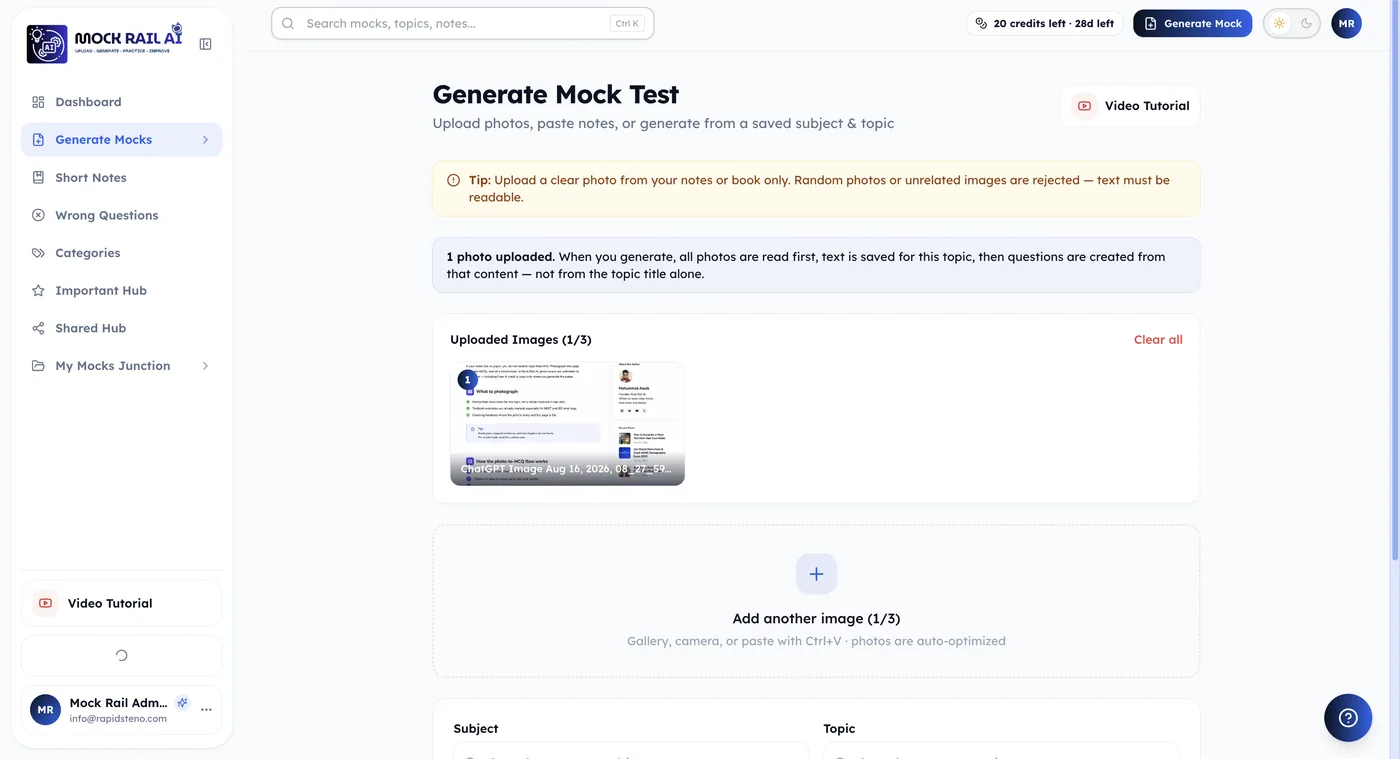
What you can generate a mock test from
| Input | Best for | What to watch |
|---|---|---|
| Pasted text | Typed notes, NCERT summaries, anything digital | Cleanest results. Strip page numbers and headers first. |
| Coaching PDF extract | Printed modules and handouts | Split by chapter — pasting forty pages gives scattered questions. |
| Photo of handwriting | Register pages, class notes, textbook spreads | One page per shot, flat, no shadow across the fold. Mixed Hindi–English is fine. |
The handwriting route is the one most aspirants actually need and the one general-purpose quiz tools handle worst. Photograph the page straight down, one page at a time, under a tubelight rather than against a window.
Built for Indian exam patterns, not generic quizzes
Most free quiz generators are built for teachers making a class worksheet. Indian competitive exams are a different problem: fixed question counts, locked section timing, and negative marking that punishes a wild guess. Set the generator to match your paper.
| Exam | Section shape | Per question | Negative marking |
|---|---|---|---|
| SSC CGL Tier 1 | 25 questions / 15 min per section | 36 sec | −0.50 |
| SSC CHSL Tier 1 | 25 questions / 15 min per section | 36 sec | −0.50 |
| SSC Stenographer | Reasoning 50 / GA 50 / English 100 | 36 sec | −0.25 |
| RRB NTPC CBT 1 | 100 questions / 90 min | 54 sec | −1/3 |
| UPSC Prelims GS 1 | 100 questions / 120 min | 72 sec | −1/3 |
Always confirm the current pattern against the official notification for your exam year — commissions revise question counts, timing and marking between cycles. But the practice principle holds: a 25-question set against a real 15-minute clock teaches you something a leisurely 100-question paper hides completely.
How this differs from a generic AI quiz generator
There are plenty of free quiz makers online. Most are built for a teacher producing a class worksheet, and they are perfectly good at that. They are a poor fit for someone preparing for SSC, RRB, UPSC or a state PSC paper, for four specific reasons.
| What an aspirant needs | Generic quiz generator | This generator |
|---|---|---|
| Reads handwritten register pages | Text and PDF only, or unreliable OCR | Photo upload, including mixed Hindi–English |
| Exam-section timing | Untimed, or a generic countdown | Set count and minutes to match your section |
| Plausible wrong options | Often one obvious answer | Distractors drawn from the same topic |
| Attempt discipline | Answers visible as you go | No answer key until you submit |
| Built for | Teachers, classrooms, general study | Indian competitive-exam aspirants |
The difference that matters most is the last row. A worksheet tool optimises for producing questions quickly. An exam aspirant needs the opposite: questions that are hard in the specific way the real paper is hard, sat under the specific time pressure the real paper applies. Recognising a fact in your notebook and answering it in thirty-six seconds against four plausible options are genuinely different skills, and only the second one is being tested.
The other honest difference is what this tool is not. It has no question bank, so it cannot hand you a ready-made full-length paper with an All-India Rank. For that, attempt the free full-length mocks the big test-series platforms publish — they are genuinely worth sitting. Use this when you want to test the chapter you finished an hour ago, which is the thing a ready-made paper cannot do.
What makes a generated question good — or flat
If a generated question comes out weak, the tool is usually telling you something about your notes rather than failing. The rule in one line: notes written to jog your memory produce weak questions; notes written to explain produce strong ones.
| What you see | What it means | The fix |
|---|---|---|
| Three options obviously wrong | Source line too thin to build plausible distractors from | Expand that note into a full explanatory sentence |
| Question quotes your note word for word | The note was a fragment, so there was nothing to rephrase | Add the surrounding context and the "why" |
| Answer visible inside the question | Term and definition sat on the same line | Split them across separate lines |
| Questions drift off your syllabus | The upload covered too many topics at once | Scope to one chapter per generation |
Around 500 words of full-sentence notes reliably yields 12 to 15 usable MCQs. The same content reduced to arrows and short forms yields roughly half that, and the questions are noticeably flatter.
What you get after you submit
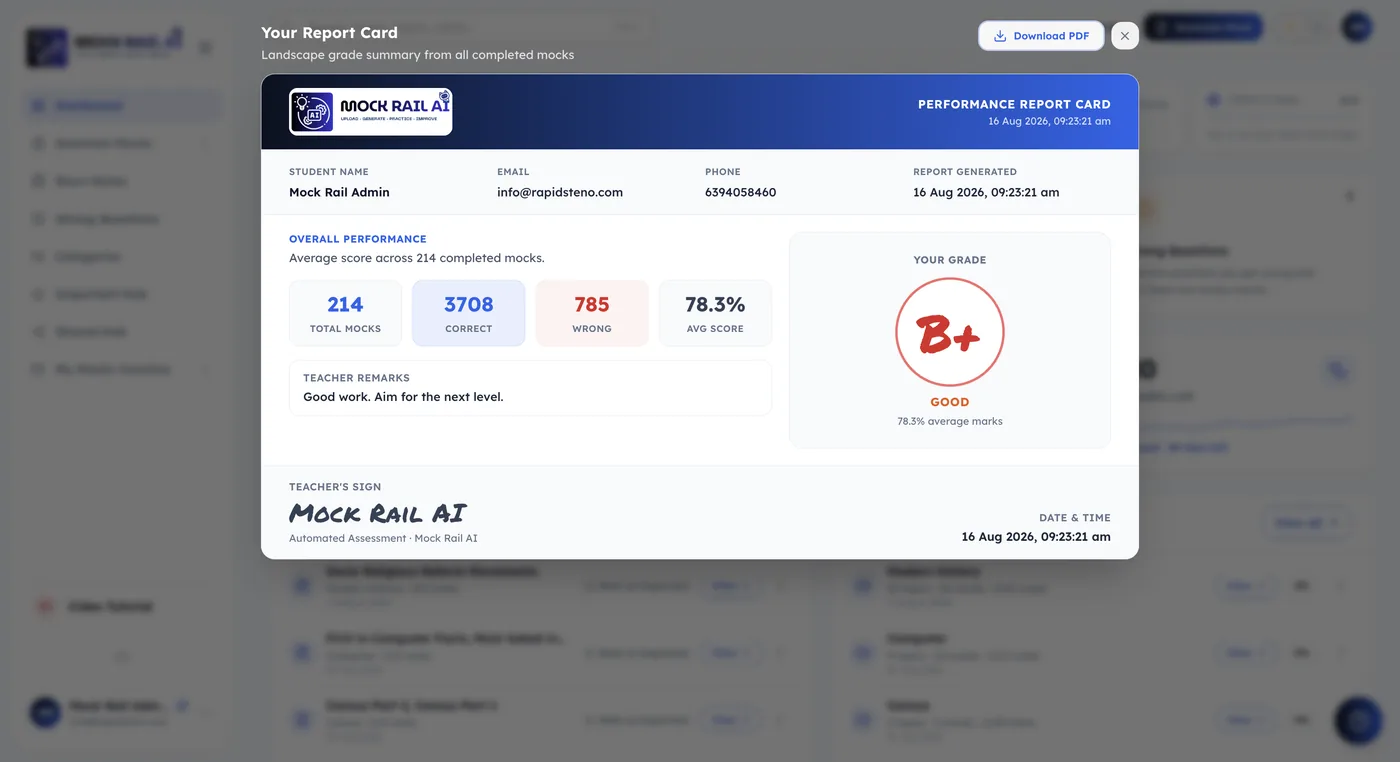
The paper is the easy half. What moves your score is the twenty minutes afterwards. On the free anonymous run you get your score, accuracy and a question-wise breakdown straight away.
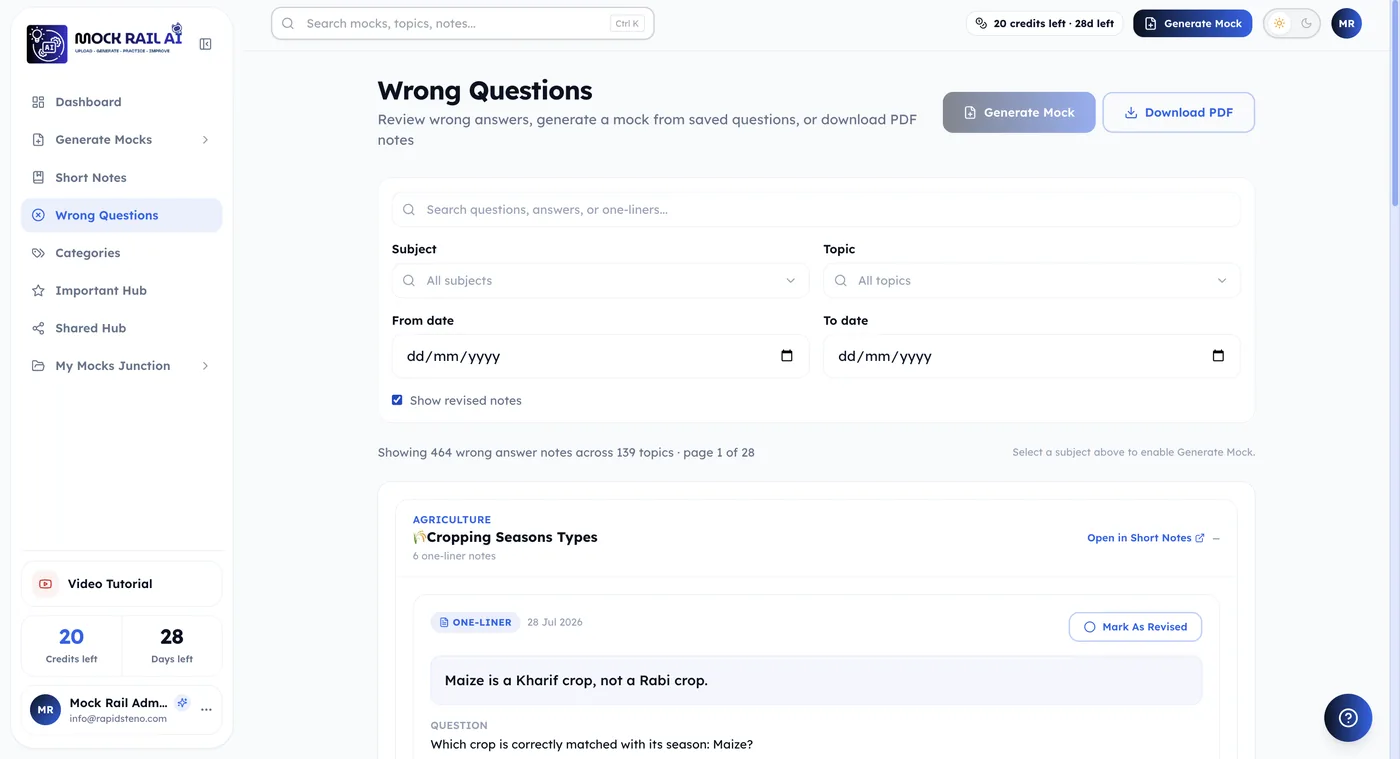
Create a free account and the loop closes properly: every wrong answer files itself by subject and topic into a Wrong Questions hub, Mock Analysis compares your score across attempts on the same paper, and a revision counter per topic tells you which chapters you keep skipping. Retakes never cost a credit, which is what makes spaced repetition affordable rather than theoretical.
Free, and what a free account adds
| No account | Free account | |
|---|---|---|
| Generate a mock from notes or a photo | Yes | Yes |
| Attempt it under a timer | Yes | Yes |
| Score and question-wise breakdown | Yes | Yes |
| Generations per month | One free run | 5 AI mocks |
| Paper saved for later | No | Yes |
| Unlimited retakes | No | Yes |
| Wrong Questions by subject and topic | No | Yes |
| Note scans stored | No | Unlimited |
Paid plans exist for heavier use — ₹99 for 20 mocks a month, ₹199 for 50, ₹399 for 120 and ₹699 for 250 — but note scans and retakes stay unlimited on every plan including Free. Full details on the pricing page.
Free mock test generator FAQs
Is this mock test generator really free?
Yes. You can generate a mock test and attempt it without creating an account, without a card and without an email address. Your first test is free to generate and free to take. Creating a free account afterwards adds 5 AI mock generations a month, unlimited note scans, saved papers and wrong-answer tracking.
Do I need to sign up to generate a mock test?
No signup is required for your first mock test. Paste your notes or upload a photo, generate the paper and sit it straight away. You only need an account if you want the test saved, your wrong answers tracked across attempts, or more generations each month.
Can I generate a mock test from a photo of handwritten notes?
Yes. Upload a photo of your register page and the generator reads it, including the mixed Hindi and English handwriting most Indian aspirants actually write. Shoot the page flat, one page per photo, under even light and avoid shadow across the fold for the cleanest questions.
How many questions can the free mock test generator create?
You can choose 5, 10 or 15 questions on the free run, which suits one chapter of notes. On a free account a 5 to 15 question mock uses 1 credit and a 16 to 30 question mock uses 2, out of 5 generations a month.
Is this a question bank for SSC, UPSC or banking exams?
No, and that is deliberate. There are no pre-loaded questions. Every paper is generated from material you supply, so the questions follow what you have actually studied rather than a generic publisher set. That is why a wrong answer here points at a line you have already read.
Can I set exam-style timing and negative marking?
You can set the question count and the time limit to match your exam section, which is what most Indian competitive exams now test through sectional locks. SSC CGL and CHSL run 25 questions in 15 minutes per section, which works out to 36 seconds a question.
What makes a generated question good or bad?
The quality of the source notes decides it. Full explanatory sentences with names, dates and numbers produce sharp questions with plausible wrong options. Notes written as arrows and short forms produce flat questions, because there is nothing for the generator to build distractors from.
What happens to the notes I paste or upload?
Your material is used to generate your questions. On a free anonymous run nothing is stored against an account because there is no account. If you create a free account, notes you choose to save go into your Short Notes library so you can rebuild mocks from them later.
Preparing for a specific exam?
The generator works the same for any four-option MCQ paper, but these guides cover pattern, timing and what to practise for individual exams:
- SSC CGL — sectional timing and the qualifying Tier 1 trap
- SSC CHSL — why 10+2 level matters and CGL material misleads
- SSC Stenographer — CBT plus the shorthand skill test
- Allahabad High Court RO/ARO — UP GK and the qualifying typing test
- The method itself — how to turn any notes into a mock