You can generate a free SSC CGL mock test in about a minute — not from a stranger's question bank, but from the notes you actually studied. Paste a chapter or photograph your register page, set 25 questions and a 15-minute timer to match the real Tier 1 section, and sit it properly. That matters more in 2026 than it ever did, because SSC has locked each section to 15 minutes and made Tier 1 qualifying in nature. Both changes quietly break the way most aspirants have been practising.
To generate a free SSC CGL mock test from your notes: paste or photograph one topic → set 25 questions and 15 minutes → attempt it with the timer running → revise every wrong answer. The Free plan gives 5 AI mock generations a month, unlimited note scans and unlimited retakes, no card needed.
Tier 1 2026: 4 sections × 25 questions, 15 minutes each, 200 marks, 0.50 negative marking. That is 36 seconds per question, and time cannot be carried between sections.
What changed in SSC CGL Tier 1 for 2026
Two changes, and they interact.
| Section | Questions | Marks | Time | Per question |
|---|---|---|---|---|
| General Intelligence & Reasoning | 25 | 50 | 15 min | 36 sec |
| General Awareness | 25 | 50 | 15 min | 36 sec |
| Quantitative Aptitude | 25 | 50 | 15 min | 36 sec |
| English Comprehension | 25 | 50 | 15 min | 36 sec |
| Total | 100 | 200 | 60 min | −0.50 per wrong answer |
Sectional timing means each of those 15-minute blocks is locked. When it ends you move on, finished or not. And Tier 1 is reported as qualifying in nature — its marks are not carried into the final merit list, which is prepared from Tier 2.
Verify before you plan. The section lock and the qualifying status are both recent changes, which makes them exactly the figures secondary sites get wrong. Download the notification from ssc.gov.in and confirm the pattern and marking scheme for your cycle.
Do not build a study plan on any coaching website's summary — including this one.
The qualifying trap
Here is where aspirants get hurt, in both directions.
Read one: "Tier 1 is qualifying, so I just need the minimum." The minimum qualifying mark is 30 per cent for unreserved candidates, 25 for OBC and EWS, 20 for others. On 200 marks that is 60 for a General candidate. Aim for that and you will not clear.
Read two: "Tier 1 decides everything, so I must maximise it." Prep platforms reporting the 2023 cycle put the General cut-off in the region of 138 to 158 out of 200 depending on post, with OBC roughly 5 to 8 lower and SC or ST roughly 12 to 18 lower. Treat those as historical trend, not prediction — cut-offs move with vacancies and paper difficulty. But they tell you the real bar sits near 75 per cent, nowhere near 30.
Both readings are wrong, and the truth sits between them:
| What it means | What you should do | |
|---|---|---|
| Qualifying minimum | 30% for UR — the floor SSC sets | Ignore it. It is not the real bar. |
| Actual cut-off trend | Roughly 138–158 for General in a recent cycle | Target this, plus a 10–15 mark cushion |
| Marks above the cut-off | Discarded — not carried into merit | Do not spend months chasing them |
| Tier 2 marks | Decide your rank and your post | Where surplus hours belong |
The practical consequence is uncomfortable and worth sitting with. Once you are consistently scoring 15 marks clear of the trend cut-off in your practice, further Tier 1 improvement earns you nothing. Those hours are better spent on Tier 2, where every mark is permanent. Almost nobody plans this way, because test-series platforms report your Tier 1 score with a rank attached and it feels like progress.
What the 15-minute lock kills
If you have been preparing for more than a year, you built a tactic that no longer works. It went like this: race through General Awareness in six or seven minutes because it is pure recall, keep Reasoning tight, and pour the fifteen banked minutes into Quantitative Aptitude where the questions actually take working out.
That tactic is now impossible. Finish GA in six minutes and the remaining nine are simply gone.
| Habit | Old single clock | 2026 sectional lock |
|---|---|---|
| Rush GA, bank the time for Quant | The standard tactic | Impossible — time is forfeited |
| Leave Quant for last with spare time | Common | Quant gets 15 minutes, full stop |
| Practise only full 100-question papers | Adequate | Hides your per-section pace |
| Practise 25-question sets on a 15-min clock | Optional | Now the core drill |
| "Aim for 25 seconds a question" | Rough heuristic | Outdated — the real figure is 36 seconds, hard-capped |
That last row is worth calling out, because the 25-second rule of thumb still circulates widely in coaching notes and WhatsApp groups. It came from an era when you could allocate freely across a 60-minute paper. Under a locked section it is simply the wrong number, and pacing to it will leave you rushing questions you had time for.
Your practice unit is no longer the paper. It is the section.
Where your 15 minutes go, section by section
General Awareness — the surplus you can no longer spend
You either know it or you do not, so this section often finishes in eight minutes. Under the old pattern that surplus was your Quant budget. Now it evaporates. The only way to convert GA strength into marks is to be more accurate within GA itself — which means your own current-affairs and static notes matter more than a generic bank, because they are what you have actually revised.
Reasoning — the section that rewards pace practice
Most Reasoning questions are solvable inside 36 seconds once the pattern is recognised. The failure mode is getting stuck on two or three puzzle-type questions and losing six minutes. Practising 25-question Reasoning sets against a live clock teaches you to abandon a question at 45 seconds, which is a skill, not an attitude.
Quantitative Aptitude — where the lock actually bites
This is the section that used to absorb your banked time. At 36 seconds a question with working out required, selection discipline matters more than raw speed. Scan, pick the ten you can do quickly, secure them, then spend what remains on the rest. Attempting sequentially is how good Quant candidates end up leaving eight questions blank.
English Comprehension — the quiet scorer
Grammar, vocabulary and error spotting move fast if your basics are solid, which makes English the most reliable section to bank marks in. Comprehension passages are the risk — a long passage with four questions can eat five minutes. Read the questions first.
Negative marking at 0.50
A correct answer is worth 2 marks and a wrong one costs 0.50, so a wrong answer sets you back a quarter of what a right one gains. Run the expected value:
| Situation | Expected value | Decision |
|---|---|---|
| You know it | +2.00 | Attempt |
| Eliminated two options | +0.75 | Attempt |
| Eliminated one option | +0.33 | Attempt |
| Blind guess, four options | +0.125 | Marginal — and it costs seconds you need |
| Blind guess while panicking | Negative in practice | Skip and move |
Note how different this is from exams with no penalty at all — our Allahabad High Court RO/ARO guide covers a paper where leaving a blank is simply irrational. Here, discipline pays.
How to generate a free SSC CGL mock test from your notes
Four steps, about ten minutes, and most of that is you attempting the paper. Only step two uses a credit, and the Free plan gives you five a month.
- Add your material. Paste a chapter of typed notes or text from a coaching PDF, photograph your handwritten register page — mixed Hindi and English reads fine — or pick a topic you already saved in Short Notes.
- Set 25 questions and a 15-minute timer. That is the real Tier 1 section. Preview a few sample questions free before committing a credit; if the preview looks thin, improve the source rather than spending it.
- Attempt it under the clock. Countdown running, question palette open, mark-for-review on anything doubtful, and a real submit. No peeking at answers.
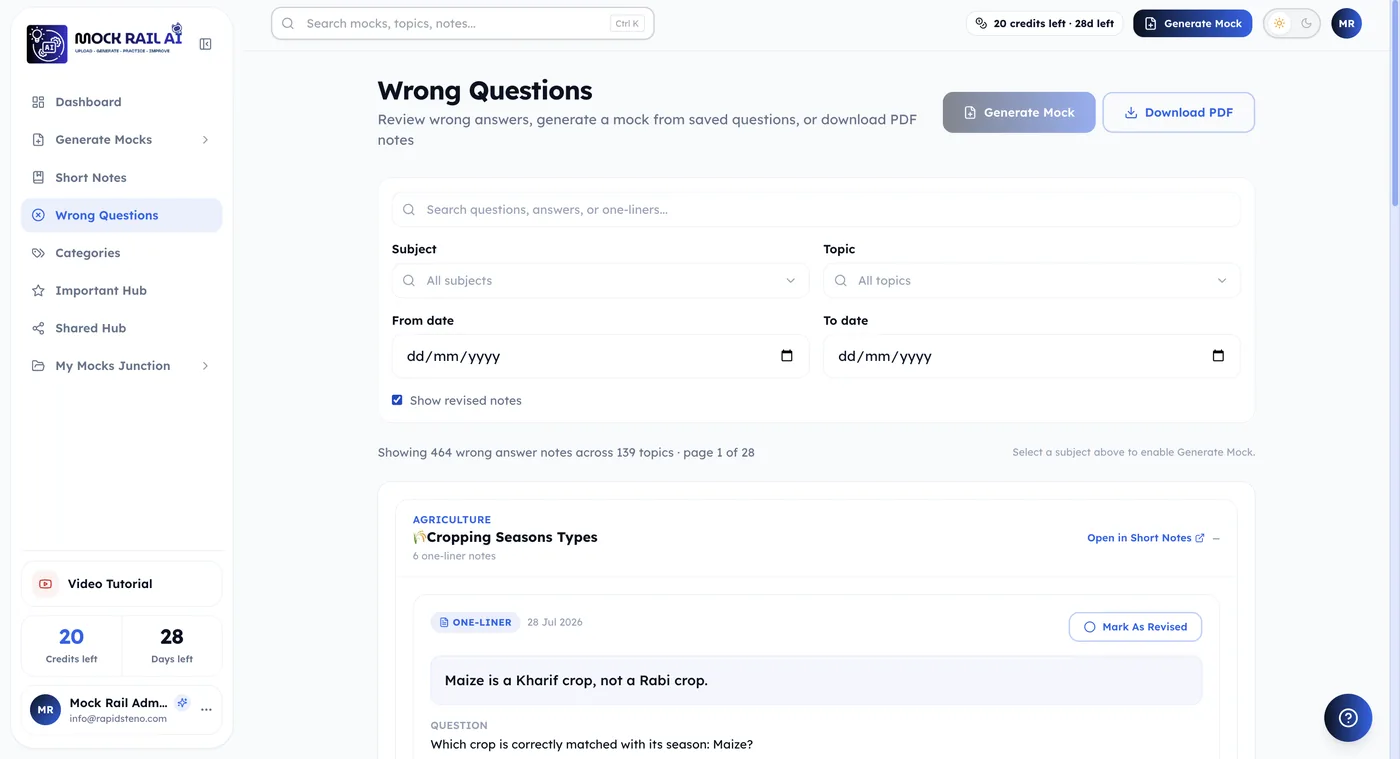
- Revise every miss. Wrong Questions files each mistake by subject and topic. Build a shorter follow-up mock from those weak areas the next morning.
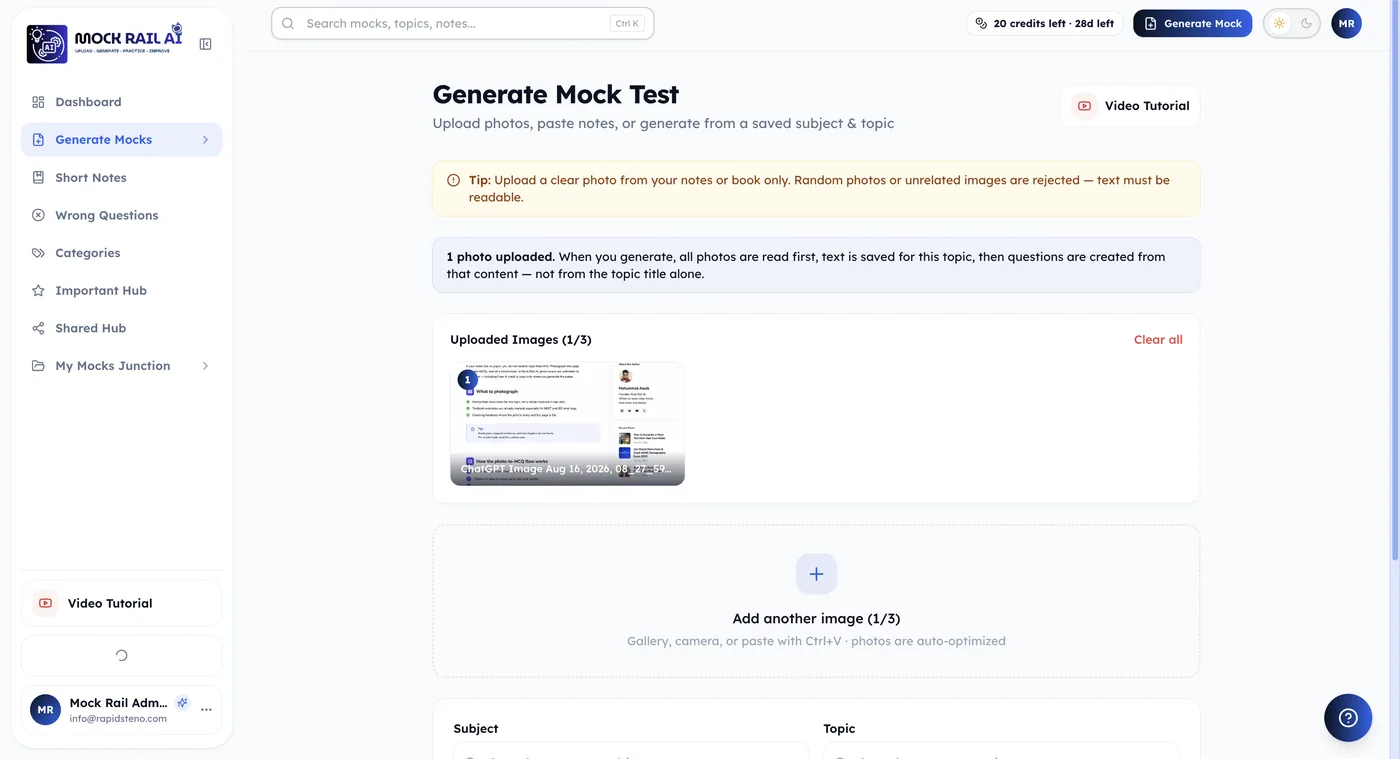
If you would rather watch than read, here is the whole loop:
How Mockrail AI fits SSC CGL preparation
Being straight about this: Mockrail AI is not an SSC CGL question bank. It has no pre-loaded CGL questions and never will. It builds the paper from what you give it. That is a limitation for some jobs and exactly the right tool for others.
| What you need | Use |
|---|---|
| Rehearsing the 15-minute section lock | Generate 25 questions, set a 15-minute timer, sit it in the exam-style layout with question palette and mark-for-review |
| Testing the chapter you studied tonight | 10 questions from that chapter only — 1 credit, ten minutes end to end |
| Current affairs that a bank cannot keep up with | Paste this week's GA notes and test yourself the same evening; note scans are unlimited and free |
| Handwritten register pages | Photo upload reads mixed Hindi and English — nothing needs retyping |
| The same Quant mistakes repeating | Wrong Questions saves every miss by subject and topic, then builds a mock from weak areas only |
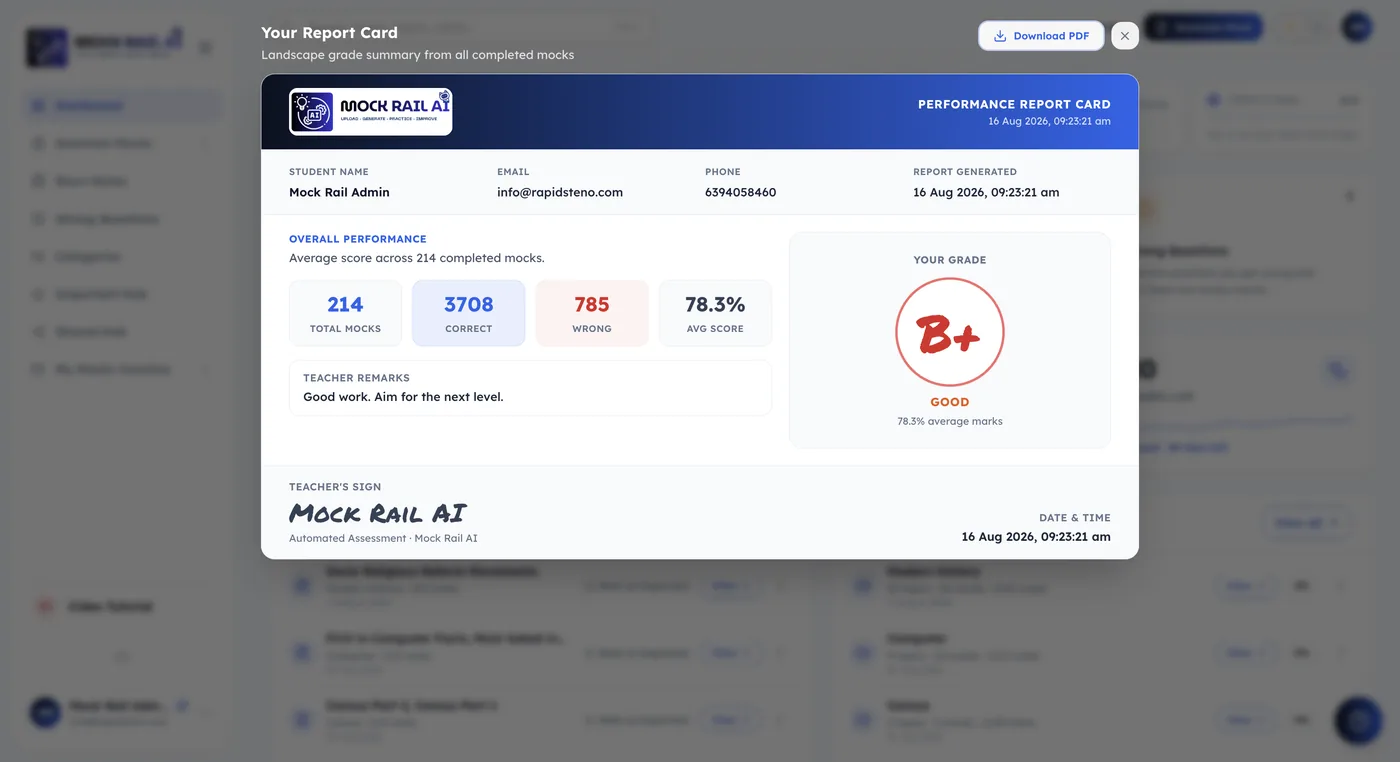
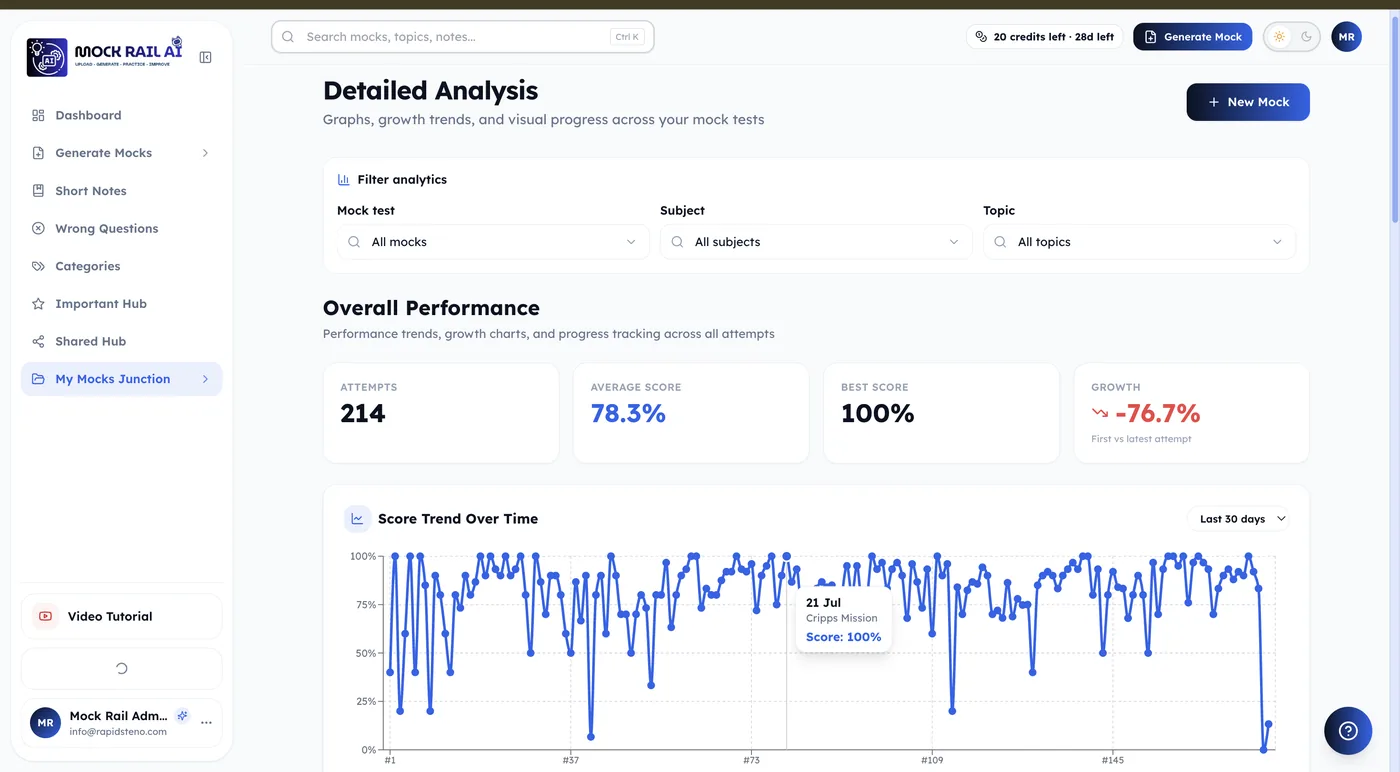
| Knowing whether a section is actually improving | Mock Analysis compares your score across attempts, not just the latest one |
| Re-sitting a paper you found hard | Unlimited retakes on every plan, including Free — retakes never cost a credit |
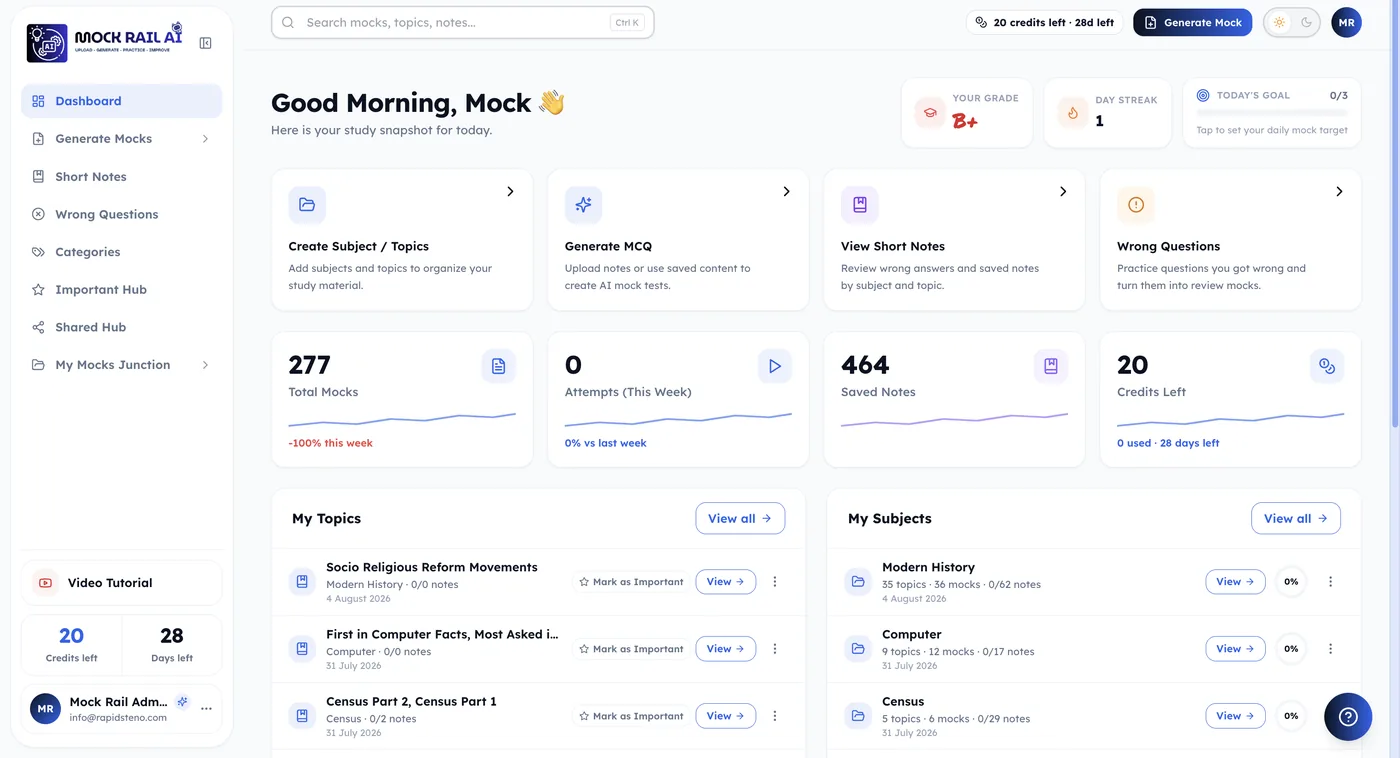
| Honest coverage tracking | Revision counter per topic, plus an Important Hub to flag chapters for the final fortnight |
| Splitting the syllabus with your batch | Shared Hub swaps notes and generated mocks between study partners |
| A full 100-question paper with All-India Rank | Not this — use a proper test series. The free mocks from the big platforms are genuinely worth attempting. |
That last row is the honest one. A ready-made series tells you where you stand against thousands of other candidates, and you should attempt those free full-length papers. What it cannot do is test the chapter you finished an hour ago, because the paper also covers topics you have not reached — which is why a low score there tells you very little.
On cost: the Free plan includes 5 AI mock generations a month with the full app, unlimited note scans and unlimited retakes. A 5–15 question mock uses 1 credit and 16–30 questions uses 2, so a daily chapter mock fits inside Free for about a week, and the ₹199 Starter plan at 50 mocks a month covers a serious Tier 1 run. Details on the pricing page and the full list on the features page.
A section-timed weekly routine
This costs about four or five credits a week, which fits inside the Free plan with room to spare.
| Day | What to do | Time |
|---|---|---|
| Mon–Fri | Study a chapter, then generate a 10-question mock from those notes and attempt it the same evening | ~10 min |
| Wed & Sat | One 25-question set from a single section against a 15-minute clock — rotate the section each time | ~20 min |
| Saturday | One mock built purely from the week's Wrong Questions | ~15 min |
| Sunday | A full-length paper from a test series, then check Mock Analysis for which sections are flat | ~90 min |
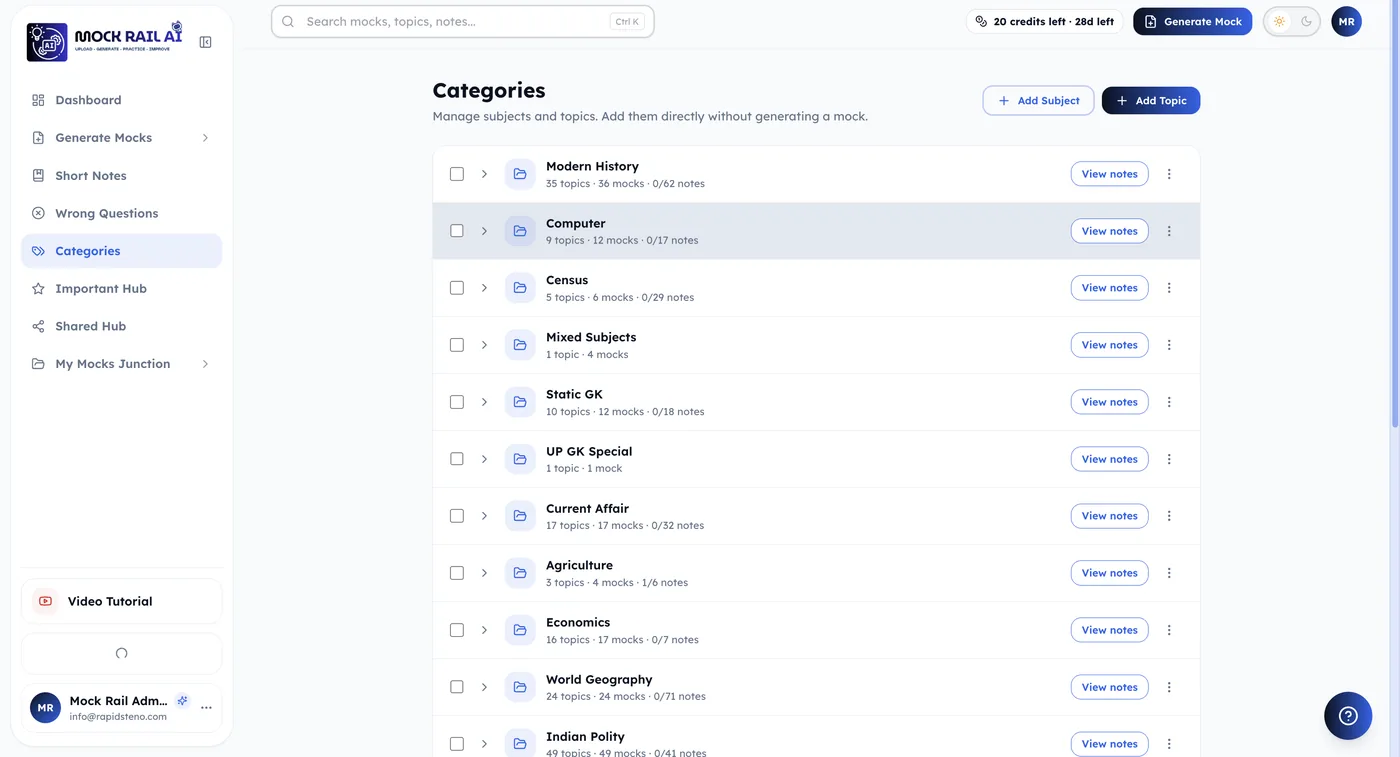
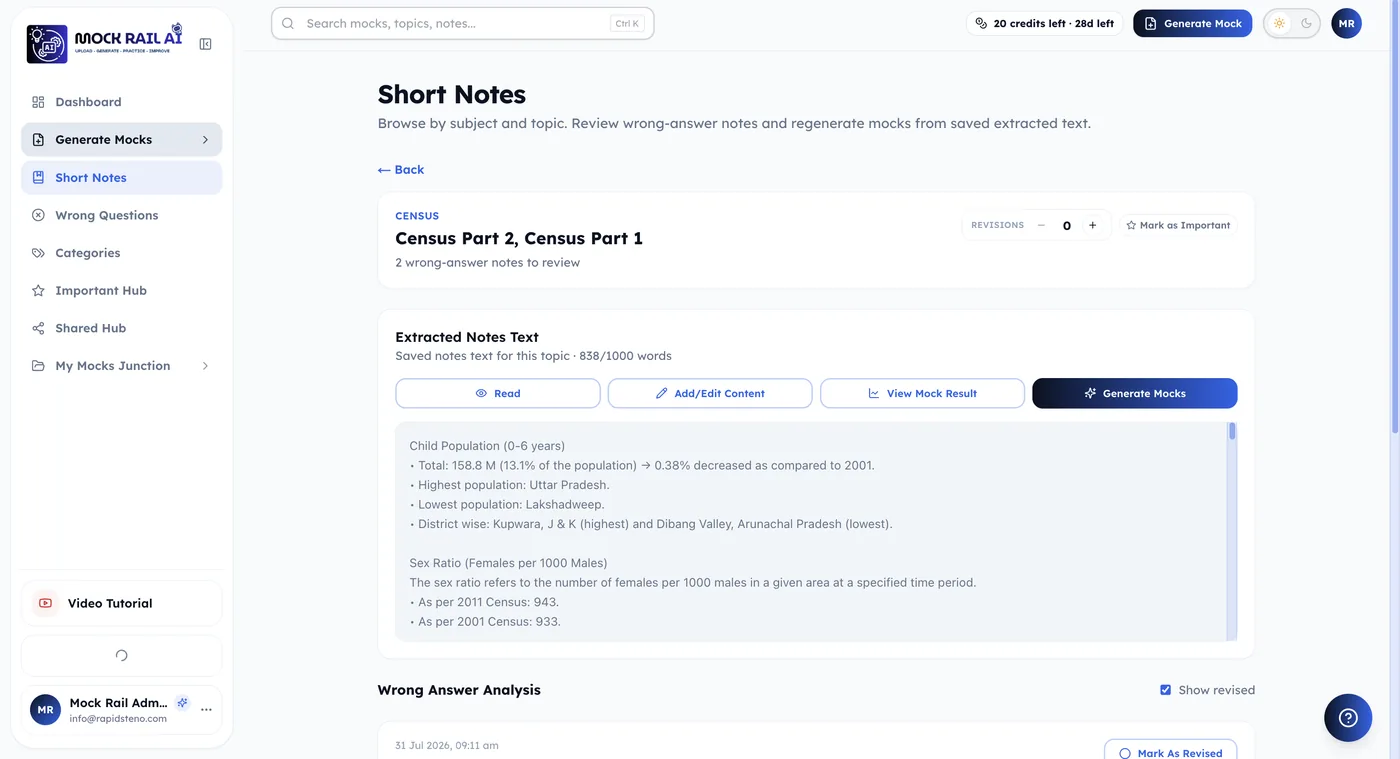
Keep the syllabus organised as it grows — subjects mirroring the four Tier 1 sections, topics nested underneath, and a revision counter that quietly tells you which chapters you keep skipping.
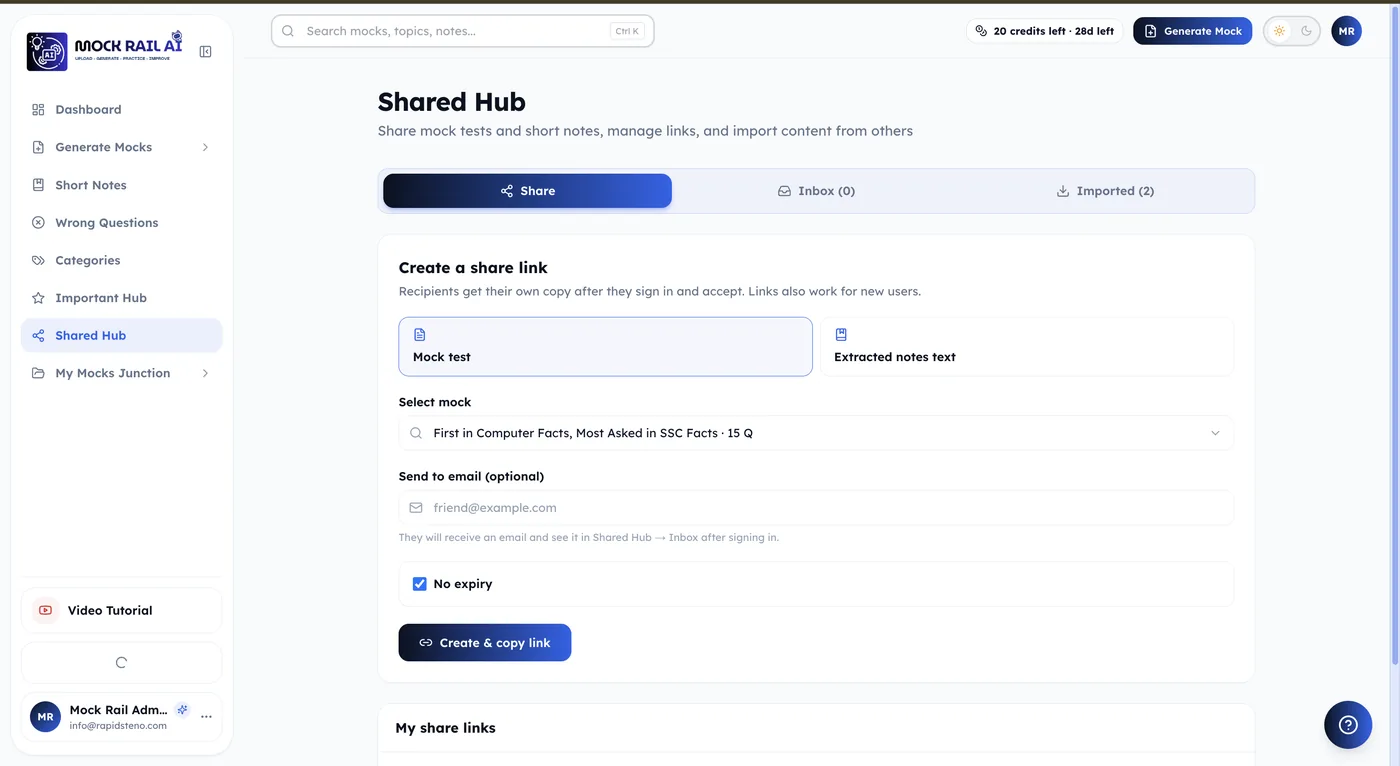
If four of you are preparing together, Shared Hub lets you split four chapters and swap the mocks, so everyone ends the week with four papers for the effort of one.
What aspirants say
"I had built my whole strategy on banking time from GA into Quant. Sectional timing broke it and I had no idea until I sat a 25-question set on a 15-minute clock."
Rakesh Meena SSC CGL aspirant, Jaipur"Nobody told me Tier 1 marks do not go into the merit list. I spent two months pushing 155 to 170 for nothing."
Divya Nambiar SSC CGL aspirant, Thrissur"Generating a free mock from the chapter I studied that night is the habit that finally stuck. Ten minutes, done before I sleep."
Ankit Raj SSC CGL aspirant, Patna"Test series told me I scored 142. It never told me that forty of those wrong answers were chapters I had not opened yet."
Shruti Deshpande SSC CGL aspirant, Pune"My current affairs notes go stale faster than any bank can update. Pasting them in and testing the same week solved that."
Manish Solanki SSC CGL aspirant, Indore"The 25-seconds-per-question advice everyone repeats is just wrong now. It is 36, and the section closes on you."
Zoya Parveen SSC CGL aspirant, HyderabadSSC CGL mock test FAQs
Can I generate a free SSC CGL mock test?
Yes. Mockrail AI lets you generate a free SSC CGL mock test from your own notes — paste a chapter or photograph your register page, set 25 questions and a 15-minute timer, and you get an exam-style paper with a score and every wrong answer saved. The Free plan includes 5 AI mock generations a month with unlimited note scans and unlimited retakes, and no card is needed.
What is the SSC CGL Tier 1 exam pattern in 2026?
Reported pattern is four sections of 25 questions each — General Intelligence and Reasoning, General Awareness, Quantitative Aptitude and English Comprehension — worth 50 marks per section, 200 marks in total. Each section is locked to 15 minutes for a 60-minute paper, with 0.50 negative marking. Confirm against the official notification at ssc.gov.in.
What does sectional timing change in SSC CGL Tier 1?
It removes time banking. You can no longer finish General Awareness in six minutes and pour the saved time into Quantitative Aptitude, because each section closes at 15 minutes whether you are finished or not. Every section works out to 36 seconds per question, and your practice unit is now the section rather than the full paper.
Do SSC CGL Tier 1 marks count in the final merit list?
Reported position is that Tier 1 is qualifying in nature and its marks are not carried into the final merit, which is prepared from Tier 2. That does not mean Tier 1 is easy — the qualifying minimum is 30 per cent for unreserved candidates, but the actual competitive cut-off has historically run far higher. Clear it with a cushion, then move your hours to Tier 2.
How many marks are safe in SSC CGL Tier 1?
Prep platforms reporting the 2023 cycle put the General category cut-off in the region of 138 to 158 out of 200 depending on post, with OBC roughly 5 to 8 marks lower and SC or ST roughly 12 to 18 lower. Treat these as historical trend and not a prediction, since cut-offs move with vacancies and difficulty each year.
Is there negative marking in SSC CGL Tier 1?
Yes, 0.50 marks are deducted for each wrong answer, against 2 marks for a correct one. That makes a blind guess a losing bet on average, but an educated guess after eliminating two options is still clearly worth attempting.
How do I practise SSC CGL sectional timing at home?
Stop sitting only full 100-question papers, because they hide your per-section pace. Generate a 25-question set from one section's notes and run it against a 15-minute countdown. Mockrail AI lets you set both the question count and the timer, so the section clock becomes a rhythm rather than a number you read about.
Is Mockrail AI an SSC CGL question bank?
No, and that is deliberate. It has no pre-loaded SSC CGL questions. It generates the paper from material you supply — pasted notes, a coaching PDF extract, or a photo of your handwritten register including mixed Hindi and English. That means the questions follow what you have actually studied rather than a generic publisher set.
How many questions should one SSC CGL practice mock have?
For sectional rehearsal, 25 questions against a 15-minute clock, because that is the real Tier 1 section. For testing one chapter you studied that evening, 10 questions is enough and uses a single credit. Save full 100-question papers for weekends, where the point is stamina rather than diagnosis.
Which is harder to manage under sectional timing, Quant or English?
Quantitative Aptitude, for most candidates. General Awareness is pure recall and often finishes inside eight minutes, but that surplus is now forfeited rather than transferred. Quant questions that need working out are the ones that overrun 36 seconds, so selection discipline inside the Quant section matters more than it ever did under a single clock.
Do this tonight
Two things. Confirm the pattern for your cycle on ssc.gov.in — the section lock and the qualifying rule are both recent, so check them rather than trusting any summary, ours included. Then take one section's notes, generate a free SSC CGL mock test of 25 questions, and run it against a real 15-minute clock. Whatever your actual pace turns out to be, better to learn it in August than in the exam hall.
You can also try the free mock test generator without signing up. For the mechanics, see how to generate a mock test from your notes, or the wider mock test maker guide. Preparing for more than one paper? We also cover SSC CHSL — same paper shape, but 10+2 level rather than graduate — plus SSC Stenographer and Allahabad High Court RO/ARO.