You can generate a free Allahabad High Court RO ARO mock test in about a minute from the notes you already have — paste a chapter or photograph your register page, set the question count and timer, and sit it properly. That fills the gap every ready-made RO ARO mock test leaves open: Uttar Pradesh GK, where national question banks are thinnest. With 543 posts reported for the 2026 cycle and no negative marking in the written paper, the strategy here is different from SSC or banking — and most aspirants prepare as though it were the same.
To generate a free Allahabad High Court RO ARO mock test from your notes: paste or photograph one topic → set the question count and timer → attempt it under the clock → revise every wrong answer. Free plan: 5 AI mock generations a month, unlimited note scans.
Written paper: 200 objective questions, 200 marks, 3 hours, no negative marking reported. Typing test: 50 marks, 20 minutes, minimum 25 WPM in English — qualifying, so failing it ends your candidature.
Where marks are actually lost: UP-specific GK, and the typing test that almost nobody practises until the last week.
The 2026 cycle at a glance
The Allahabad High Court recruits Review Officers, Assistant Review Officers and Computer Assistants together. Reported figures for the current cycle put the total at 543 posts across all three roles, with applications through the official portal at allahabadhighcourt.in.
It is worth understanding what the job actually is, because it shapes the paper. A Review Officer handles file examination, note-writing and drafting inside the court's administrative machinery. That is why the syllabus leans so heavily on language accuracy and computer skill rather than quantitative aptitude — this is not an SSC paper with a Maths section hiding in it.
Most candidates for this exam are also preparing for UPPSC RO/ARO. That overlap is genuinely useful and we will come back to it, but the two exams are not identical and you should not assume one notification's pattern applies to the other. If you are also looking at stenographer posts, our SSC Stenographer preparation guide covers that exam's sectional timing and skill test, and our SSC CGL guide covers its 15-minute section lock.
Exam pattern: what sources agree on
Start with what is consistently reported across sources. These are the figures you can build a study plan around.
| Stage | Format | Marks | Duration | Key condition |
|---|---|---|---|---|
| Written examination | 200 objective MCQs | 200 | 3 hours | No negative marking reported |
| Computer typing test | English passage typing | 50 | 20 minutes | Minimum 25 WPM · qualifying |
The written syllabus covers General Studies, General Science, History of India and the National Movement, Indian Polity and Economy, Geography, Current Affairs, General Aptitude and Reasoning, General Hindi, General English, Elementary Computer Knowledge, and Uttar Pradesh specific knowledge.
And what sources disagree on
We are going to be straight with you about something the other preparation sites gloss over. Published sources contradict each other on whether this exam has a descriptive Mains paper.
| Version | Stages described | Descriptive Mains? |
|---|---|---|
| Version A | Written exam → typing test | No |
| Version B | Prelims → Mains → computer test | Yes — 150 marks, 2 hours |
The Mains described in Version B breaks down as essay in English, precis writing, English-to-Hindi and Hindi-to-English translation, and comprehension. If that structure sounds familiar, there is a reason: it closely mirrors the UPPSC RO/ARO Mains pattern. Our reading is that some sites have carried the UPPSC structure across to the Allahabad High Court exam because the post names are identical.
Verify before you plan. Download the official notification from allahabadhighcourt.in and confirm the number of stages, marking scheme and whether a descriptive paper applies to your cycle. Commissions also issue corrigenda after the first notification.
Do not build a twelve-week plan on a coaching website's summary — including this one. We have told you exactly where the uncertainty is so you know what to check.
Practically, this matters less than it sounds. Writing practice for precis and translation improves your General Hindi and General English scores in the objective paper anyway, so the work is not wasted either way. We cover it further down as a conditional section.
No negative marking changes everything
If your notification confirms zero negative marking, this single fact should reshape how you sit the paper — and almost nobody adjusts for it.
In SSC CGL, a wrong answer costs you 0.50 marks, so leaving a question blank is often the correct decision. Here, a blank and a wrong answer are worth exactly the same: zero. Leaving any question unattempted is strictly irrational. Even a pure guess on four options carries a 25% expected return, and an educated guess after eliminating one option carries 33%.
Run the arithmetic on what that is worth. Twenty questions you would have skipped in a negative-marking exam, guessed blind, return around five marks. Eliminate one option on each and it is closer to seven. In a recruitment where thousands of candidates cluster within a few marks of each other, that is not a rounding error — that is a rank band.
| Situation | SSC-style (−0.50) | AHC RO ARO (no negative) |
|---|---|---|
| You know the answer | Attempt | Attempt |
| You eliminated two options | Attempt | Attempt |
| You eliminated one option | Marginal | Always attempt |
| You have no idea | Skip | Always attempt |
UP GK: the section that decides your rank
Uttar Pradesh specific knowledge is typically worth around 15 to 20 questions. On paper that looks small. In practice it is where the scoring gap opens up, for one simple reason: every candidate has studied Polity and Modern History, but UP GK preparation is wildly uneven.
It is also the section where national question banks let you down. A generic GK test series is built for candidates across India, so it cannot afford to spend much space on Bundelkhand geography, UP government schemes, or the judicial history of the Allahabad High Court itself. Compile this yourself:
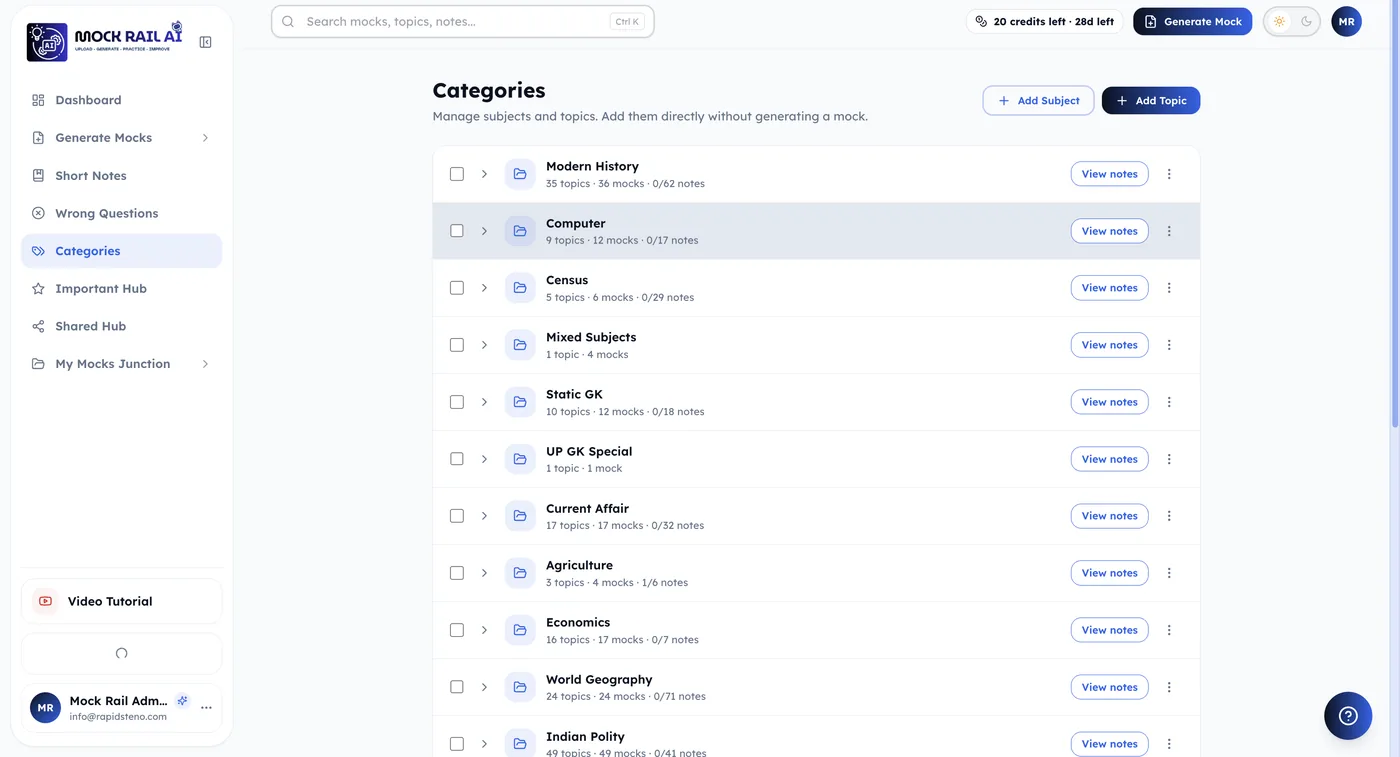
- UP geography — rivers, districts, agricultural zones, mineral belts, national parks.
- UP history and culture — dynasties, freedom-movement events on UP soil, folk arts, fairs, GI-tagged crafts.
- State polity and administration — divisions, current officeholders, panchayati raj structure in UP.
- Judicial history of UP — establishment of the High Court, the Lucknow Bench, notable milestones. Directly relevant to this recruiter.
- Current state schemes — anything launched in the last 12 months, with the department attached.
Keep this as one growing set of notes under a single subject, and test yourself on it weekly rather than reading it repeatedly. Reading UP GK feels productive and retains badly; being asked about it retains well.
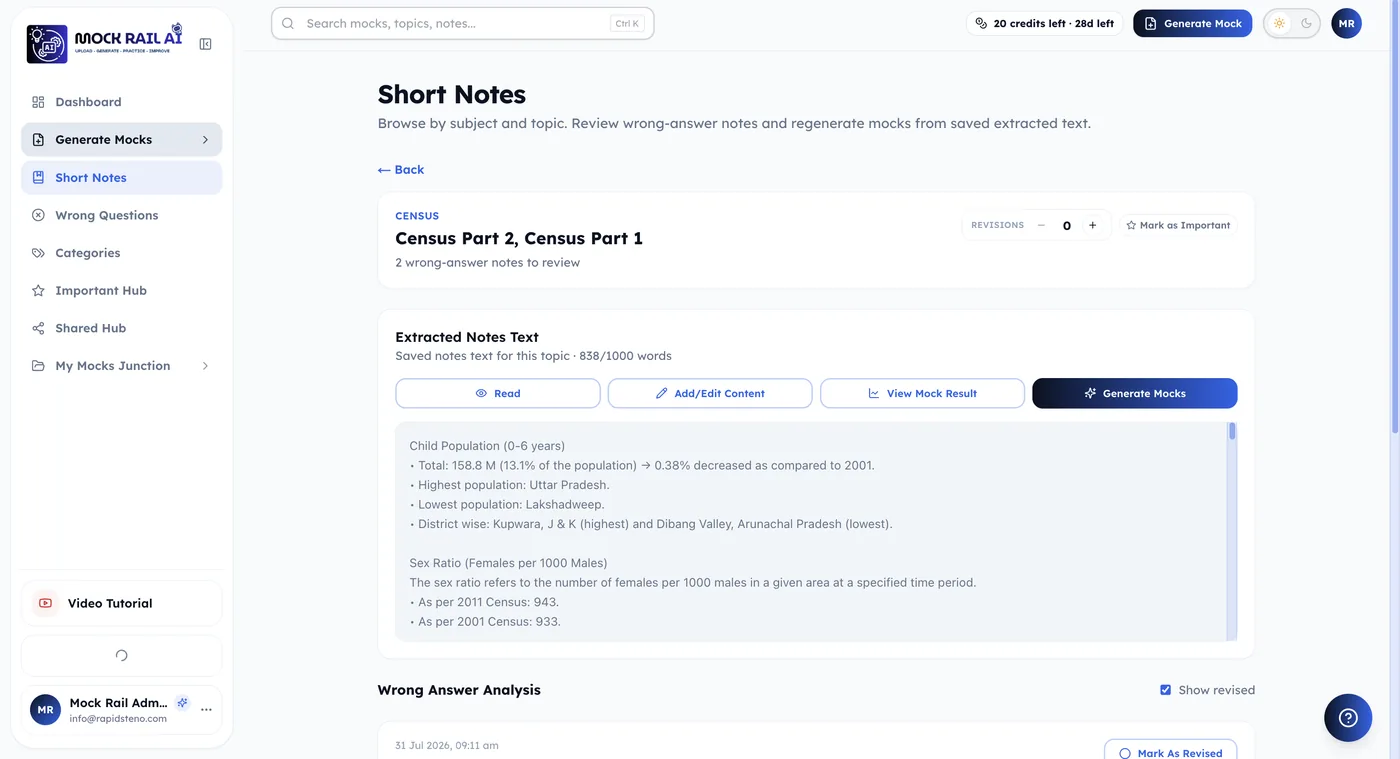
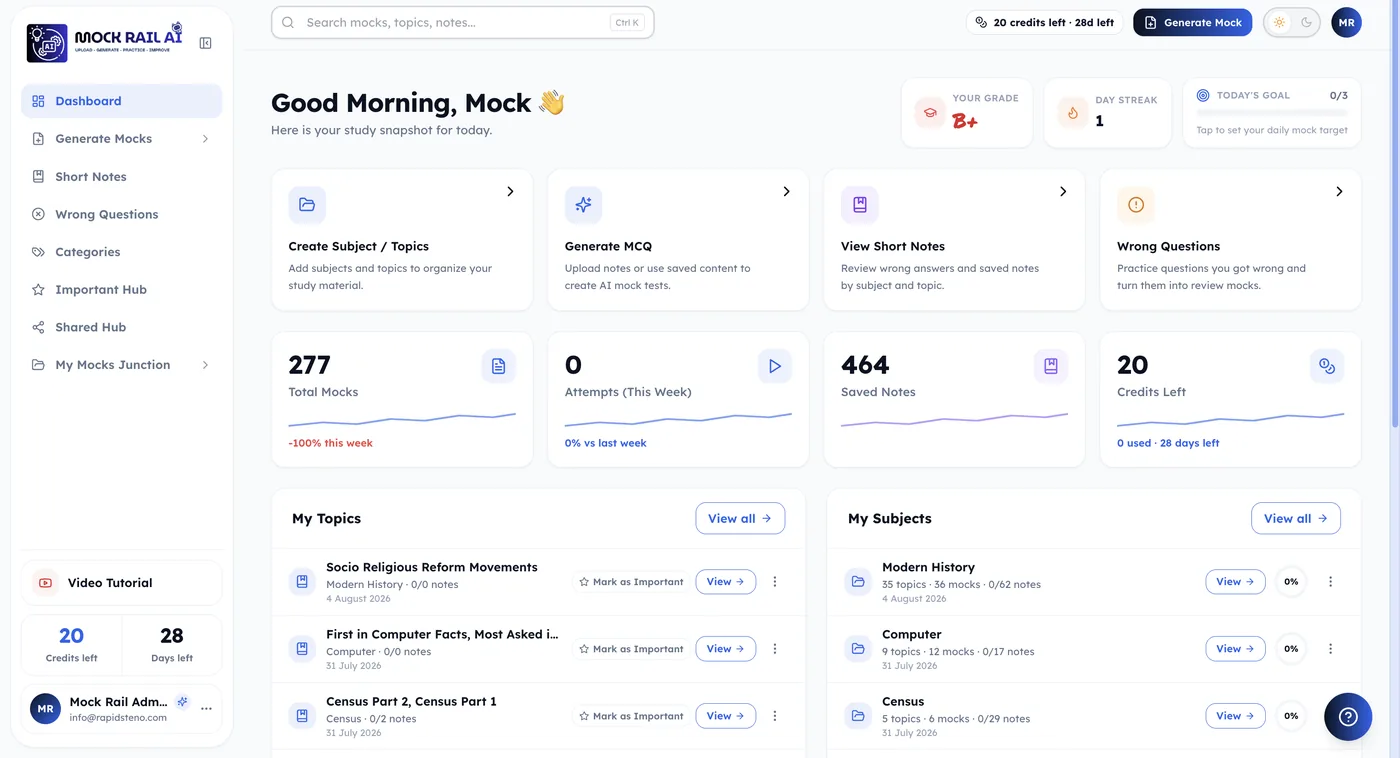
This is the practical use case for Mockrail AI on this exam. Photograph the UP GK pages of your register or paste in your typed notes, save them under a UP GK subject, and generate a fifteen-question mock from them every Sunday. Scanning is unlimited and free on every plan, so you can build the library all month without spending a credit — you only spend one when you actually generate a paper.
The typing test nobody prepares for
Fifty marks, twenty minutes, minimum 25 words per minute in English — and it is qualifying. Score 190 in the written paper and fail this, and your candidature ends there.
Twenty-five WPM is not fast. It is roughly one word every 2.4 seconds, which any regular computer user can reach. That is exactly why aspirants leave it until the final week, and exactly why some of them get an unpleasant surprise. Speed is not the problem — accuracy under a running clock is. Typing a passage you did not write, on an unfamiliar keyboard, with errors counting against you, is a different task from casual typing.
- Practise on a physical keyboard. Phone typing speed tells you nothing about this test.
- Fifteen minutes daily beats three hours on Sunday. This is muscle memory, not knowledge.
- Type unfamiliar passages, not the same paragraph repeatedly — you will only be memorising it.
- Target 35 WPM in practice so 25 stays comfortable under exam nerves.
Start this in week one alongside your reading. It costs fifteen minutes a day and removes an entire category of risk. If you want exam-style typing tests rather than a generic typing site, Rapid Steno runs RO/ARO, CA and LDC typing tests with per-mistake analytics — spelling, capitalisation and punctuation counted separately, the way an evaluator marks them.
If your cycle includes a descriptive Mains
Check your notification first. If a descriptive paper does apply, here is what actually needs practising — and note that no MCQ test series on the market can prepare any of it.
| Section | What it tests | Weekly practice target |
|---|---|---|
| Essay in English | Structure and argument in about 200 words | 2 essays, timed at 25 minutes each |
| Precis writing | Compression to roughly one third of the passage without losing meaning | 3 passages |
| English → Hindi translation | Register and accuracy, not word-for-word substitution | 2 passages |
| Hindi → English translation | Same, in reverse — usually the harder direction | 2 passages |
| Comprehension | Reading accuracy under time | 3 passages |
Two rules that save marks. For precis, the one-third length guideline is close to non-negotiable — going over it costs marks even when the content is good. For translation, do not fight to translate every technical or legal term; established convention allows retaining the term and marking it appropriately, and forcing an awkward equivalent reads worse than keeping it.
Self-checking descriptive answers is genuinely hard without a teacher. Two things help. Rapid Steno includes essay, letter and translation practice built for RO/ARO and PS/APS, which is the closest thing to structured descriptive drilling you will find outside a coaching class. And for a quick second opinion on a single answer, paste your precis and the original passage into a chatbot and ask what meaning was lost — we cover that technique in our guide to ChatGPT mock test prompts, where prompt 6 is built for exactly this feedback.
Allahabad High Court RO ARO mock tests: use the free ones first
Straightforward advice, and it does not point where you might expect. Adda247, Testbook, Safalta, Exampur and Toppersexam all publish free Allahabad High Court RO ARO mock tests, including full-length 200-question papers. Go and attempt those. They are built to the reported pattern, they are free, and sitting a full-length paper end to end is the only way to find out whether your stamina holds for three hours.
Then you hit the wall every serious aspirant hits. The free papers run out. The paid series repeats questions you have already seen. And crucially, none of it targets your weak topics — the UP GK notes you compiled, the computer-knowledge chapter you keep failing, the state schemes you read once in June.
That is the point where generating mocks from your own material earns its place. Paste your UP GK notes or photograph the register page, and generate a mock test from those notes — timed, four options, exam layout. Questions come from what you actually studied, so a wrong answer points at a line you have already read rather than a chapter you have not reached.
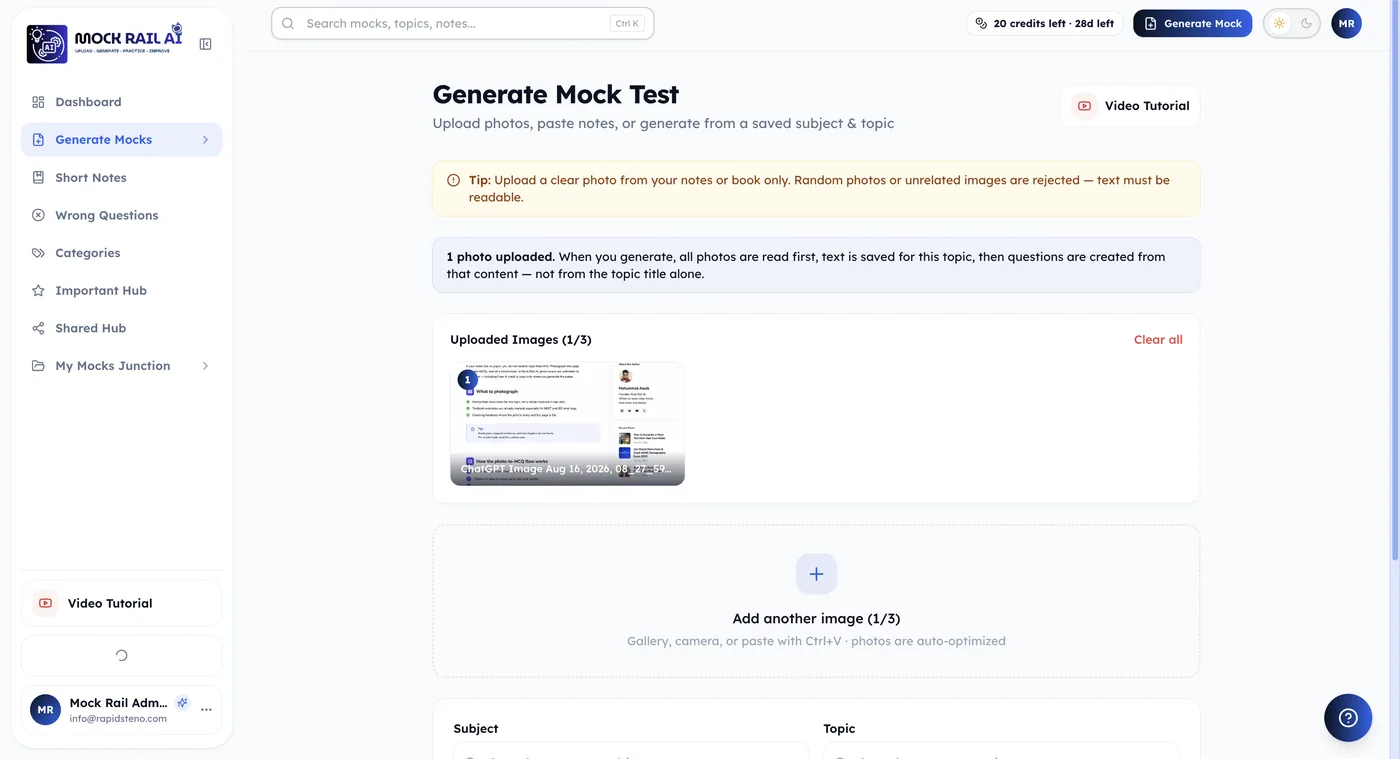
Here is the full process end to end:
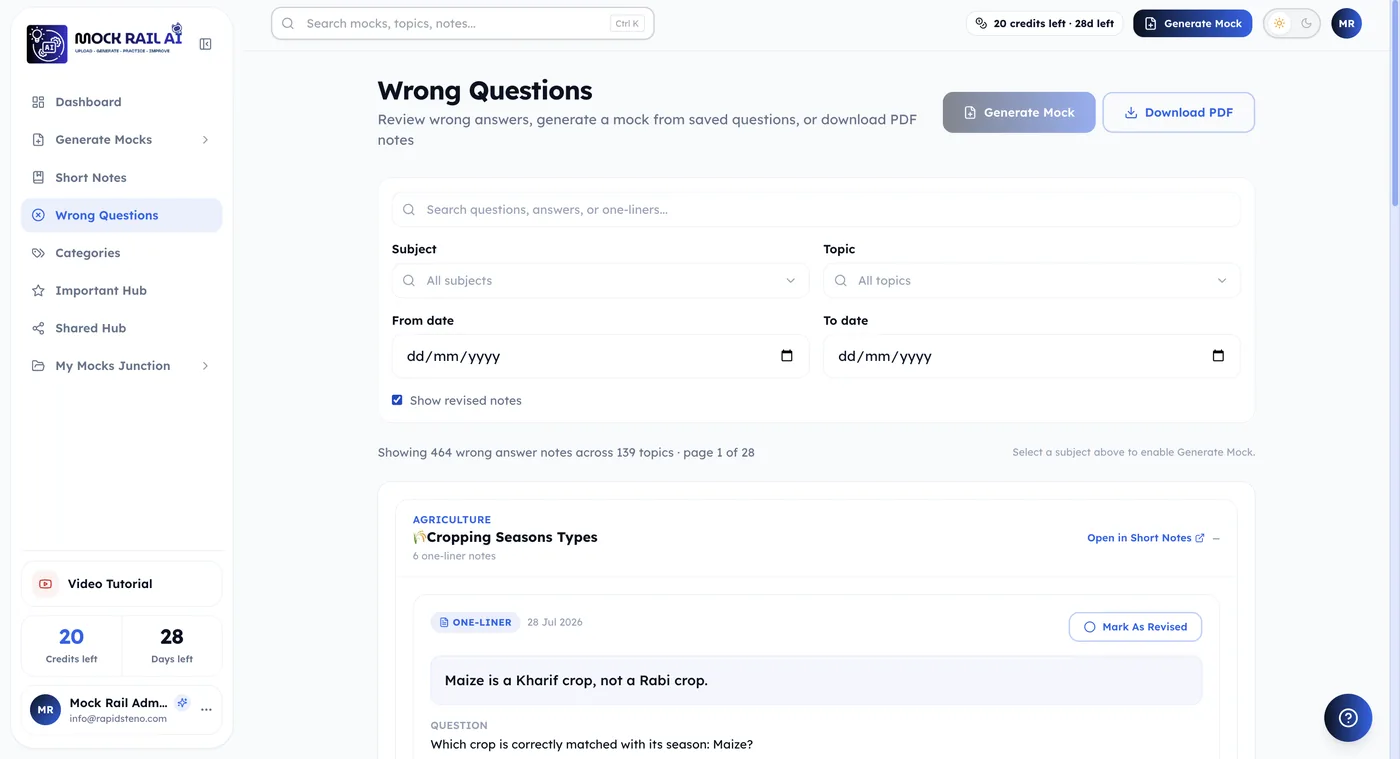
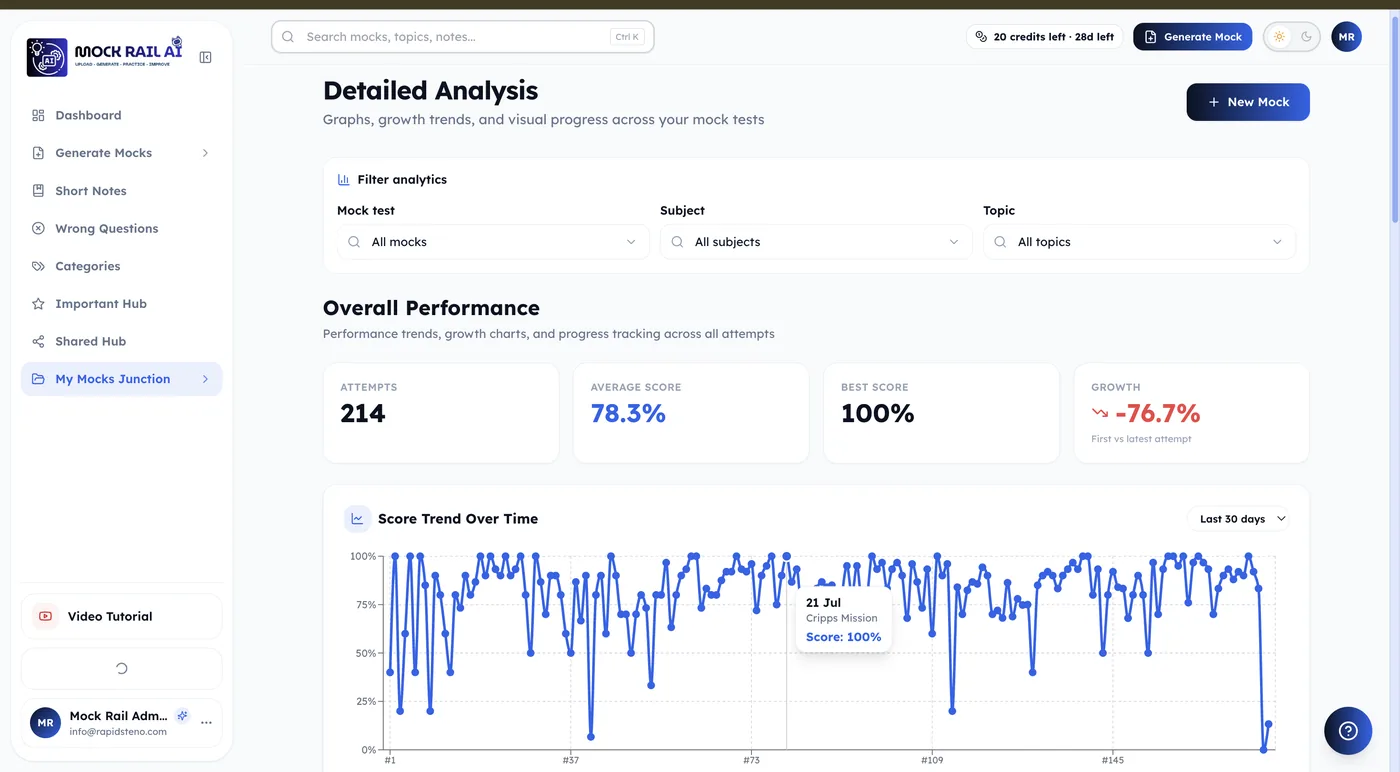
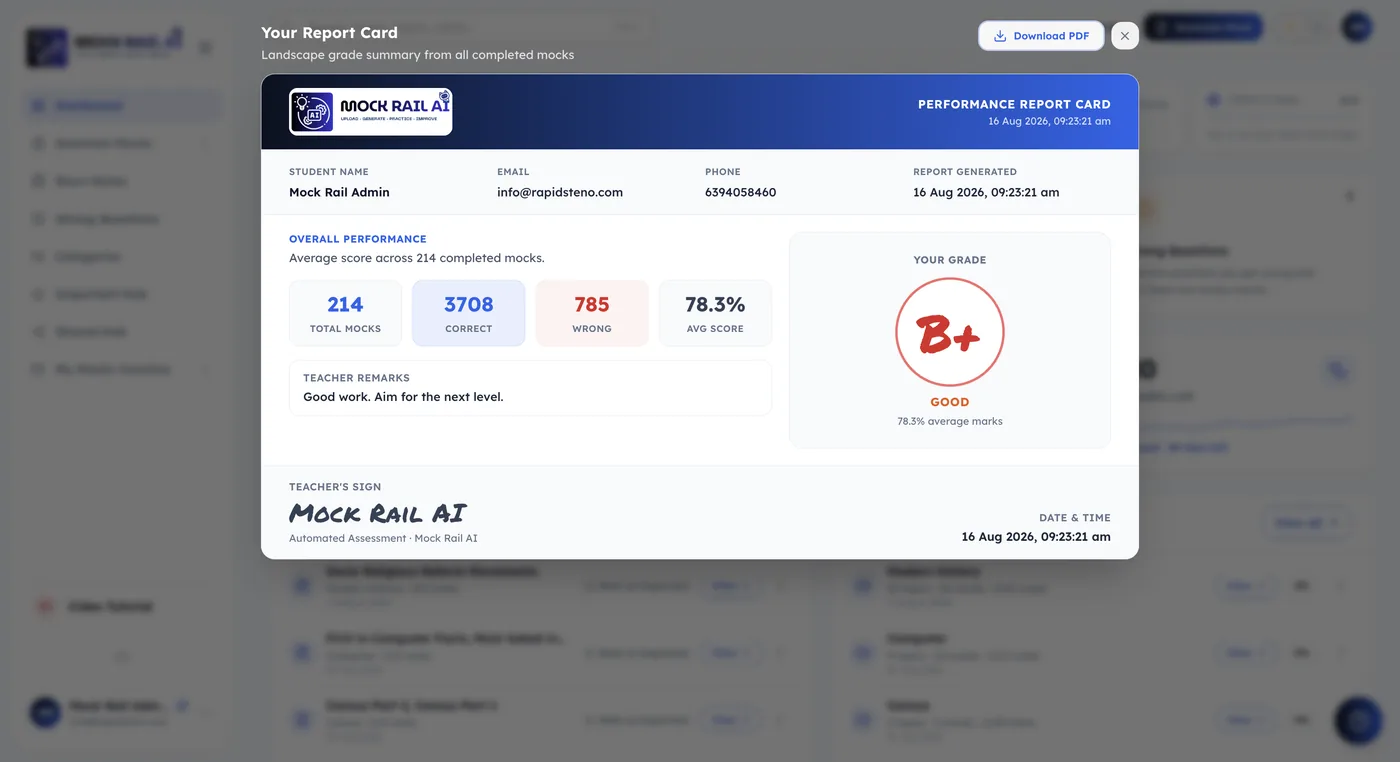
Every wrong answer is filed automatically by subject and topic, so your UP GK misses collect in one place instead of a separate error notebook you abandon by week three. Mock Analysis then tells you whether that section is genuinely climbing across attempts or just feels more familiar.
How to generate your own RO/ARO mock test from notes
To be concrete about it, here is each problem this particular exam creates and what in the app answers it. Mockrail AI is not a question bank and has no ready-made RO/ARO paper — it builds the paper from whatever material you give it, which is exactly why it covers the parts a national test series cannot.
| RO/ARO problem | What handles it |
|---|---|
| UP GK barely covered by national banks | Generate mocks straight from your own UP GK notes — pasted, or photographed from your register |
| Hindi–English notes in one notebook | Photo upload reads mixed Hindi and English handwriting, so nothing needs retyping |
| No negative marking, so you must attempt all 200 | Exam-style layout with countdown timer, question palette and mark-for-review builds the habit of leaving nothing blank |
| 54 seconds per question | Set the timer on every practice paper instead of solving at your own pace |
| Same mistakes repeating in Computer Knowledge | Wrong Questions saves every miss by subject and topic, and builds a fresh mock from weak areas only |
| Free mocks exhausted by week six | Unlimited retakes on any saved paper, plus new papers from any chapter you have covered |
| No idea whether UP GK is actually improving | Mock Analysis compares your score across attempts, not just the latest one |
| "I have already revised Polity twice" (you have not) | Revision counter per topic, and an Important Hub to flag chapters for the final two weeks |
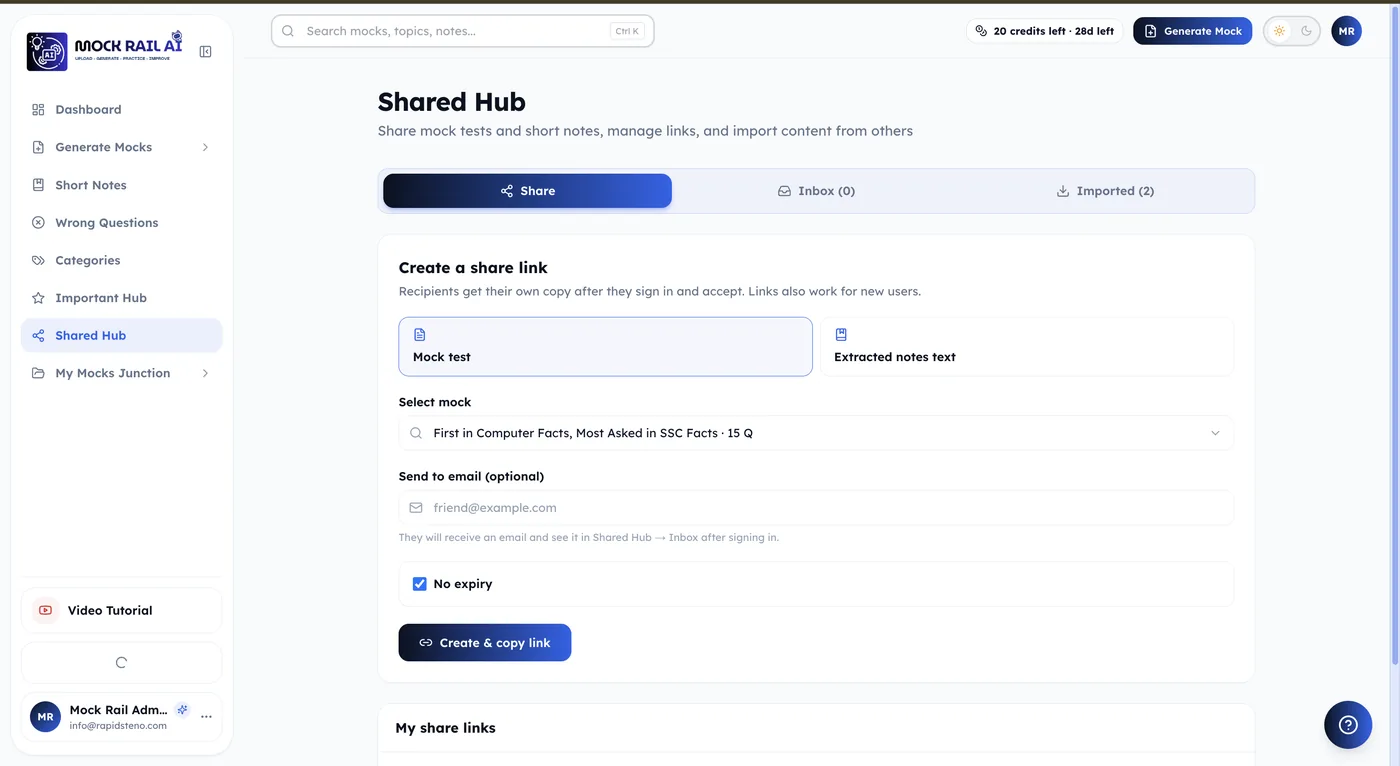
| Splitting the syllabus with your batch | Shared Hub swaps notes and generated mocks, so four people get four papers each |
| Typing test at 25 WPM | Not Mockrail — use Rapid Steno, which runs exam typing tests for RO, ARO, CA and LDC with accuracy analytics |
That last row matters as much as the rest. Mockrail AI is an MCQ tool and does nothing for typing speed — do not let a tidy dashboard convince you that box is ticked. The typing stage is qualifying, so it needs its own practice, which is what our sister platform Rapid Steno is built for.
On cost, since aspirants ask: the Free plan gives 5 AI mock generations a month with the full app, unlimited note scans and unlimited retakes. A 5–15 question chapter mock uses 1 credit, 16–30 questions uses 2. If you are running the daily-chapter routine below, the ₹199 Starter plan at 50 mocks a month comfortably covers a twelve-week preparation, and you can preview sample questions free before committing a credit. Full breakdown on the pricing page and every feature is listed on the features page.
A 12-week study plan
Assuming you already have a general studies base and can give four to five hours a day. Adjust the block lengths, keep the structure.
| Weeks | Focus | Daily routine |
|---|---|---|
| 1–4 | Syllabus coverage — GS, History, Polity, Science | One chapter, notes made, 10-question mock the same evening. 15 min typing. |
| 5–8 | UP GK, General Hindi, General English, Computer Knowledge | Same loop. Build the UP GK note set daily. 15 min typing. |
| 9–10 | Weak areas only | Mocks built purely from Wrong Questions. First full-length free mock on a Sunday. |
| 11–12 | Revision and full-length practice | Two full papers a week. Typing at target 35 WPM. Final UP GK sweep. |
The Saturday habit is the one to protect: one mock built entirely from the week's wrong answers. It is the highest-value paper you will sit all week because every question is something you have already got wrong once.
If you are preparing alongside friends in a coaching batch, Shared Hub lets four of you split four chapters and swap the mocks, so everyone ends up with four papers for the effort of one.
What aspirants say
"UP GK was my weakest section and no test series covered it properly. I made my own notes on state schemes and generated mocks from them every week."
Shivam Dwivedi RO/ARO aspirant, Prayagraj"Nobody told me the typing test was qualifying. I started practising in week one after reading that, and it stopped being a worry."
Anjali Verma RO/ARO aspirant, Lucknow"I am preparing for UPPSC RO/ARO and the High Court exam together. One set of notes, mocks generated for whichever pattern I am revising."
Rahul Tripathi RO/ARO aspirant, Varanasi"After the free mocks ran out I had nothing left to practise on. Generating papers from my own notebook filled that gap."
Nidhi Srivastava RO/ARO aspirant, Kanpur"The no-negative-marking point changed how I sit the paper. I used to leave 20 blank out of habit from SSC."
Abhishek Pandey RO/ARO aspirant, Gorakhpur"My wrong questions in Computer Knowledge kept repeating. Seeing them collected in one place was uncomfortable but it worked."
Swati Mishra RO/ARO aspirant, JhansiAllahabad High Court RO ARO FAQs
How many vacancies are there in Allahabad High Court RO ARO 2026?
Reported sources list 543 posts across Review Officer, Assistant Review Officer and Computer Assistant. Always confirm the current vacancy count and any subsequent corrigendum on the official website, allahabadhighcourt.in, before planning your preparation.
Is there negative marking in Allahabad High Court RO ARO?
Sources consistently report no negative marking in the objective written paper. If your notification confirms this, it changes your strategy completely — attempt all 200 questions, because a blank and a wrong answer are worth exactly the same. Verify in the official notification before relying on it.
How many questions are there in the AHC RO ARO written exam?
Sources report 200 objective questions worth 200 marks in 3 hours. That works out to roughly 54 seconds per question including reading time, so speed practice matters as much as knowledge.
Does Allahabad High Court RO ARO have a descriptive Mains paper?
Sources disagree. Some describe a two-stage process of written exam plus typing test, while others describe an additional 150-mark descriptive Mains with essay, precis and translation — a pattern closely matching the UPPSC RO ARO exam, which suggests possible confusion between the two. Check the official notification for your cycle.
What typing speed is required for AHC RO ARO?
Reported requirement is a minimum of 25 words per minute in English in a 20-minute computer test worth 50 marks. It is a qualifying stage, so failing it disqualifies you regardless of your written score. Practise on a physical keyboard, not a phone. Our sister platform Rapid Steno runs RO/ARO and LDC typing tests with mistake-wise analytics if you want exam-style practice rather than a generic typing site.
What is asked in the UP GK section of RO ARO?
Uttar Pradesh specific knowledge typically covers state geography, history, culture, schemes, and the judicial history of the state. It is usually worth around 15 to 20 questions and is where generic national question banks are weakest, so your own compiled notes matter most here.
Where can I find free Allahabad High Court RO ARO mock tests?
Adda247, Testbook, Safalta, Exampur and Toppersexam all offer free AHC RO ARO mock tests, including full-length papers. Attempt those first. Once the free papers run out, generate practice mocks from your own notes for weak topics like UP GK, where ready-made banks are thin.
How do I practise UP GK when question banks are limited?
Compile UP GK into your own notes from a state GK book and the news, then convert those notes into MCQs. Mockrail AI generates a timed mock from notes you paste or photograph, so you test yourself on exactly the UP material you have collected rather than a generic national set.
How long should I prepare for Allahabad High Court RO ARO?
Around 12 weeks of consistent study is realistic if you already have a general studies base. Six weeks on syllabus coverage with daily chapter mocks, weeks seven to ten on weak areas and typing practice, and the final two weeks on revision and full-length papers.
Can Mockrail AI help with Allahabad High Court RO ARO preparation?
It helps with the practice half, not the question-bank half. Mockrail AI has no ready-made RO ARO paper. What it does is turn your own notes — pasted, or photographed from your register including mixed Hindi and English — into a timed MCQ mock with a question palette, a score, and every wrong answer saved by subject and topic. That covers UP GK and Computer Knowledge, where national question banks are thinnest. It does nothing for the typing test, so practise that separately. The Free plan gives 5 mock generations a month with unlimited note scans.
Can I prepare for AHC RO ARO and UPPSC RO ARO together?
Yes, and most aspirants do. The general studies, Hindi, English and UP GK portions overlap substantially, so one set of notes serves both. Check each notification separately, because the exam patterns and the presence of a descriptive Mains differ between the two.
Start with one subject this week
Do two things today. Download the official notification from allahabadhighcourt.in and confirm the pattern for your cycle — do not take any coaching site's word for it, including ours. Then open a fresh notebook page for UP GK and start filling it.
Fifteen minutes of typing practice every evening from tonight. One chapter mock before you sleep. That is the whole method — the rest is just keeping it going for twelve weeks. For the practice mechanics, start with how to generate a mock test from your notes or the wider mock test maker guide.